
Official statement
What you need to understand
What is Google's official position on Page Speed as a ranking factor?
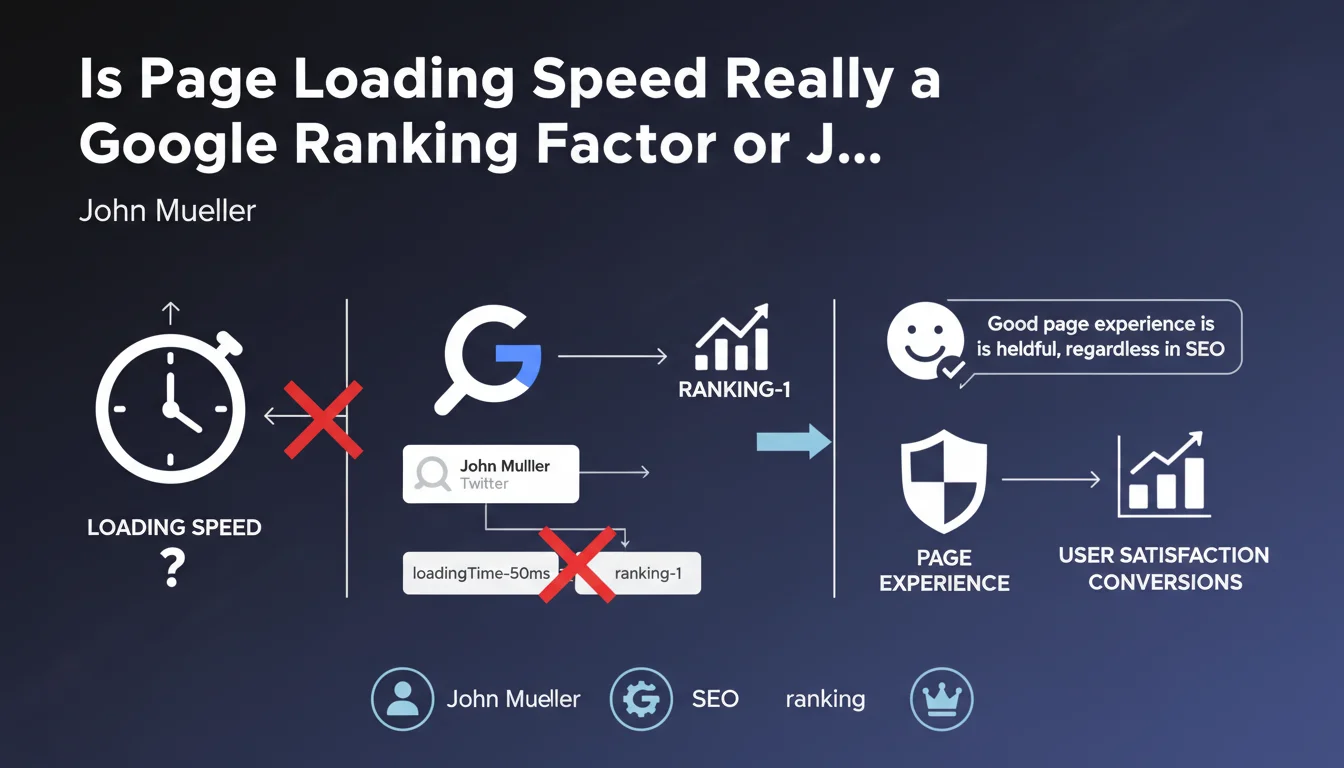
John Mueller clarifies a frequent confusion: Page Speed is not a direct and measurable ranking factor. There is no simple correlation like "50ms less loading time = +1 position in results".
Google considers speed as an element of the overall user experience, but not as an isolated algorithmic criterion. The very notion of "Page Speed" is too vague to be used as a precise ranking signal.
Why does Google emphasize user experience so much then?
User experience influences visitor behavior: bounce rate, time spent on site, conversions. These behavioral signals can indirectly impact search rankings.
Commercial case studies demonstrate that a minimal speed improvement generates measurable changes in user actions. It's this behavioral modification that matters, not raw speed.
Can user experience compensate for poor quality content?
No, and that's the crucial point raised by Mueller. An excellent user experience cannot fix fundamental problems of relevance or content quality.
Users today have high expectations regarding speed and fluidity, but they primarily seek relevant answers to their queries.
- Page Speed is not a direct and measurable ranking factor
- User experience influences indirect behavioral signals
- Speed improves engagement but doesn't replace content quality
- Google prioritizes relevance and quality over technical experience
- User expectations regarding speed are now very high
SEO Expert opinion
Is this statement consistent with what we observe in the SERPs?
Absolutely. Analysis of pages in first position shows that sites with average loading times regularly outperform ultra-fast sites with superficial content.
However, in competitive sectors where content quality is equivalent, user experience then becomes a differentiator. That's where speed can tip the scales.
What important nuances should be added to this statement?
The Core Web Vitals introduced in 2021 are indeed official ranking factors, contrary to what this statement might suggest. So there's a subtlety to grasp.
Mueller is talking about "Page Speed" as an isolated metric, not the overall page experience measured by LCP, FID and CLS. These indicators are ranking signals, but their weight remains moderate compared to relevance.
In what cases does speed become truly critical for SEO?
For e-commerce and transactional sites, where every second of delay directly impacts conversions. Google observes these behavioral signals and adjusts ranking accordingly.
On mobile, where connections are more variable and users more impatient. A slow mobile site quickly loses its visitors, which sends negative signals to Google.
In ultra-competitive niches where all players produce similar quality content. It's then user experience that separates positions 1 to 5.
Practical impact and recommendations
What should you concretely prioritize in your SEO strategy?
Focus first on content quality and relevance. This is the non-negotiable foundation of any sustainable search ranking. Without it, no technical optimization will save you.
Next, ensure an acceptable level of user experience: not necessarily perfect, but good enough not to frustrate your visitors. Aim for Core Web Vitals in the green.
Invest in speed optimization as continuous improvement, not as an absolute priority. Marginal gains accumulate and progressively improve your performance.
What costly mistakes should you absolutely avoid?
Never sacrifice content quality for speed. An ultra-fast site with mediocre content will not rank, period.
Don't invest disproportionate resources to gain a few milliseconds when your content lacks depth. The return on investment will be non-existent.
Avoid focusing on a single measurement tool. PageSpeed Insights, GTmetrix and actual Core Web Vitals can give different results. Prioritize field data.
- Audit the quality and depth of your existing content
- Check your Core Web Vitals in Search Console (real data)
- Identify strategic high-traffic pages requiring optimization
- Fix major speed issues (unoptimized images, blocking scripts)
- Test behavioral impact: bounce rate, time on page, conversions
- Establish a balanced roadmap: 60% content, 40% technical/UX
- Regularly monitor behavioral signals in Analytics
- Document correlations between speed and user engagement
💬 Comments (0)
Be the first to comment.