
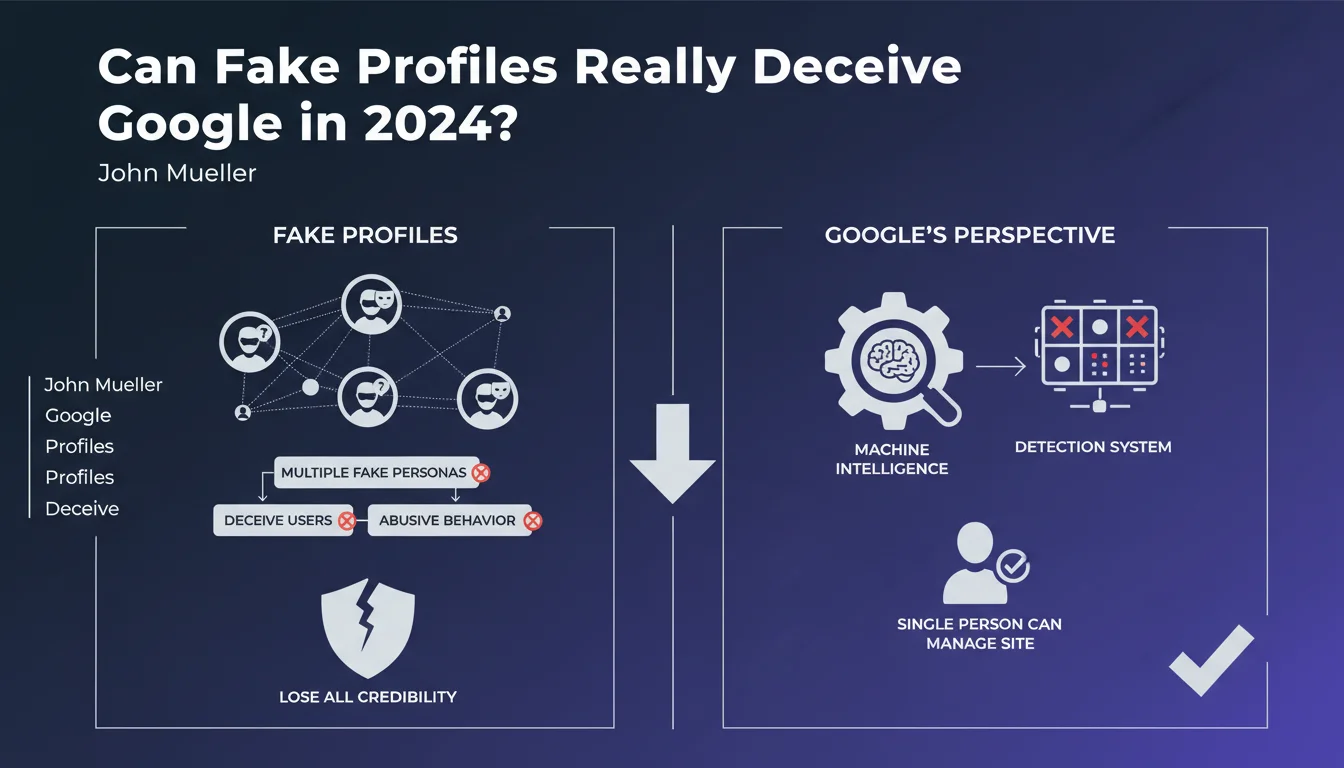
Official statement
What you need to understand
Why Is Google Cracking Down on Fake Profiles and Personas?
Google fights against fake profiles and artificial personas because they aim to manipulate the perception of credibility and authority. These tactics include creating multiple fictitious identities to manage a site, publish reviews, or create a fake team of experts.
The search engine now uses advanced artificial intelligence systems to detect this fraudulent behavior. The goal is to preserve user trust and promote authenticity rather than manipulation.
What Types of Fake Profiles Does This Statement Cover?
This warning covers several common practices: fake article authors created to simulate an editorial team, fictitious LinkedIn profiles linked to a site to increase its social credibility, and invented personas to manage multiple aspects of a web project.
Google clearly links authenticity with algorithmic credibility. A site managed by a real and identifiable person gains more trust than a site with obviously artificial profiles.
How Does Google Detect These Manipulations?
Google's algorithms analyze multiple behavioral signals: inconsistencies in publication histories, generated or stolen profile photos, lack of verifiable social presence, and suspicious patterns in interactions.
Machine learning allows this data to be cross-referenced at scale. Google can identify revealing patterns even when manipulators think they've concealed their practices well.
- Authenticity has become a credibility criterion for Google
- AI technologies effectively detect fake profiles and personas
- A real person can manage a site without needing multiple fictitious identities
- Credibility is built through quality work, not through the quantity of fake profiles
- Manipulators who think they're undetectable are deluding themselves
SEO Expert opinion
Does This Statement Align with Practices Observed in the Field?
Absolutely. Field observations show that Google has indeed strengthened its detection of authenticity signals since 2022-2023. Many sites using fake authors have seen their visibility drop, particularly in YMYL sectors (health, finance).
Current algorithms favor verifiable entities: authors with consistent histories, real social presence, and demonstrable expertise. Sites with phantom teams are gradually losing ground to those displaying real and identifiable people.
What Nuances Should Be Added to This Firm Position?
We must distinguish manipulative fake profiles from legitimate situations. A consistent pseudonym used over time by a real person is not problematic. Similarly, an author who wishes to remain anonymous for valid reasons but produces authentic content is not the target.
The issue specifically concerns fraudulent operations: creating multiple fictitious identities to simulate a team, using stolen photos, inventing complete biographies without real foundation.
In What Contexts Does This Rule Most Impact SEO Professionals?
The impact is greatest on content sites (blogs, media outlets, affiliate sites) that created fictitious authors to appear more professional. E-commerce sites with fake reviews are also affected, although the focus here is on author profiles.
YMYL sites are particularly scrutinized: Google actively verifies the existence and credentials of authors in these sensitive sectors. A fictitious cardiologist or invented financial advisor will likely be detected and penalize the site.
Practical impact and recommendations
What Should You Do Concretely to Remain Compliant?
The priority is to audit all your current author profiles. Identify fictitious or partially invented personas, and decide to remove them or replace them with real people.
For new content, assume your real identity or that of your legitimate contributors. Create complete profiles with authentic photos, verifiable biographies, and links to consistent social presences.
If you manage your site alone, it's better to sign with your name rather than invent a fictitious team. Google now values transparency over artificial sophistication.
What Mistakes Should You Absolutely Avoid in This Process?
Don't try to sophisticate your fake profiles thinking you'll escape detection. Algorithms are becoming more powerful, and this race is a losing battle. The energy invested would be better used creating quality content.
Also avoid abrupt deletion of all your fictitious authors without a strategy. This can create 404 errors and lose your history. Plan a gradual transition with appropriate redirects.
Don't underestimate the importance of cross-platform consistency. An author present on your site should have a minimal verifiable presence elsewhere (LinkedIn, Twitter, etc.).
- Audit all existing author profiles on your site
- Identify and progressively remove fictitious personas
- Replace with real authors with verifiable identities
- Create complete profiles with authentic biographies and real photos
- Establish a consistent social presence for each legitimate author
- Implement 301 redirects when changing authors
- Favor transparency: better a site managed by an identified person than a fictitious team
- Document real expertise rather than inventing credentials
- Verify that your author photos are not stock images or AI-generated
How Can You Ensure Your Authenticity Strategy Is Optimal?
Compliance with these authenticity requirements may seem simple in theory, but it raises many practical questions: how to restructure your existing content, what strategy to adopt for archives, how to showcase your real expertise without pretense?
These adjustments affect technical aspects (redirects, structured data), editorial aspects (content reattribution), and strategic aspects (personal brand positioning vs. corporate). Complexity increases with the size of your site and the history of your practices.
💬 Comments (0)
Be the first to comment.