
Official statement
What you need to understand
What Exactly Is Google Saying About AI-Generated Content Rankings?
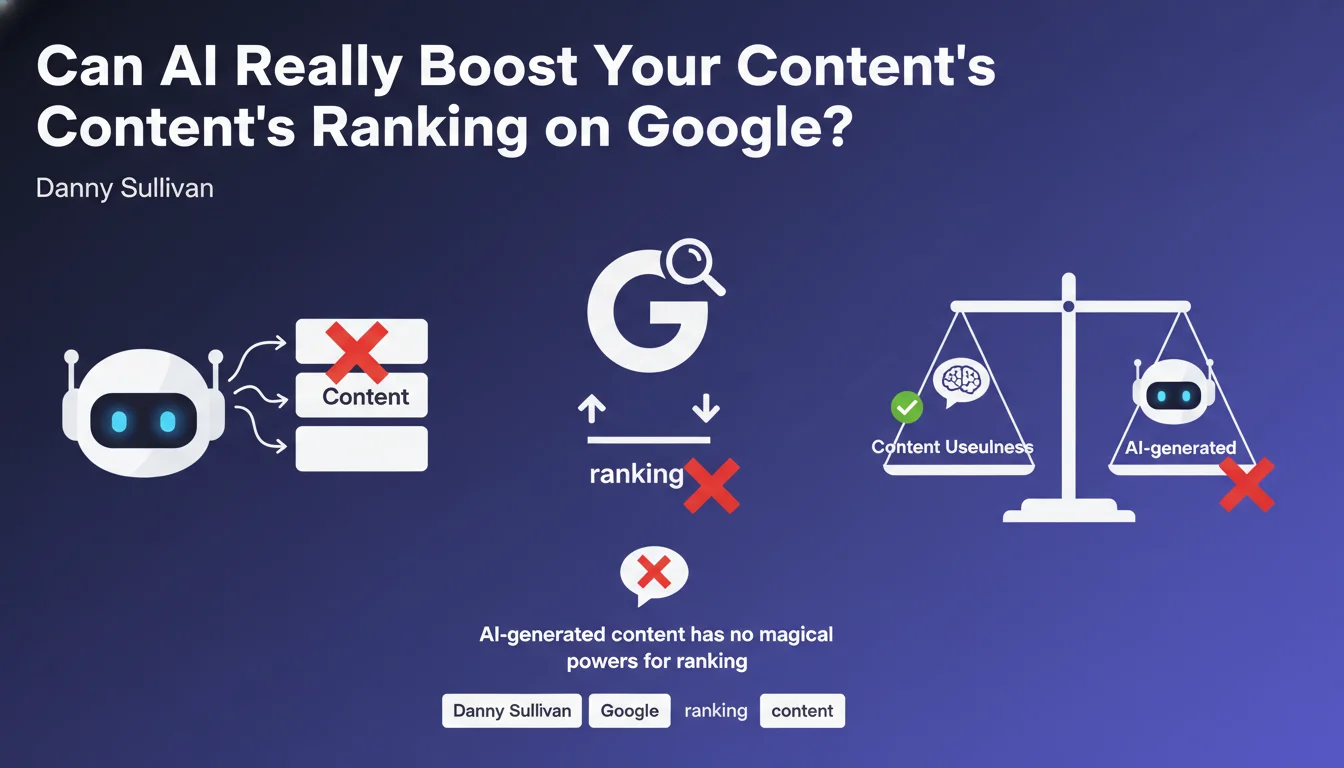
The official position of Google Search Liaison is clear: content produced by artificial intelligence receives no preferential treatment in ranking algorithms. Danny Sullivan even affirms that numerous AI contents are poorly positioned in search results.
The search engine focuses on the actual usefulness of content to users, regardless of its production method. Whether written by a human or generated by a machine, only perceived quality matters for ranking.
Why Is This Statement Coming Out Now?
This position follows declarations by media company executives who were praising the SEO performance of their AI-generated content. Google wants to clarify the misconceptions circulating in the industry.
The goal is to discourage practices consisting of flooding the web with low-quality automated content, while acknowledging that AI can be a legitimate tool if used appropriately.
What Criteria Actually Matter to Google?
Google evaluates content according to several dimensions: informational relevance, demonstrated expertise, depth of analysis, and satisfaction of search intent. The technical origin of the content doesn't enter the equation.
- Usefulness to the user is the main ranking criterion
- The production method (human or AI) doesn't directly influence ranking
- AI content receives no particular algorithmic advantage
- Quality always trumps quantity, regardless of the technology used
- Google can identify and penalize low-value automated content
SEO Expert opinion
Is This Statement Consistent With SEO Practitioners' Field Observations?
As an expert, I indeed observe that many sites having massively deployed generic AI content are stagnating or declining in SERPs. Google's algorithms, particularly since the Helpful Content updates, penalize superficial content.
However, some sites using AI in a strategic and supervised manner achieve excellent results. The difference lies in the process: editorial validation, factual enrichment, personalization, and integrated human expertise.
What Important Nuances Should Be Added to This Official Position?
Google's statement conceals a more complex reality. While AI itself isn't favored, it enables faster production of quality content when properly used. The productivity gain is undeniable.
The real question isn't "AI or not AI," but rather: does the content provide unique added value? Does it answer users' questions better than the competition? Does it demonstrate real expertise?
In What Contexts Does AI Remain Relevant for SEO?
AI retains real value for certain SEO tasks: keyword research, structuring long-form content, generating variations for A/B testing, or creating documentary bases to enrich. It excels as an assistant, not as an autonomous writer.
Technical domains, structured data, or content requiring frequent updates can benefit from AI, provided an expert validates and personalizes each publication before going live.
Practical impact and recommendations
What Should You Concretely Change in Your Content Strategy?
If you're already using AI, don't panic: the problem isn't the tool but its usage. Revise your production process to integrate systematic human validation. Each piece of content must be enriched with real expertise and concrete examples.
Prioritize quality over quantity. Better to publish 10 deeply crafted articles per month than 100 generic texts. Integrate original data, case studies, experience feedback that demonstrates your expertise.
Audit your existing AI-generated content. Identify underperforming pages and improve them substantially, or delete them if they provide no unique value to your audience.
What Critical Mistakes Should You Absolutely Avoid?
Never publish AI content without thorough proofreading. Factual hallucinations, generic phrasing, and absence of personal viewpoint are immediately detectable and damage your credibility.
Avoid mass production without differentiation. Creating 500 similar pages targeting keyword variations with nearly identical content is now a counterproductive strategy that exposes you to algorithmic filters.
Don't use AI for all your content types. Strategic pages (pillars, conversions, expertise demonstration) must benefit from 100% human and personalized writing.
How Can You Verify That Your Approach Aligns With Google's Expectations?
Analyze your engagement metrics: time on page, bounce rate, pages per session. Useful content generates engagement, regardless of its production method. If your indicators deteriorate, it's a warning signal.
Compare your content to that of well-positioned competitors. Are you providing as much value? Is your expertise visible? Does your content answer users' questions better?
- Implement a systematic editorial validation process for all AI content
- Enrich each publication with original data and concrete field examples
- Limit AI production to supporting content, prioritize human writing for strategic pages
- Regularly audit the performance of AI versus human content
- Integrate real business expertise and a differentiating viewpoint in each article
- Monitor engagement metrics to detect ineffective content
- Train teams on best practices for using AI as a complement to human expertise
- Document and demonstrate your expertise through tangible proof (case studies, client results, original analyses)
💬 Comments (0)
Be the first to comment.