
Official statement
Other statements from this video 12 ▾
- □ Google suit-il vraiment tous les codes HTTP ou s'arrête-t-il au premier rencontré ?
- □ Un CDN améliore-t-il vraiment votre classement Google ?
- □ Faut-il bloquer le crawl des endpoints API pour optimiser son budget de crawl ?
- □ Faut-il vraiment bannir le nofollow des liens internes ?
- □ Pourquoi Google préfère-t-il les redirections serveur aux redirections JavaScript ?
- □ Faut-il vraiment différencier les redirections 301 et 302 pour le SEO ?
- □ Faut-il vraiment isoler vos contenus archivés pour améliorer votre SEO ?
- □ Peut-on vraiment forcer l'affichage des sitelinks dans Google ?
- □ Faut-il vraiment abandonner les iframes et les PDF pour indexer du contenu textuel ?
- □ Faut-il vraiment bloquer ou masquer les liens externes pour protéger son PageRank ?
- □ Google favorise-t-il vraiment certaines plateformes CMS pour le référencement ?
- □ Les URLs dans les données structurées sont-elles crawlées par Google ?
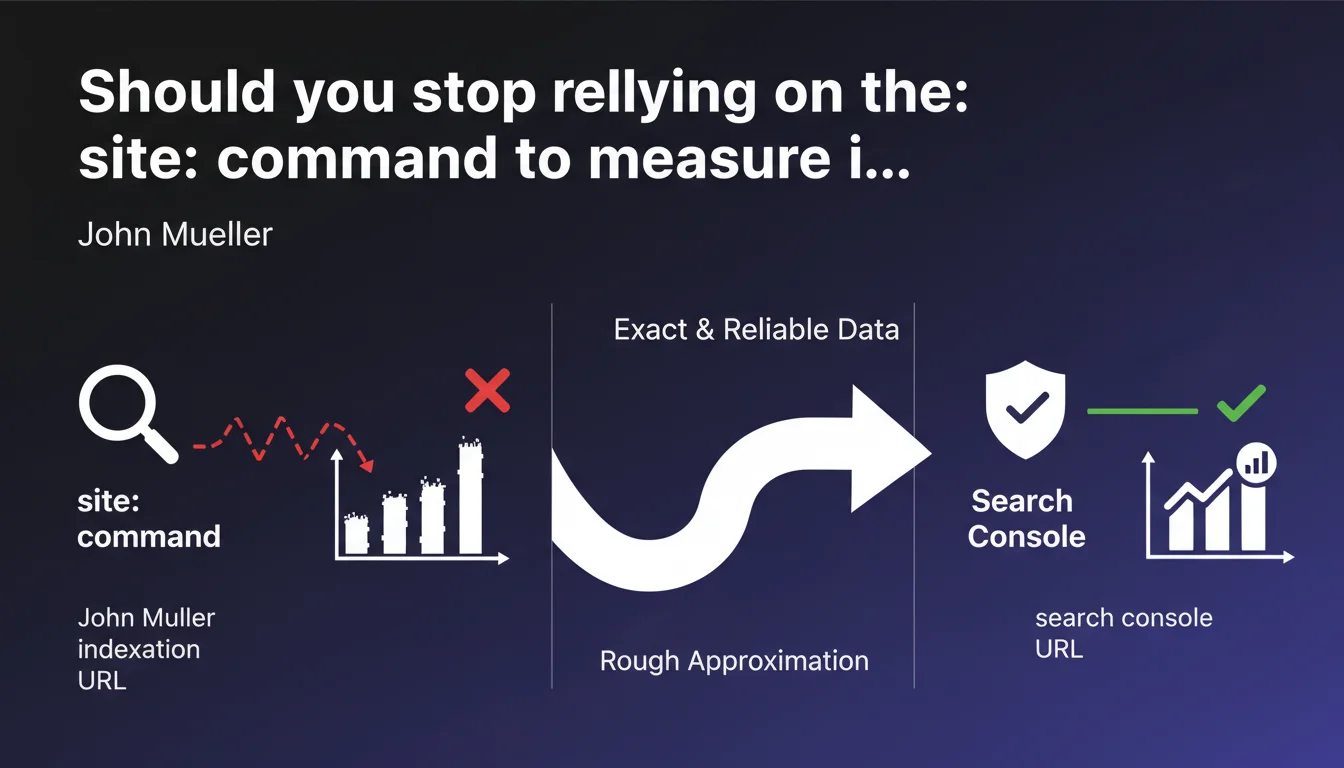
Google confirms that the site: query displays an approximate number of indexed pages, unusable for reliable diagnostics. The only credible tool to know the exact volume of indexed URLs is the Search Console indexation report. SEO practitioners must abandon this command for any serious audit.
What you need to understand
Why is the site: command so imprecise?
The query site:example.com returns an estimate based on rapid sampling of Google's servers, not an exhaustive count. This number varies depending on the datacenter queried, the time of the request, and the search engine's internal optimizations to quickly display a result.
Google never designed this command as a measurement tool — it's a user shortcut to roughly explore pages on a domain. The algorithm prioritizes speed over accuracy, hence the sometimes massive discrepancies between two identical queries a few minutes apart.
What's the difference with Search Console data?
The indexation report in Search Console compiles data directly from Google's indexation systems. It reflects the actual state of the index, with reliable history and detailed categories of excluded pages (4xx errors, blocked by robots.txt, canonicalized, etc.).
Where site: displays a round and fluctuating number, Search Console precisely details how many pages are indexed, how many are discovered but not indexed, and why. It's the difference between a broken compass and a GPS.
What are the implications for an SEO audit?
An audit based on site: can lead to faulty diagnostics — unjustified panic over an apparent drop in indexation, or false security when the number seems stable while thousands of pages are actually excluded.
Professionals must systematically cross-reference Search Console volumes with XML sitemaps, server logs, and internal crawls. This is the only way to detect real anomalies (blocked pagination, wrongly indexed facets, massive cannibalization).
- The site: command is a rough approximation, never a diagnostic tool
- Search Console provides the only reliable and granular count of indexed URLs
- Discrepancies between site: and GSC can reach +/- 30% or more without reflecting a real problem
- A serious audit relies on GSC, sitemaps, logs, and crawls — never on a search command
SEO Expert opinion
Is this statement consistent with what we observe in the field?
Absolutely. All experienced practitioners know that site: produces erratic results — a site can display 12,000 pages one day, 8,500 the next, without any structural change. Clients panic, juniors get stressed, but it's just statistical noise.
Yet this command remains ubiquitous in low-cost audits and automated reports. Many SEOs still cite it as a metric, for lack of anything better or out of habit. Google is finally setting the record straight: stop using it to count.
What limitations does this statement not cover?
Mueller doesn't explain why Google maintains such an unreliable command in production. If it's unusable for diagnostics, why not display a direct warning message or redirect to Search Console? [To verify]
Another gray area: the site: command can reveal pages indexed but absent from Search Console (rare but documented cases, notably after migration or redesign). In these situations, which tool is « accurate »? Google doesn't answer.
Should you completely abandon the site: command?
No. It remains useful for quickly verifying the presence of a specific URL in the index (site:example.com/page-test), exploring content facets (site:example.com inurl:category), or detecting spam content indexed without the owner's knowledge.
But for any quantitative analysis — indexed volume, temporal evolution, sitemap vs. index discrepancies — Search Console is the only credible source. Period.
Practical impact and recommendations
What should you do concretely to audit indexation?
Permanently ban the site: command from your client reports and KPI metrics. Replace it with the Search Console indexation report, which segments indexed pages, excluded pages, and reasons for exclusion (noindex, soft 404, redirect, etc.).
Systematically cross-reference this report with your XML sitemaps to identify URLs submitted but not indexed. A massive discrepancy (>20%) often signals duplicate content, mismanaged pagination, or conflicting canonical tags.
How do you monitor indexation evolution over time?
Export Search Console's indexation report data weekly and track trends in a dashboard (Google Sheets, Data Studio, Looker). Set up automated alerts if the volume of excluded pages increases sharply (+15% in 7 days).
Supplement with server log analysis: a gap between pages crawled by Googlebot and those indexed reveals quality issues (thin content), structural problems (excessive depth), or crawl budget constraints (infinite facets).
What errors should you avoid when interpreting Search Console data?
Don't confuse « discovered but not indexed » with a technical problem. Google may legitimately choose not to index low-value pages (redundant pagination, faceted filters, old archives).
Also be wary of artificial indexation spikes after mass sitemap submissions — Google indexes quickly then de-indexes if the content doesn't hold up. Sustainable indexation matters more than the initial spike.
- Migrate all your indexation audits to Search Console, abandon site:
- Export and archive GSC data weekly to track trends
- Cross-reference indexation GSC with XML sitemaps and server logs
- Set up automated alerts for sharp variations (>15% in 7 days)
- Document sitemap vs. index discrepancies and investigate mass exclusions
- Don't panic over site: fluctuations — they have no diagnostic value
❓ Frequently Asked Questions
La commande site: peut-elle encore servir à quelque chose en SEO ?
Pourquoi les chiffres site: et Search Console sont-ils parfois très différents ?
Que faire si Search Console affiche moins de pages indexées que mon sitemap ?
Les outils SEO tiers qui utilisent site: sont-ils obsolètes ?
Comment détecter une désindexation massive rapidement ?
🎥 From the same video 12
Other SEO insights extracted from this same Google Search Central video · published on 08/06/2022
🎥 Watch the full video on YouTube →
💬 Comments (0)
Be the first to comment.