
Official statement
Other statements from this video 12 ▾
- □ Google suit-il vraiment tous les codes HTTP ou s'arrête-t-il au premier rencontré ?
- □ Faut-il bloquer le crawl des endpoints API pour optimiser son budget de crawl ?
- □ Faut-il vraiment bannir le nofollow des liens internes ?
- □ Faut-il arrêter de se fier à la commande site: pour mesurer l'indexation ?
- □ Pourquoi Google préfère-t-il les redirections serveur aux redirections JavaScript ?
- □ Faut-il vraiment différencier les redirections 301 et 302 pour le SEO ?
- □ Faut-il vraiment isoler vos contenus archivés pour améliorer votre SEO ?
- □ Peut-on vraiment forcer l'affichage des sitelinks dans Google ?
- □ Faut-il vraiment abandonner les iframes et les PDF pour indexer du contenu textuel ?
- □ Faut-il vraiment bloquer ou masquer les liens externes pour protéger son PageRank ?
- □ Google favorise-t-il vraiment certaines plateformes CMS pour le référencement ?
- □ Les URLs dans les données structurées sont-elles crawlées par Google ?
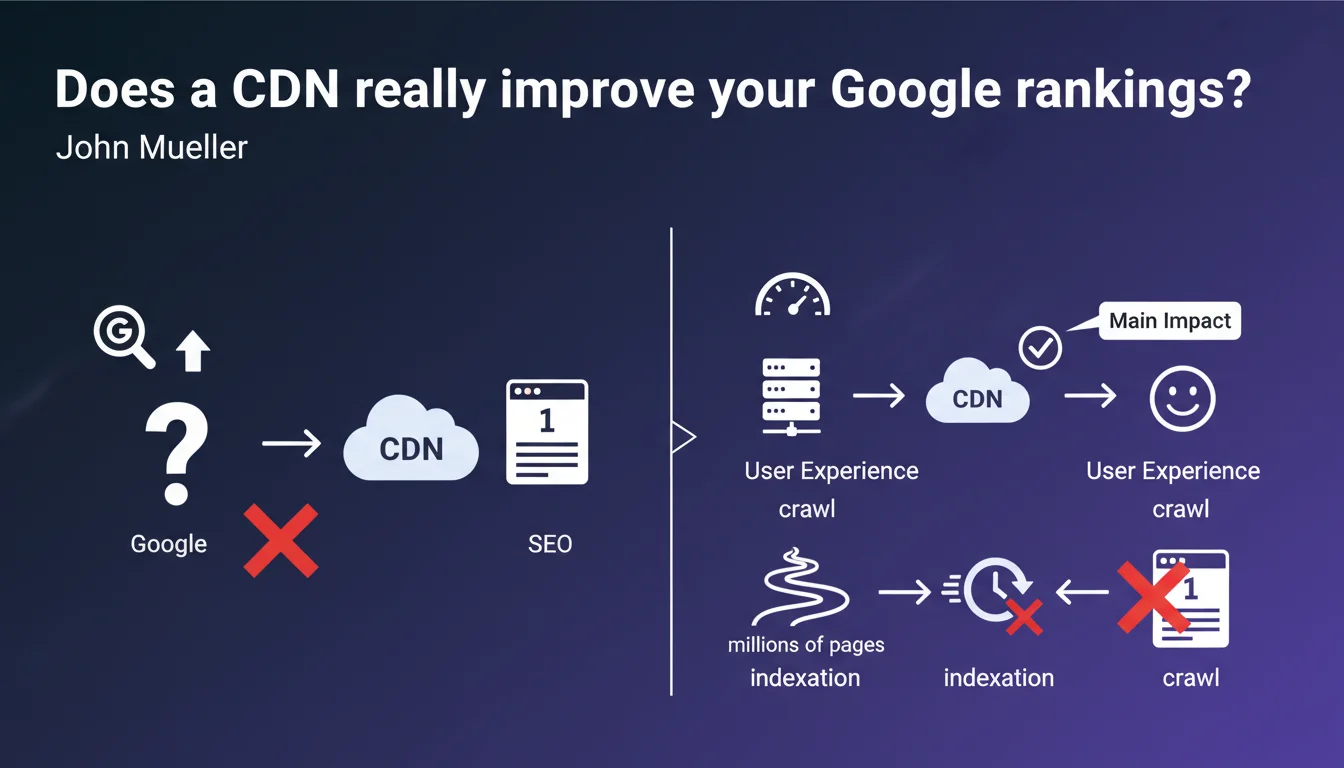
CDNs have no direct impact on Google rankings. Their role is limited to user experience and, in extreme cases of sites with millions of pages, facilitating indexation if crawl speed is abnormally slow. For most sites, the SEO effect is zero.
What you need to understand
Why does Google claim that CDNs don't impact rankings?
Google clearly distinguishes between technical infrastructure and direct SEO impact. A CDN distributes your content across multiple geographic servers to improve load times — but this optimization is not a ranking criterion in itself.
The search engine evaluates content quality, relevance of answers, and site authority. Whether your HTML arrives in 200ms instead of 800ms via a CDN doesn't change these fundamental parameters.
In what cases could a CDN still influence indexation?
Mueller mentions a limiting case: sites with several million pages where Googlebot's crawl becomes problematic. If your servers are too slow and the bot spends ages crawling, you risk an indexation deficit.
Concretely? The CDN accelerates server responses, Googlebot crawls more pages within its allotted time budget, so more content gets indexed. But we're talking about extreme configurations — not your corporate blog with 500 pages.
What's the real value of a CDN then?
User experience. A visitor from Australia on your French site sees images and scripts served from a local point of presence rather than crossing the Atlantic. Result: faster pages, potentially reduced bounce rate.
And this user behavior — time spent, engagement, conversions — can indirectly influence your SEO. Not the CDN itself.
- CDNs provide no direct ranking advantage in Google's algorithm
- Their main impact is on page load speed perceived by users
- For massive sites (millions of pages), a CDN can facilitate crawl and indexation
- The SEO effect remains indirect, through improvement of user engagement metrics
SEO Expert opinion
Does this statement match real-world observations?
Yes, broadly speaking. We've observed for years that switching to a CDN doesn't cause a miraculous jump in SERPs. Sites that gain positions after CDN migration have generally also fixed other issues — heavy code, undersized server, unoptimized images.
The trap? Confusing correlation with causation. Your site climbs after implementing Cloudflare? Maybe it's because you also enabled Brotli compression, cleaned up unused CSS, and migrated to HTTP/3 in the process.
What nuances should be added to this position?
Mueller remains deliberately vague about the weight of Core Web Vitals in the equation. A CDN often improves LCP (Largest Contentful Paint) by reducing TTFB. And CWV have officially been a ranking factor since 2021.
So saying a CDN has "no significant effect" deserves a [To be verified]. The effect exists, but it's diluted in the overall signal mix — likely marginal for most queries, except in very competitive scenarios where every millisecond counts.
In what cases does this rule not apply?
International e-commerce platforms with millions of SKUs and worldwide traffic. There, a CDN becomes critical not for ranking, but to ensure that Googlebot can index your entire catalog.
Another case: media sites with sudden heavy traffic (breaking news). Without a CDN, servers saturate, Googlebot hits 503s, and you lose pages from the index. The SEO impact becomes very real, even if indirect.
Practical impact and recommendations
Should you invest in a CDN for SEO?
If your only goal is to climb the SERPs, no. Focus your resources on content, backlinks, and structure. A CDN won't gain you 10 positions.
If you're targeting a globally optimized experience — and you have international traffic or traffic spikes — then yes, a CDN makes sense. But for its UX and infrastructure benefits, not for a fantasized SEO boost.
How do you verify if a CDN would improve your indexation?
Check the Google Search Console, Crawl Statistics section. If you see average response times above 500ms and you have 100k+ pages, that's a signal. But before paying for a CDN, first verify your server configuration — often the real bottleneck.
Also analyze your daily crawl rate vs content volume published. If Googlebot isn't keeping up and your TTFB is poor, a CDN can unlock the situation.
What mistakes should you avoid when implementing a CDN?
- Don't duplicate your content across multiple URLs (canonical tags and redirects required)
- Verify that the CDN doesn't block Googlebot via robots.txt or HTTP headers
- Monitor response codes after migration — a poorly configured CDN can serve 403s or 500s
- Don't hide critical dynamic pages (forms, shopping carts) without proper cache purging
- Test JavaScript rendering on the CDN if you use a modern framework
❓ Frequently Asked Questions
Un CDN peut-il nuire au SEO si mal configuré ?
Les Core Web Vitals s'améliorent-ils forcément avec un CDN ?
Google crawle-t-il depuis plusieurs localisations géographiques ?
Un site sous 10 000 pages a-t-il besoin d'un CDN pour le SEO ?
Faut-il privilégier un CDN avec support HTTP/3 ?
🎥 From the same video 12
Other SEO insights extracted from this same Google Search Central video · published on 08/06/2022
🎥 Watch the full video on YouTube →
💬 Comments (0)
Be the first to comment.