
Official statement
Other statements from this video 12 ▾
- □ Google suit-il vraiment tous les codes HTTP ou s'arrête-t-il au premier rencontré ?
- □ Un CDN améliore-t-il vraiment votre classement Google ?
- □ Faut-il bloquer le crawl des endpoints API pour optimiser son budget de crawl ?
- □ Faut-il vraiment bannir le nofollow des liens internes ?
- □ Faut-il arrêter de se fier à la commande site: pour mesurer l'indexation ?
- □ Pourquoi Google préfère-t-il les redirections serveur aux redirections JavaScript ?
- □ Faut-il vraiment différencier les redirections 301 et 302 pour le SEO ?
- □ Faut-il vraiment isoler vos contenus archivés pour améliorer votre SEO ?
- □ Faut-il vraiment abandonner les iframes et les PDF pour indexer du contenu textuel ?
- □ Faut-il vraiment bloquer ou masquer les liens externes pour protéger son PageRank ?
- □ Google favorise-t-il vraiment certaines plateformes CMS pour le référencement ?
- □ Les URLs dans les données structurées sont-elles crawlées par Google ?
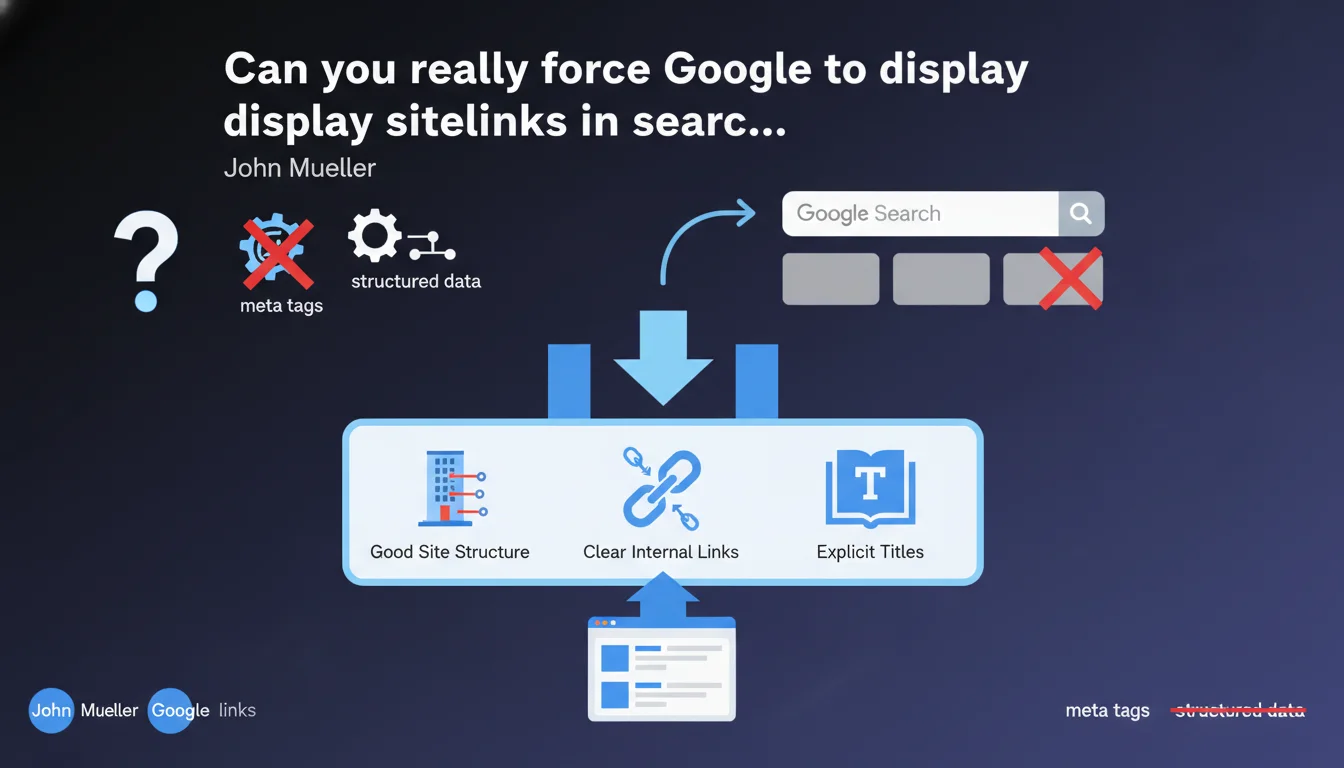
Google offers no meta tags or structured data to control sitelink display. The only effective approach relies on solid site architecture, coherent internal linking, and explicit page titles that allow algorithms to identify the most relevant pages to display.
What you need to understand
Sitelinks are those additional links that appear beneath certain search results, offering direct access to key sections of a website. Their presence improves visibility and click-through rates, but their control largely escapes webmasters' reach.
Why does Google refuse to give direct control over sitelinks?
Google favors an algorithmic approach to identify pages deserving to appear as sitelinks. The goal is to display the most useful links for users, not those the site owner wants to highlight.
This logic relies on analyzing multiple signals: site structure, internal click volume, link anchors, and thematic relevance. No tag can bypass this process — and that's deliberate.
What indirect levers can influence sitelink selection?
While direct control is impossible, three factors strongly influence Google's sitelink selection: site architecture, internal linking clarity, and page title quality.
A site with flat hierarchy, chaotic internal links, or vague titles has little chance of displaying the right sitelinks. Conversely, logical structure and descriptive anchors increase the odds that Google selects strategic pages.
- No meta tags or structured data can force sitelink display
- Google relies on architecture, internal linking, and titles to identify relevant pages
- Sitelinks are generated algorithmically with no manual intervention possible
- Clear hierarchy and descriptive anchors increase chances of displaying the right pages
SEO Expert opinion
Is this statement consistent with real-world observations?
Yes, and it's actually one of the rare areas where Google remains remarkably transparent. Tests show that sites with well-designed architecture do indeed get more relevant sitelinks than those with confusing structures.
But — and this is where it gets tricky — the definition of "clear structure" remains fuzzy. Google never specifies how many depth levels are ideal or what optimal internal link density looks like. [To verify]: the exact criteria remain opaque.
What nuances should we add to this recommendation?
Mueller's statement overlooks one crucial point: brand authority. A site with strong authority gets sitelinks much more easily than a new site, even if the latter has flawless architecture.
Sitelinks also appear more frequently for branded searches ("company name") than generic queries. In other words, architecture helps, but it's not enough if your site lacks authority or if users aren't searching for your brand directly.
In what cases is this approach insufficient?
Let's be honest: some sites have perfect architecture and never see sitelinks. Others with questionable structure display them regularly. The difference often comes from factors beyond direct control: branded search volume, click-through rate, domain age.
Google doesn't promise every site will have sitelinks, only that well-structured sites increase their chances. This is a key nuance Mueller doesn't explicitly state.
Practical impact and recommendations
What exactly should you do to maximize your chances?
First step: audit your information architecture. Strategic pages should be accessible in 2-3 clicks from the homepage. If an important page is buried 5 levels deep, Google will never consider it for sitelinks.
Second step: review your internal link anchors. They must be descriptive, not generic. "Our services" tells Google nothing; "Technical SEO audit" sends a clear signal about the target page content.
What mistakes should you absolutely avoid?
Don't create pages solely to "capture" sitelinks. Google spots artificial pages with no real value. Sitelinks should point to pages answering genuine user intent.
Also avoid vague or duplicate page titles. If three pages have the title "Services," Google won't know which to prioritize. Each strategic page must have a unique and explicit title.
How can you verify your site is properly optimized?
Test your internal linking with a crawler (Screaming Frog, Oncrawl). Identify strategic pages receiving few internal links — that's where to take action first.
Monitor which sitelinks appear (or don't) for branded searches. If Google displays secondary pages instead of your key pages, it's a signal your architecture or linking sends conflicting messages.
- Audit architecture: key pages accessible in maximum 2-3 clicks
- Review internal link anchors: descriptive, not generic
- Ensure each strategic page has a unique and explicit title
- Crawl the site to identify under-linked pages
- Monitor sitelinks displayed for branded searches
- Avoid artificial pages created solely to capture sitelinks
Optimizing architecture and internal linking to favor relevant sitelink display requires careful analysis of existing structure and strategic overhaul of internal links. While conceptually simple, this approach often proves complex to deploy on medium or large sites, especially when multiple content types coexist.
To avoid missteps and structure your site effectively, support from a specialized SEO agency can prove valuable — particularly for identifying priority pages, redefining user journeys, and deploying coherent internal linking aligned with your business objectives.
❓ Frequently Asked Questions
Existe-t-il un moyen de bloquer un sitelink indésirable ?
Combien de temps faut-il pour que Google mette à jour les sitelinks après une refonte ?
Les données structurées peuvent-elles influencer les sitelinks ?
Un site récent peut-il obtenir des sitelinks rapidement ?
Faut-il privilégier un menu horizontal ou vertical pour favoriser les sitelinks ?
🎥 From the same video 12
Other SEO insights extracted from this same Google Search Central video · published on 08/06/2022
🎥 Watch the full video on YouTube →
💬 Comments (0)
Be the first to comment.