
Official statement
Other statements from this video 11 ▾
- □ Is the HTML loading=lazy attribute really enough to prevent indexation issues?
- □ Should you really ban lazy loading from hero images?
- □ Is lazy loading actually killing your LCP?
- □ Is your custom JavaScript lazy loading library sabotaging Google's ability to index your images?
- □ Is your lazy loading blocking Google from seeing your images?
- □ Does WordPress's native lazy loading really boost your SEO performance?
- □ What if your LCP is a text block loaded in JavaScript—how does Google actually measure it?
- □ Is native HTML lazy loading really enough to optimize your page crawl?
- □ Is lazy loading destroying your image indexation in Google?
- □ Are CSS background images really invisible to Google's search algorithm?
- □ Why does Google really insist that infinite scroll and lazy loading are fundamentally different?
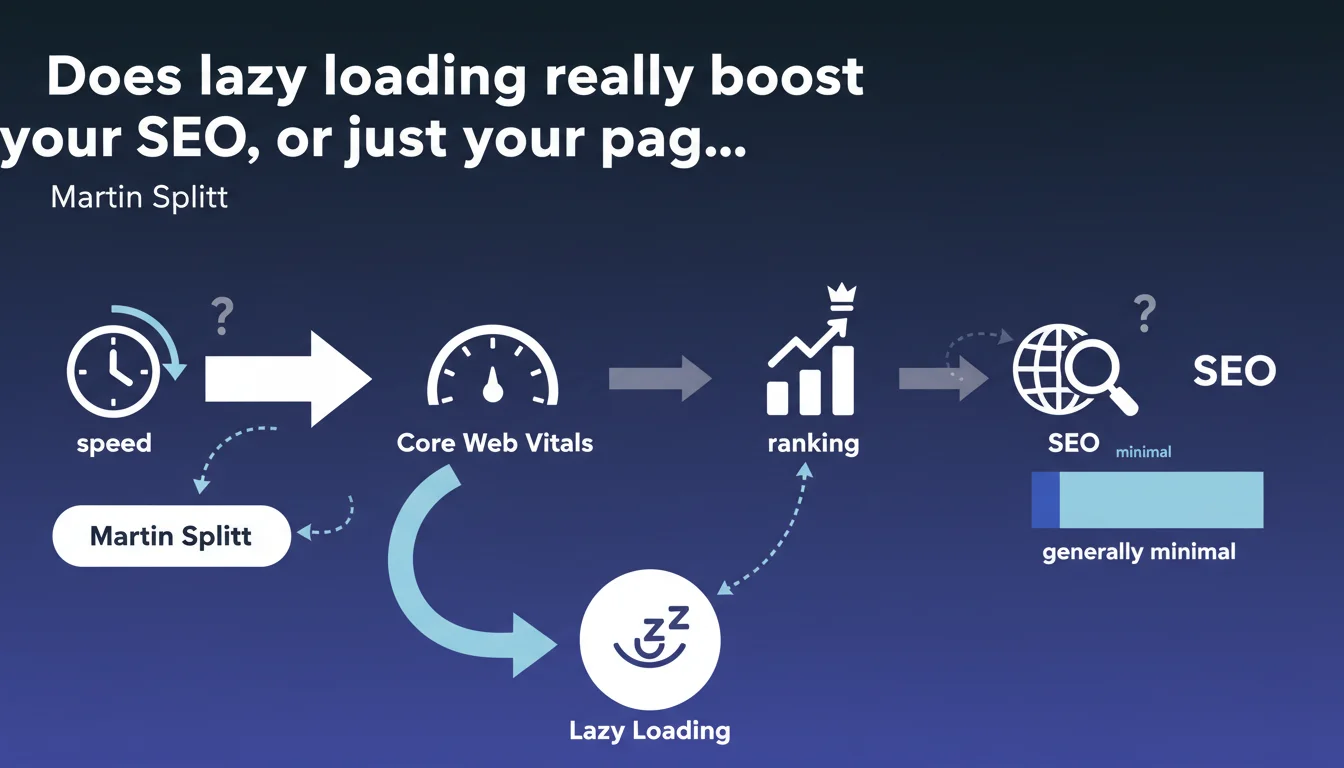
Google confirms that lazy loading impacts SEO only through performance improvement, particularly Core Web Vitals. These remain a minor ranking factor in most cases — except in exceptional situations where the performance gap becomes decisive. Optimizing lazy loading therefore guarantees no magical jump in search rankings.
What you need to understand
Does lazy loading directly affect crawling or indexing?
No. Google clearly distinguishes the technical impact of lazy loading from its influence on rankings. Properly implemented lazy loading doesn't prevent Googlebot from discovering and indexing your content — at least if you follow official recommendations (avoid lazy loading on above-the-fold content, use standard attributes like loading="lazy").
The SEO impact does not come from a specific algorithmic bonus linked to lazy loading itself. It flows exclusively through the improvement of user performance metrics, particularly LCP and CLS, which are part of Core Web Vitals.
Why does Google emphasize the 'minor' nature of this factor?
Because Core Web Vitals are a tiebreaker signal, not a foundational pillar of the algorithm. In 95% of cases, content relevance, backlinks, domain authority, and search intent weigh far more heavily.
CWV become decisive only when two pages are on equal footing on all other criteria — a rare but real situation, especially on ultra-competitive queries or saturated niche markets.
What are the exceptional cases mentioned by Google?
Google never details these 'exceptional cases,' but we can infer they involve contexts where user experience becomes the differentiator: e-commerce sites competing with direct rivals with similar catalogs, nearly identical informational content, local queries where multiple players offer the same service.
In these scenarios, a site with catastrophic CWV can indeed lose to a competitor with flawless performance — but only if everything else is strictly equivalent.
- Lazy loading impacts SEO through performance, not through a specific crawling or indexing mechanism.
- Core Web Vitals are a minor signal except in cases of perfect equality between competitors.
- Poorly implemented lazy loading can harm rankings if Googlebot fails to load critical content.
- Improving CWV never compensates for weak content, poor link profile, or flawed architecture.
SEO Expert opinion
Does this statement contradict real-world observations?
No, it confirms them. For years, we've observed that sites boosting their CWV don't automatically climb search rankings — unless they simultaneously fix other structural weaknesses. Martin Splitt hammers the point home: performance is a hygiene factor, not an organic growth lever.
Conversely, we see that the opposite is true: a site with deplorable CWV can lose ground to competitors optimizing their load times and visual stability. This aligns with the idea of a 'tiebreaker signal.'
Should you ignore lazy loading in SEO then?
Absolutely not. Let's be honest: Core Web Vitals directly impact conversion rates and user engagement. A 6-second LCP means your bounce rate explodes — and Google perceives that through behavioral signals (dwell time, pogo-sticking, organic CTR).
Well-configured lazy loading improves actual user experience, which indirectly feeds your SEO. It's a virtuous circle: better performance → better UX → stronger user signals → better rankings over time.
In what cases does this rule not apply?
If your site suffers from major structural problems — massive duplicate content, keyword cannibalization, nonexistent internal linking, toxic backlinks — optimizing lazy loading will change absolutely nothing in your positions. It's like repainting a car whose engine is dead.
Similarly, on queries where domain authority is overwhelming (think giants like Amazon, Wikipedia, national media outlets), your perfect CWV won't matter against their sheer power. Lazy loading never compensates for a credibility deficit.
Practical impact and recommendations
Should you implement lazy loading on all images?
No. Avoid lazy loading on above-the-fold content — that is, everything visible before the first scroll. If your hero image or main logo are lazy-loaded, you artificially degrade your LCP.
Apply lazy loading only to below-the-fold resources: images lower on the page, secondary carousels, embedded iframes (YouTube, Google Maps), product galleries. Use the native loading="lazy" attribute natively supported by Chrome, Firefox, and Edge.
How do you verify that your lazy loading doesn't negatively impact SEO?
Three essential tools: PageSpeed Insights to measure LCP and identify render-blocking resources, the Search Console Core Web Vitals report to track evolution across your site, and the URL inspection tool to verify that Googlebot properly accesses lazy-loaded content.
Also test in private browsing mode with JavaScript disabled (rare today, but it still happens on some bots). If your critical images disappear, you have an implementation problem.
- Enable
loading="lazy"only on images and iframes below-the-fold - Explicitly exclude above-the-fold content from lazy loading (hero, logo, first visible section)
- Monitor your LCP in PageSpeed Insights after each change
- Verify that Googlebot properly renders your pages via the URL inspection tool
- Test the impact on bounce rate and time-on-page via Google Analytics
- Configure a CDN with image compression (WebP, AVIF) to maximize performance gains
- Regularly audit Core Web Vitals via Search Console to detect regressions
Lazy loading improves your Core Web Vitals, which remain a minor but significant SEO signal. Its true impact comes from improved user experience — which, over time, feeds positive behavioral signals.
Focus first on SEO fundamentals (content, technical, link building) before fine-tuning performance. And if the technical implementation of these optimizations seems complex — particularly balancing lazy loading, preloading, and critical rendering — it may be wise to engage an SEO-specialized agency for custom guidance tailored to your infrastructure.
🎥 From the same video 11
Other SEO insights extracted from this same Google Search Central video · published on 21/08/2025
🎥 Watch the full video on YouTube →
💬 Comments (0)
Be the first to comment.