
Official statement
Other statements from this video 11 ▾
- □ Is Google really sending more traffic to websites each year?
- □ Why is Google pushing domain-level verification in Search Console—and should you switch now?
- □ How long does it really take for your data to show up in Search Console after verification?
- □ Why do Google Analytics and Search Console never show the same numbers?
- □ Does Google really only index a single video per page?
- □ Is Google really indexing all your pages, or should you accept partial coverage?
- □ How does Google really index videos embedded on your web pages?
- □ Are video structured data really essential to appear in search results?
- □ Does Google Really Ignore Your Canonical Tag?
- □ Is Page Experience really the ranking factor Google claims it to be?
- □ Should you always validate fixes in Search Console to speed up re-crawling?
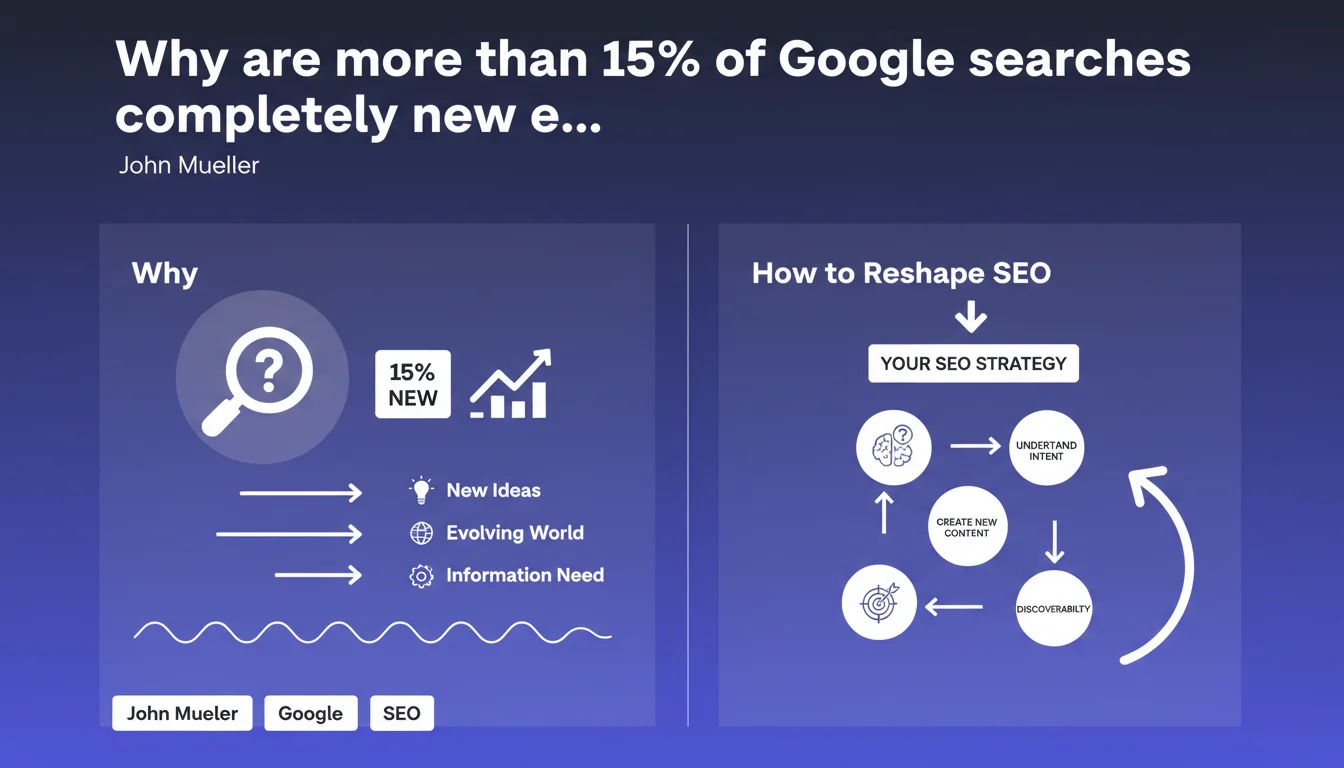
Google confirms that over 15% of daily search queries have never been typed before. This stable statistic over time proves that the search engine constantly processes new search intentions, which creates continuous opportunities to capture traffic on unexploited niches.
What you need to understand
What does this 15% statistic actually mean in concrete terms?
Every day, Google processes billions of queries. If 15% of them are new, that represents hundreds of millions of searches the engine has never seen before. These unprecedented queries can be long-tail expressions, neologisms, unusual word combinations, or highly specific questions.
This metric, which has remained stable for years — Google has been mentioning it regularly since at least 2013 — shows that language evolution and user needs continue to accelerate. New products, events, cultural trends, technical questions: vocabulary is constantly being renewed.
Why is this stability so important for SEO?
The stability of this figure indicates that despite the accumulation of content on the web, semantic space remains open. It does not become saturated. Every day brings a fresh batch of new intentions, which means that even a recently launched site can rank on emerging queries without facing entrenched competitive history.
It also dismantles the myth that "everything has already been said." No. Users constantly invent new ways to express their problems, and Google must answer them even without historical search data. This is where semantic understanding algorithms (BERT, MUM) come into play to interpret intent despite the novelty.
How does Google handle these unprecedented search queries?
Google has no behavioral data for these new queries — no click-through rates, no historical user signals. It therefore relies heavily on semantic analysis: proximity to known queries, named entities, linguistic context.
Pages that cover a broad semantic field around a topic have a better chance of ranking, even on formulations never seen before. This is why comprehensive, well-structured content performs better than pages hyper-targeted to a single expression.
- 15% of daily queries are completely brand new to Google
- This rate has remained stable for over a decade
- Unprecedented queries are often long-tail, highly specific, or tied to recent events
- Google uses semantic analysis and language models to interpret them without historical data
- Sites can capture this traffic without established competition if they cover their topic area thoroughly
SEO Expert opinion
Is this statement consistent with real-world observations?
Yes, very much so. Log audits regularly show single-occurrence queries that nonetheless trigger indexing or temporary ranking. Rank tracking tools also capture expressions that never appear twice in historical records — confirming that Google is constantly testing semantic variations.
That said, John Mueller doesn't specify whether these 15% generate meaningful traffic volume. A new query might be typed only once, never repeated, and therefore have marginal SEO impact. The metric is impressive, but data is missing on conversion rates or search recurrence. [To be verified]
What nuances should we add to this opportunity?
Saying "there are opportunities for new sites" is true, but incomplete. New queries are often variations of existing searches, and Google will likely favor sites already well-positioned on the parent semantic field.
A new site can capture traffic on a unique expression, yes — but if topical authority and E-E-A-T signals are weak, rankings will be ephemeral. Google will test, observe user behavior, then adjust. If the site fails to hold attention, it will be replaced by an established player.
In which cases does this statistic have minimal practical impact?
For highly competitive and stable niches — finance, healthcare, law — new queries often represent minor rewording. They don't fundamentally change editorial strategy. A well-structured site already covers these variations through its internal linking and semantic coverage.
Conversely, in emerging sectors or those tied to current events — tech, culture, trends — these 15% are strategically critical. A responsive site can capture qualified traffic before competitors, build authority on an emerging topic, and capitalize on the snowball effect.
Practical impact and recommendations
What should you do concretely to capture this emerging traffic?
Invest in comprehensive topic coverage rather than exact keyword targeting. Rich, well-structured content with clear semantic markup (headings, lists, tables) will naturally capture unprecedented variations without you having to anticipate them.
Adopt a semantic silo strategy: pillar pages covering a topic in depth, satellite pages addressing sub-aspects. Internal linking should be explicit, with varied anchor text. Google will better understand your topical authority and rank you on new formulations.
Monitor your crawl logs and Search Console queries. Single-occurrence expressions that generate impressions or clicks give you clues on which semantic zones to strengthen. Some new queries become recurring after a few weeks — identify them early.
What mistakes should you avoid with this approach?
Don't create dedicated pages for every long-tail variation. It's counterproductive: keyword cannibalization, authority dilution, thin content risk. A well-built page should address multiple related intentions.
Also avoid over-optimizing for hypothetical expressions. Keyword suggestion tools can't capture new queries — by definition, they don't exist yet. Focus on user understanding and intent, not estimated search volume.
How do you measure whether your site effectively captures these new queries?
Analyze in Search Console the low-occurrence queries (fewer than 10 impressions per month) that drive traffic. If you see many, your semantic coverage is working. If you see almost none, your content may be too generic or too competitive.
Also compare your ratio of unique queries with direct competitors. A site that captures broader semantic diversity tends to better withstand algorithm fluctuations, because it doesn't depend on just a few expressions.
- Build comprehensive pillar pages covering a broad semantic field
- Structure your content with clear heading tags and explicit internal linking
- Analyze your logs and Search Console to identify emerging queries
- Don't create dedicated pages for each variation — focus on semantic density
- Measure the diversity of queries you capture, not just total volume
❓ Frequently Asked Questions
Est-ce que les 15% de requêtes nouvelles concernent principalement la longue traîne ?
Google favorise-t-il les sites établis ou les nouveaux sites sur ces requêtes inédites ?
Faut-il créer du contenu pour anticiper ces requêtes nouvelles ?
Comment mesurer l'impact de ces requêtes nouvelles sur mon trafic ?
Ces 15% de requêtes nouvelles sont-elles stables dans toutes les langues et pays ?
🎥 From the same video 11
Other SEO insights extracted from this same Google Search Central video · published on 12/05/2022
🎥 Watch the full video on YouTube →
💬 Comments (0)
Be the first to comment.