
Official statement
Other statements from this video 11 ▾
- □ Pourquoi 15% des requêtes Google sont-elles inédites chaque jour et qu'est-ce que ça change pour votre stratégie ?
- □ Google envoie-t-il vraiment plus de trafic vers les sites web chaque année ?
- □ Pourquoi Google pousse-t-il la vérification au niveau du domaine dans Search Console ?
- □ Combien de temps faut-il attendre avant de voir les données apparaître dans Search Console ?
- □ Pourquoi Google Analytics et Search Console ne montrent-ils jamais les mêmes chiffres ?
- □ Google n'indexe-t-il vraiment qu'une seule vidéo par page ?
- □ Comment Google indexe-t-il réellement les vidéos sur vos pages web ?
- □ Les données structurées vidéo sont-elles vraiment indispensables pour apparaître dans les résultats de recherche ?
- □ Pourquoi Google ignore-t-il parfois votre balise canonical ?
- □ La mise à jour Page Experience est-elle vraiment un critère de classement déterminant ?
- □ Faut-il systématiquement valider les corrections dans Search Console pour accélérer le re-crawl ?
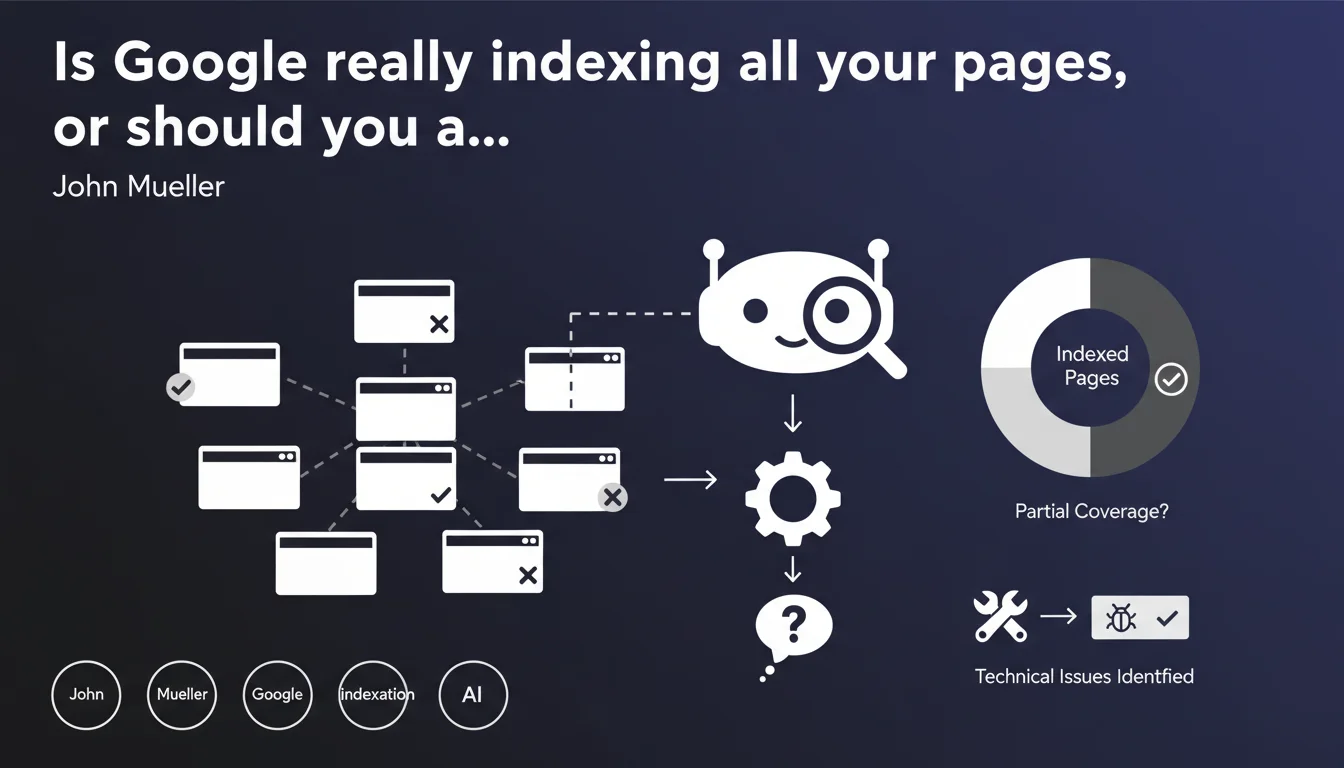
Google does not automatically index every page on a website. This is an accepted reality, not a bug. The challenge then becomes diagnosing whether non-indexed pages represent a real technical issue or simply legitimate algorithmic filtering.
What you need to understand
Why does Google refuse to index certain pages?
Google has a limited crawl budget for each site. Indexing every page on the internet would be technically impossible and economically absurd. The algorithm therefore selects content deemed useful, original, and relevant.
This selection is based on several criteria: content quality, perceived URL popularity, page depth in the site structure, the number of internal and external links pointing to it. A page without added value has no reason to take up space in the index.
Is this situation normal or problematic?
It depends on the nature of non-indexed pages. If these are pagination pages, filters, or variants without unique content, their exclusion is often desirable. This prevents wasting your crawl budget on low-value URLs.
Conversely, if your strategic pages — high-potential product sheets, in-depth articles, commercial landing pages — remain out of the index, you have a problem. The lack of indexation then becomes a technical symptom that needs to be investigated quickly.
How do you distinguish algorithmic choice from technical blocking?
Google Search Console remains the reference tool. Consult the coverage report: it distinguishes between pages voluntarily excluded (noindex, canonicalized, blocked by robots.txt) and pages discovered but not indexed.
If important pages appear in this second category, check the click depth from the homepage, internal linking quality, absence of duplicate or overly thin content. Sometimes it's just a matter of patience — Google will return.
- Partial indexation is normal on large sites with lots of pagination or filters
- Prioritize strategic pages: it's better to have 500 indexed high-performing pages than 5,000 ghost pages
- Technical diagnosis becomes crucial when key pages are missing
- Google Search Console allows you to monitor index coverage evolution month after month
SEO Expert opinion
Is this statement consistent with real-world practices observed in the field?
Absolutely. SEO audits regularly reveal sites with 40 to 60% of pages not indexed, and this is not systematically a problem. Google has always favored quality over quantity.
What's changing is that Mueller is finally saying it clearly. For years, many SEOs fantasized about achieving 100% indexation rates, pushing massive sitemaps and mass submissions via Search Console. Result: zero impact if the content doesn't deserve to be in the index.
What nuances should be added to this statement?
The essential nuance: Google doesn't guarantee indexation, but it doesn't prevent it either if you do what's necessary. A site with solid architecture, original content, and effective internal linking generally achieves good coverage.
The real trap is confusing indexation and performance. An indexed page delivers nothing if it doesn't rank for any query. Sometimes it's better to voluntarily de-index weak content to concentrate your crawl budget on profitable pages. [To verify]: the real impact of this pruning strategy varies depending on domain size and authority.
In which cases does this rule become a real problem?
When strategic pages — those that generate quality traffic or conversions — remain invisible despite optimization efforts. If your product catalog is only 30% indexed, you're losing revenue.
Another concerning case: news sites or frequently-updated blogs. If Google only crawls once a week, your fresh content loses its visibility window. There, you need to act on crawl frequency, not just hope for miraculous indexation.
Practical impact and recommendations
What should you do concretely if strategic pages are not indexed?
Start by identifying affected URLs via Search Console. Export the coverage report, filter for "Discovered, currently not indexed" pages and cross-reference with your high-potential pages.
Next, verify the fundamentals: absence of noindex tag, correct canonical, reasonable click depth from the homepage (ideally less than 4 clicks), substantial content (more than 300 words with real added value). If everything checks out technically, strengthen internal linking to these pages.
What mistakes should you avoid when trying to increase your indexation rate?
Don't manually submit hundreds of URLs via Search Console. It's useless and can even slow down crawling if Google detects spam. Your XML sitemap should remain clean, limited to truly strategic pages.
Another classic mistake: creating content in bulk to artificially inflate the number of indexed pages. Google spots automatically generated or thin content. You lose crawl budget without gaining visibility.
How do you monitor your index coverage evolution over time?
Set up monthly tracking via Google Search Console. Note the total number of indexed pages, excluded pages, and exclusion reasons. Compare month after month to detect abnormal variations.
If you notice a sudden drop, cross-reference with server logs to identify potential 404 errors, redirect chains, or response time issues. A slow site gets crawled less, so it gets indexed less.
- Audit your strategic non-indexed pages via Search Console
- Verify the absence of technical blocks (noindex, robots.txt, canonical)
- Optimize internal linking to priority pages
- Limit your XML sitemap to truly important URLs
- Remove or voluntarily de-index low-value content
- Monitor index coverage evolution monthly
- Cross-reference Search Console data with server logs to anticipate crawl issues
❓ Frequently Asked Questions
Combien de pages mon site doit-il avoir indexées pour être performant ?
Puis-je forcer Google à indexer une page spécifique ?
Mon concurrent a plus de pages indexées que moi, est-ce grave ?
Faut-il désindexer volontairement les pages faibles pour améliorer le crawl budget ?
Combien de temps Google met-il à indexer une nouvelle page ?
🎥 From the same video 11
Other SEO insights extracted from this same Google Search Central video · published on 12/05/2022
🎥 Watch the full video on YouTube →
💬 Comments (0)
Be the first to comment.