
Official statement
Other statements from this video 11 ▾
- □ Why are more than 15% of Google searches completely new every day, and how should this reshape your SEO strategy?
- □ Is Google really sending more traffic to websites each year?
- □ Why is Google pushing domain-level verification in Search Console—and should you switch now?
- □ How long does it really take for your data to show up in Search Console after verification?
- □ Why do Google Analytics and Search Console never show the same numbers?
- □ Does Google really only index a single video per page?
- □ Is Google really indexing all your pages, or should you accept partial coverage?
- □ How does Google really index videos embedded on your web pages?
- □ Are video structured data really essential to appear in search results?
- □ Is Page Experience really the ranking factor Google claims it to be?
- □ Should you always validate fixes in Search Console to speed up re-crawling?
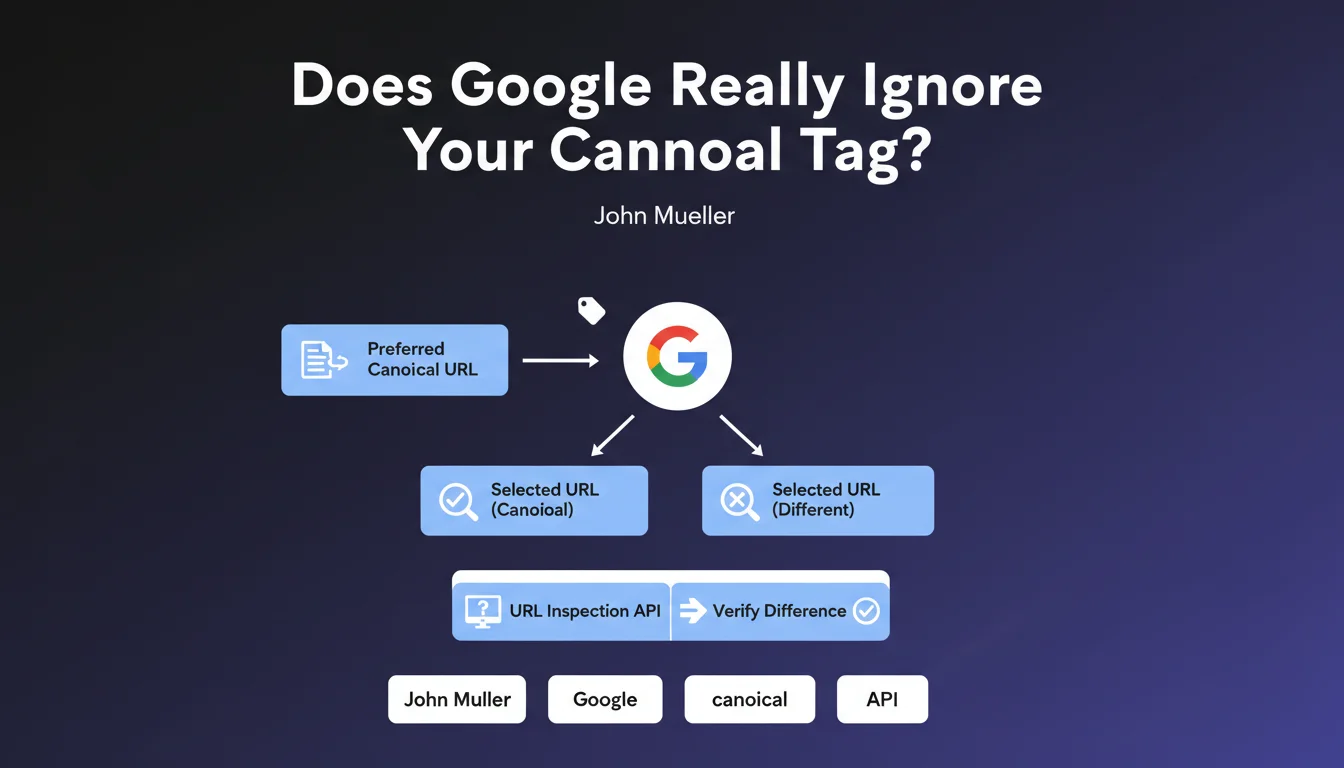
Google can choose a canonical URL different from the one you declare via the rel=canonical tag. The URL Inspection API allows you to compare your choice with Google's and quickly identify discrepancies. This situation is not an anomaly — it's normal behavior for the search engine.
What you need to understand
What is a canonical URL and why doesn't Google always respect your choice?
A canonical URL represents the preferred version of a page among multiple URLs displaying similar or identical content. You declare it via the rel="canonical" tag, XML sitemap, or HTTP headers.
Google treats this tag as a signal, not a command. The search engine analyzes roughly a dozen factors — internal link structure, redirects, URLs in the sitemap, consistency of signals — to determine which canonical version it deems most relevant. If your signals contradict each other or another URL appears more legitimate, Google makes the call.
In which cases does Google choose a different URL?
Several scenarios trigger this divergence. Massive internal links pointing to a non-canonical variant send a strong signal. A 301 redirect to a third-party URL can also carry more weight than a canonical tag.
Inconsistencies between protocols (http/https), trailing slashes, URL parameters, or www/non-www variations create confusion. If your XML sitemap lists a URL different from the one declared as canonical, Google must arbitrate — and it doesn't always choose your side.
How does the URL Inspection API help diagnose these gaps?
The URL Inspection API in Search Console reveals which URL Google selected as canonical. You test the URL you believe is canonical, then its variant — and you compare the results.
If Google displays "User-declared canonical URL: X" but the selected canonical URL is Y, you've identified a divergence. This tool exposes the signals that tipped the balance — canonical tag detected, URL in sitemap, active redirect.
- Google treats the canonical tag as a recommendation, not an absolute directive.
- Contradictory signals (internal links, sitemap, redirects) push Google to ignore your choice.
- The URL Inspection API reveals the canonical URL retained by Google and the signals detected.
- A divergence is not necessarily an error — it may reflect Google's better understanding of your structure.
SEO Expert opinion
Is this statement consistent with practices observed in the field?
Absolutely. SEO audits regularly reveal cases where Google ignores the canonical tag. The search engine favors a holistic approach — it crosses multiple signals to prevent a technical error (misplaced canonical, duplicate tag) from skewing indexation.
E-commerce sites with filters and sorts generate hundreds of URL variants. Despite well-declared canonicals, Google sometimes indexes filtered URLs if they capture more backlinks or direct traffic. This isn't a bug — it's a form of validation through user behavior and third-party signals.
What nuances should be added to this statement?
Google doesn't specify the relative weight of each signal. We know 301 redirects carry heavy weight, internal links matter, but what's the exact hierarchy? [To verify] — Google remains vague on the thresholds that trigger a switch.
Another gray area: timing. If you fix an inconsistency (for example, aligning sitemap and canonical), how long until Google reassesses? Delays vary depending on crawl budget and bot crawl frequency — no guarantee of immediate reindexing.
In which cases doesn't this rule apply?
If all your signals converge — canonical, sitemap, redirects, internal links — Google typically follows your choice. Sites with a clean architecture and strict URL governance encounter few divergences.
Practical impact and recommendations
What should you do concretely to align Google with your canonical choice?
Start with a consistency audit. List all URLs likely to cannibalize each other — variants with/without trailing slash, http/https, www/non-www, sort parameters. Verify that each page points to the same canonical URL via the tag, sitemap, and redirects.
Use the URL Inspection API to test strategic URLs. Compare the declared canonical URL and the one retained by Google. If divergence exists, identify the conflicting signal — often a massive internal link to the wrong variant or a phantom URL in the sitemap.
What errors should you avoid to prevent sending mixed signals to Google?
Never declare a canonical to a 404 or 301 URL. Google ignores this signal and chooses for itself. Avoid chains of canonicals (A points to B, B to C) — Google often truncates and selects A or C randomly.
Don't list non-canonical URLs in your XML sitemap. It's a strong signal that these pages deserve indexation — direct contradiction with your canonical tag. Finally, don't neglect internal links: if 80% of your links point to a non-canonical variant, Google infers that's the legitimate version.
How can you verify your site follows canonical best practices?
- Crawl the site with Screaming Frog or Oncrawl to list all canonical tags and detect inconsistencies.
- Export URLs from the XML sitemap and compare with declared canonicals — they should match exactly.
- Use the URL Inspection API on a sample of strategic URLs and verify that Google retains your choice.
- Analyze server logs to spot URLs indexed by Google that shouldn't be.
- Audit 301/302 redirects — any redirect to a third-party URL effectively nullifies the canonical.
- Verify that internal links point massively to the canonical URL, not its variants.
❓ Frequently Asked Questions
Google peut-il ignorer une balise canonical même si elle est techniquement correcte ?
L'API URL Inspection remplace-t-elle l'ancien outil "Inspecter une URL" de la Search Console ?
Combien de temps faut-il attendre après correction d'une canonical pour que Google mette à jour son choix ?
Si Google choisit une URL canonique différente, cela pénalise-t-il mon SEO ?
Puis-je forcer Google à respecter ma balise canonical via un autre signal ?
🎥 From the same video 11
Other SEO insights extracted from this same Google Search Central video · published on 12/05/2022
🎥 Watch the full video on YouTube →
💬 Comments (0)
Be the first to comment.