
Official statement
Other statements from this video 11 ▾
- □ Why are more than 15% of Google searches completely new every day, and how should this reshape your SEO strategy?
- □ Is Google really sending more traffic to websites each year?
- □ Why is Google pushing domain-level verification in Search Console—and should you switch now?
- □ How long does it really take for your data to show up in Search Console after verification?
- □ Why do Google Analytics and Search Console never show the same numbers?
- □ Is Google really indexing all your pages, or should you accept partial coverage?
- □ How does Google really index videos embedded on your web pages?
- □ Are video structured data really essential to appear in search results?
- □ Does Google Really Ignore Your Canonical Tag?
- □ Is Page Experience really the ranking factor Google claims it to be?
- □ Should you always validate fixes in Search Console to speed up re-crawling?
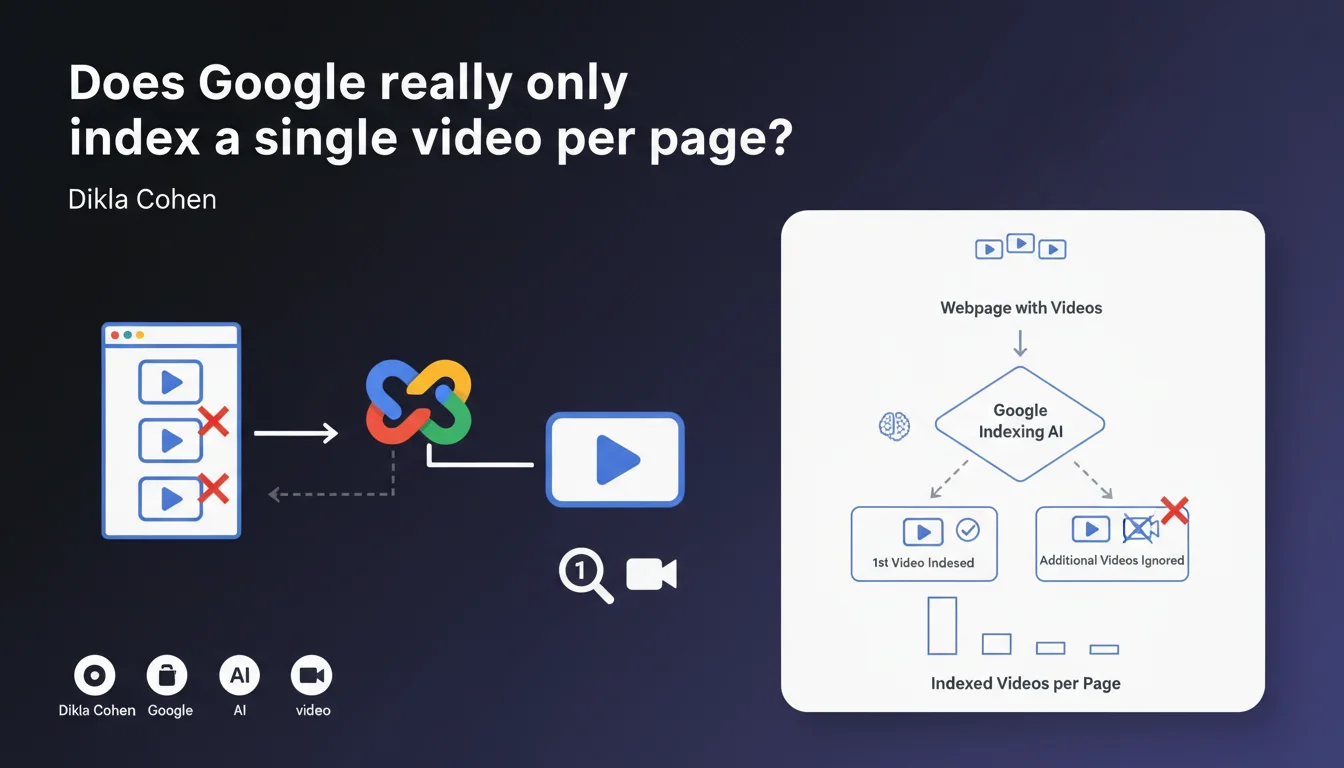
Google indexes a single video per page, regardless of how much video content is present. This limitation directly impacts your visibility strategy in rich results and Google Discover. If you stack multiple videos on the same URL, only one of them will be eligible for video indexing.
What you need to understand
Why does Google limit indexing to one video per page?
Google treats web pages as singular documentary entities. Indexing multiple videos per page would complicate the attribution of relevance signals and create ambiguities in rich results.
In practice? The engine selects the video deemed most relevant according to technical and contextual criteria — position in the DOM, VideoObject markup, proximity to the main title. Other videos present remain technically crawlable, but don't benefit from the video indexing treatment that triggers rich snippet display.
How does Google choose which video to index?
Official documentation remains vague on the precise selection criteria [To verify]. Field observations suggest a preference for the first video in HTML code order, especially if it has structured VideoObject schema markup.
Proximity to main editorial content also appears to matter. A video placed high on the page, near the H1, with detailed textual description, generally gets priority over a secondary video buried mid or end of scroll.
What happens to other videos present on the page?
They remain accessible to users and can be played normally. Google can even crawl them and understand their content through audio/visual analysis. But they won't trigger rich display in the SERPs or appearance in the Videos tab.
- Only one video per page benefits from complete video indexing treatment
- Other videos remain crawlable but invisible in rich results
- The choice of indexed video depends on partially documented technical and contextual criteria
- VideoObject schema markup strongly influences selection
SEO Expert opinion
Is this limitation consistent with field observations?
Yes, largely. Tests conducted on pages containing multiple videos consistently show that only one VideoObject generates a rich snippet in the SERPs, even when multiple schemas are correctly declared.
Search Console moreover only reports performance data for one video per URL in the Video report. Other VideoObjects present in the code trigger neither error nor validation — they are simply ignored for rich indexing.
What nuances should be added to this rule?
Let's be honest: this rule concerns enriched video indexing, not crawling or content understanding. Google can perfectly analyze all your videos to understand the page topic, feed its knowledge graph, or power features like Discover.
The important nuance? A page with multiple videos can still perform in standard results thanks to overall content richness. But it will never benefit from multiple video thumbnails in the SERPs.
In what cases does this constraint really pose a problem?
Primarily for editorial or e-commerce sites betting on thematic playlists or multi-step tutorials. Grouping 3-4 complementary videos on the same page seems logical for UX, but sabotages the SEO visibility of each video individually.
Niche sites creating long-form video content with multiple chapters also lose the opportunity to occupy multiple positions in Video SERPs. Each segment could potentially deserve its own ranking, but only the main content will be indexed.
Practical impact and recommendations
What architecture should you adopt to maximize video visibility?
Favor the one video = one dedicated URL approach. Create individual pages for each video you want to appear in rich results, even if this seems redundant from an editorial standpoint.
For complex content requiring multiple videos, structure as series or playlists with separate URLs linked by coherent internal linking. Each episode or chapter gets its own optimized page, its own VideoObject schema, and its own chance to rank.
How do you avoid markup errors that dilute signals?
Audit your templates to identify automatically generated VideoObjects. Many WordPress themes or video plugins create markup for each iframe, even on secondary or illustrative videos.
Clearly define which video is primary on each page, and only mark it with VideoObject. Secondary videos can remain as simple embeds without schema — they'll still be crawled and understood, but won't interfere with your enriched indexing.
What if you absolutely must keep multiple videos on one page?
Accept that only the first will benefit from enriched visibility. Place it strategically high on the page, with an explicit H2 title, detailed textual description, and complete VideoObject schema.
Secondary videos then serve user experience but not video SEO. If some truly deserve organic traffic, create dedicated landing pages and link them through contextual internal linking from your main page.
- Audit pages containing multiple videos to identify which deserve a dedicated URL
- Create individual pages for each strategic video (tutorials, product demos, premium content)
- Verify that only the main video has VideoObject schema per page
- Clean up automatic markups generated by themes or plugins on secondary videos
- Structure multi-video content as series with internal linking between episodes
- Check in Search Console that each URL reports only one indexed video
❓ Frequently Asked Questions
Si je supprime les vidéos secondaires d'une page, est-ce que cela améliore l'indexation de la vidéo principale ?
Une vidéo YouTube embarquée est-elle indexée sur ma page ou seulement sur YouTube ?
Comment savoir quelle vidéo Google a choisi d'indexer sur ma page ?
Peut-on forcer Google à indexer une vidéo spécifique en modifiant l'ordre dans le code HTML ?
Les chapitres vidéo via le markup SeekToAction comptent-ils comme plusieurs vidéos ?
🎥 From the same video 11
Other SEO insights extracted from this same Google Search Central video · published on 12/05/2022
🎥 Watch the full video on YouTube →
💬 Comments (0)
Be the first to comment.