
Official statement
Other statements from this video 11 ▾
- □ Le contenu texte reste-t-il vraiment le pilier du classement Google ?
- □ Google peut-il vraiment identifier le niveau technique de votre audience ?
- □ Les noms de domaine ont-ils vraiment perdu leur pouvoir de classement dans Google ?
- □ Faut-il vraiment privilégier le trafic qualifié au volume de visiteurs ?
- □ Faut-il privilégier rel=canonical à noindex pour gérer les contenus similaires ?
- □ Les redirections 301/302 sont-elles vraiment un problème pour l'expérience utilisateur ?
- □ Faut-il sacrifier du trafic pour cibler la bonne audience ?
- □ Pourquoi les impressions et les clics ne suffisent-ils pas à mesurer le succès SEO ?
- □ La meta description est-elle vraiment inutile pour le classement Google ?
- □ Pourquoi le contenu générique tue-t-il votre différenciation SEO ?
- □ Le taux de satisfaction utilisateur révèle-t-il un problème de ciblage SEO ?
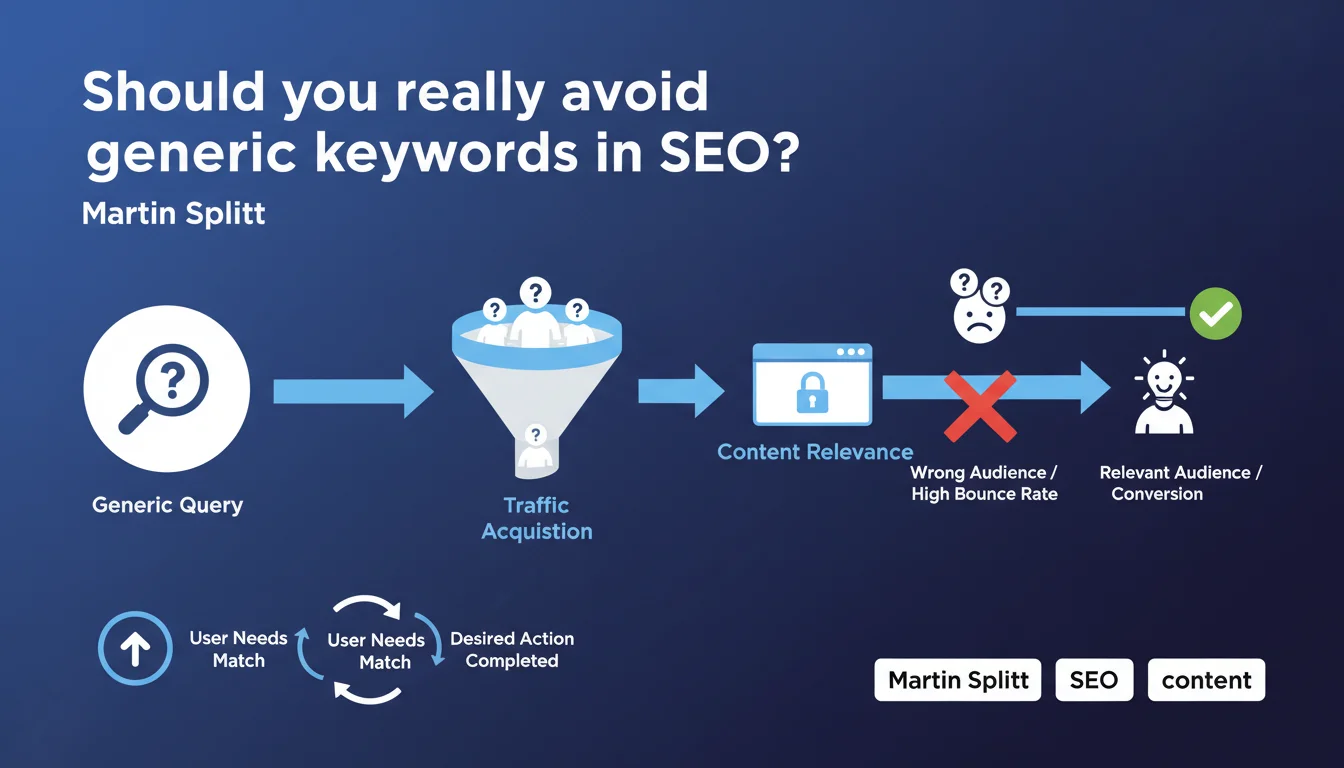
Google says that targeting overly generic queries attracts mismatched traffic that doesn't convert. Visitors arriving through these broad keywords don't find what they're truly looking for, which tanks your engagement metrics and ROI. The stakes: aim for relevance over raw volume.
What you need to understand
Why is Google pushing this message now?
Google wants sites to align their semantic targeting with users' actual intent. A generic keyword like "shoes" attracts both someone looking to buy and someone wanting to clean their soles. If your content only talks about sales, you frustrate half your traffic.
This statement fits into the logic of updates centered on user experience: high bounce rate, low time on page, zero conversions — all signals that Google interprets as a mismatch between promise (the keyword) and delivery (the content).
What exactly counts as a "too generic" keyword?
It's a broad query, single-term or two-term, that covers multiple incompatible intents. "Insurance" could mean auto, home, health, or even educational content about the concept of insurance. Impossible to satisfy all these expectations with a single page.
Martin Splitt is talking here about documentation or content: if you sell HR software and you target the keyword "HR", you'll attract students looking for definitions, headhunters, HR directors seeking training… not your audience.
What's the real SEO risk?
Google doesn't directly penalize a site that ranks for generic terms. But degraded behavioral signals (pogo-sticking, low engagement) can reduce your overall visibility. You're also wasting crawl budget and link equity on pages that don't convert.
- Mismatched traffic: high volume, low qualification, virtually zero conversions
- Negative signals: high bounce rate, low time on page, no secondary clicks
- Semantic dilution: Google struggles to understand your true topic if you try to cover too broad a scope
- Opportunity cost: resources invested in generic keywords instead of qualified queries
SEO Expert opinion
Is this statement really a revelation?
No. Every SEO practitioner has known for years that intent trumps volume. What Splitt is saying here is basic SEO common sense: 100 qualified visitors beats 10,000 curious ones who bounce in 5 seconds.
What's more interesting is that Google is saying it officially. It confirms their algorithms now heavily weight engagement metrics — and that ranking for generic keywords without addressing all possible intents could actually hurt you.
When doesn't this rule really apply?
For editorial and news sites, the game is different. A site like Wikipedia should rank for generic keywords because its mission is precisely to cover broadly. Same for marketplaces: Amazon benefits from ranking for "shoes" because it serves all possible intents.
The problem mainly affects specialized sites or niche e-commerce. If you only sell trail running shoes, ranking for "shoes" attracts 95% off-target traffic. [To verify]: Does Google actually adjust ranking based on these behavioral signals, or just offer generalizations? Real-world case studies show mixed results.
What's the line between generic and specific?
Google gives no numerical metrics — typical. In practice, people usually talk about search volume and competition: a keyword with 100,000 searches/month and a SERP dominated by giants is probably too generic for an average site.
But be careful: a "specific" keyword in one sector might be "generic" in another. "CRM" is massive in B2B SaaS, but could be manageable for a tech definitions site. It all depends on your thematic authority and ability to cover all facets of intent.
Practical impact and recommendations
How do you identify keywords that are too generic for your site?
Analyze your Search Console and Analytics data together. A keyword is probably too generic if: bounce rate > 70%, time on page < 30 seconds, conversion rate < 0.5% while your site average is 2-3%.
Also look at the SERP itself: if the top 10 results cover radically different intents (purchase, info, comparison, tutorial), the keyword is ambiguous. You can't beat all these sites across all these intents.
What strategy should you adopt for generic keywords?
Three options: ignore, segment, or build a hub. Ignore if you lack both authority and resources to cover all intents. Segment by creating multiple targeted pages (one per sub-intent). Build an editorial hub if you can produce comprehensive content addressing every angle.
For 80% of niche sites, the right answer is: move down the long tail. Rather than "insurance", target "car insurance for young drivers" or "home insurance comparison for renters". Less volume, but 5-10x higher conversion rates.
How do you verify your semantic strategy is aligned?
Audit your main pages with an intent mapping tool (manually or via AI). For each page, list: primary keyword, secondary keywords, dominant intent (info/purchase/comparison), and current conversion rate.
If you find a gap between keyword intent and page content (example: product page ranking for an informational query), either adjust the content or create a new dedicated page.
- Extract from Search Console queries with high impressions but low CTR and short time on page
- Cross-reference these queries with Analytics data to identify non-converting ones
- Analyze the SERP for each generic query to understand multiple intents
- Decide for each keyword: abandon, create segmented content, or optimize for a specific intent
- Prioritize long-tail variations with clear intent and sufficient volume for your business
- Regularly monitor engagement metric changes on your targeted pages
❓ Frequently Asked Questions
Un site e-commerce doit-il complètement abandonner les mots-clés génériques ?
Comment mesurer si un mot-clé est trop générique pour mon site ?
Google pénalise-t-il les sites qui se positionnent sur du générique ?
Faut-il supprimer les pages qui rankent sur du générique mais ne convertissent pas ?
Les mots-clés de marque sont-ils considérés comme génériques ?
🎥 From the same video 11
Other SEO insights extracted from this same Google Search Central video · published on 24/03/2022
🎥 Watch the full video on YouTube →
💬 Comments (0)
Be the first to comment.