
Official statement
Other statements from this video 11 ▾
- □ Le contenu texte reste-t-il vraiment le pilier du classement Google ?
- □ Google peut-il vraiment identifier le niveau technique de votre audience ?
- □ Les noms de domaine ont-ils vraiment perdu leur pouvoir de classement dans Google ?
- □ Faut-il vraiment éviter les mots-clés génériques en SEO ?
- □ Faut-il vraiment privilégier le trafic qualifié au volume de visiteurs ?
- □ Faut-il privilégier rel=canonical à noindex pour gérer les contenus similaires ?
- □ Les redirections 301/302 sont-elles vraiment un problème pour l'expérience utilisateur ?
- □ Faut-il sacrifier du trafic pour cibler la bonne audience ?
- □ Pourquoi les impressions et les clics ne suffisent-ils pas à mesurer le succès SEO ?
- □ La meta description est-elle vraiment inutile pour le classement Google ?
- □ Pourquoi le contenu générique tue-t-il votre différenciation SEO ?
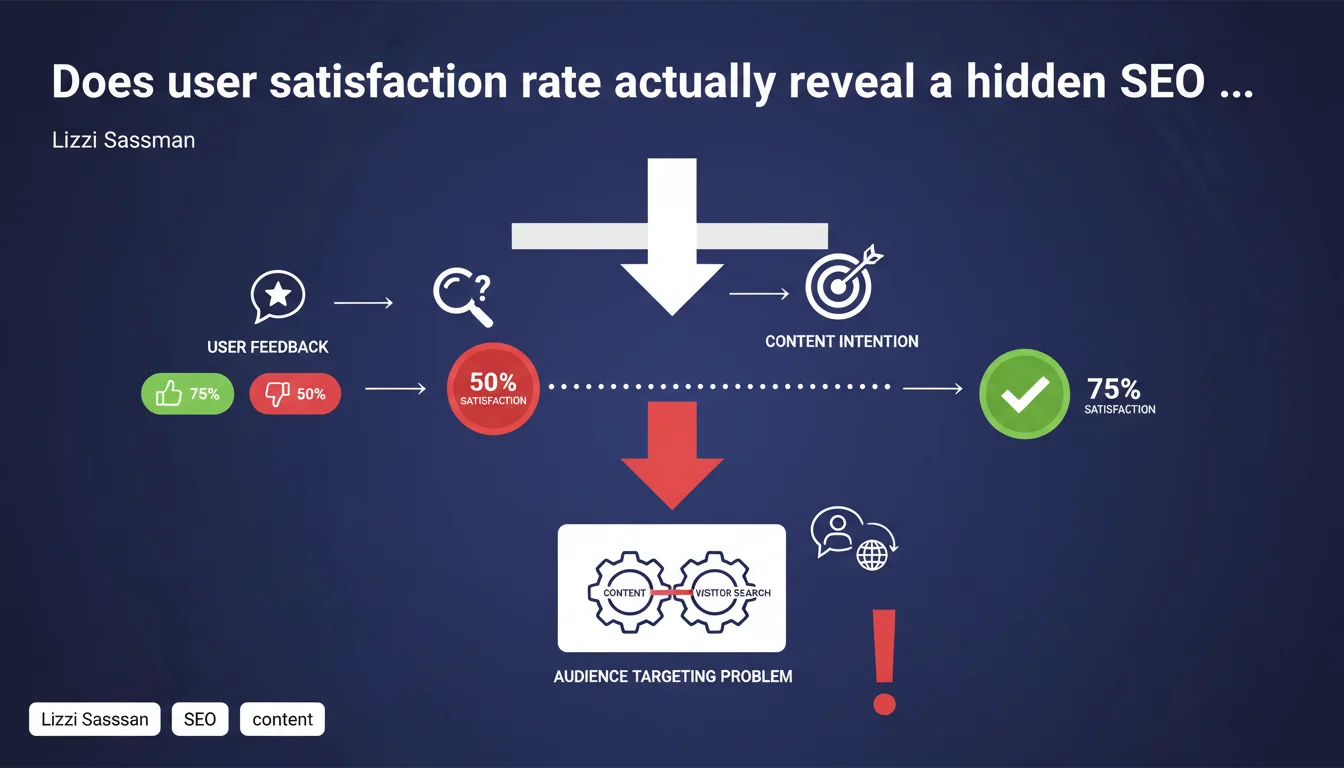
Google confirms that user feedback metrics (satisfaction buttons, surveys) can signal a disconnect between your content and what visitors actually need. A satisfaction rate dropping from 75% to 50% clearly indicates an audience targeting problem, not just a content quality issue.
What you need to understand
Why is Google suddenly interested in direct user feedback?
Google is no longer satisfied with analyzing traditional behavioral signals — bounce rate, time on page, and so on. The company now encourages publishers to collect explicit feedback through satisfaction buttons or post-read surveys. The goal? To identify gaps between search intent and what the page actually delivers.
Lizzi Sassman uses the example of a satisfaction rate that drops from 75% to 50%. This isn't a simple accident — it's a red flag about audience targeting. The page might be attracting traffic, but not the right traffic. Or worse: it's answering a question nobody is really asking.
What's the difference between low satisfaction and poor quality?
That's where it gets tricky. A page can be technically flawless, well-written, properly structured — and still disappoint 50% of visitors. The problem isn't always in the execution, but in how well the content matches what the visitor actually expects.
Google doesn't explicitly say these satisfaction metrics directly influence rankings. But the company does say they allow you to diagnose a targeting problem. In other words: if your audience isn't finding what they need, you're targeting the wrong keywords or the wrong search intent.
How do you interpret a 50% versus 75% threshold?
Google provides specific numbers here — which is rare. A 75% satisfaction rate seems to be the benchmark for a page properly aligned with its audience. Dropping to 50% cuts the perceived content effectiveness in half.
Let's be honest: Google doesn't explain how these thresholds were defined, or whether they're observed averages or recommendations. [Needs verification] — no statistical context is provided. But the underlying message is clear: a 25-point satisfaction gap is enough to question your targeting strategy.
- Direct user feedback (buttons, surveys) reveals a gap between intent and content
- A satisfaction rate of 50% instead of 75% signals an audience targeting problem
- Google implicitly distinguishes between content quality and audience relevance
- These metrics serve as diagnostic tools, not necessarily direct ranking factors
SEO Expert opinion
Is this statement consistent with real-world observations?
Yes, and it's actually one of the rare Google statements that perfectly matches what we observe in SEO. Sites that collect user feedback often discover paradoxical pages: good rankings, decent traffic, but catastrophic engagement. These are typically pages that rank for adjacent keywords, but not the main intent.
The problem is Google doesn't elaborate. Lizzi Sassman mentions diagnosis, but doesn't clarify whether these satisfaction signals are fed into the algorithm or remain manual audit tools. From experience, Google probably relies on behavioral proxies (back clicks, query reformulations) rather than in-site surveys.
What risks come with taking this statement literally?
First trap: over-interpreting causality. A 50% satisfaction rate could result from a UX problem, catastrophic page load time, or an audience frustrated by a paywall. It's not always a semantic targeting issue.
Second trap: thinking Google recommends adding feedback buttons everywhere. That's not what they're saying. They use this example to illustrate a gap between intent and content, not to push a specific collection method. If you don't have the resources to process this feedback strategically, it's pointless.
When doesn't this rule apply?
Some content naturally has a low satisfaction rate — and that's fine. News pages on sensitive topics, controversial subjects, highly specialized technical content: the audience is often inherently divided. A 50% rate may be perfectly acceptable.
Another case: transactional pages. If the user wants to buy a product and your page is informational, feedback will be poor even if the content is excellent. The gap isn't in quality, but in where they are in the customer journey. Google seems to be talking about informational content here, not product pages or landing pages.
Practical impact and recommendations
What should you do concretely to detect a targeting problem?
First step: set up a user feedback system on your key pages. This could be a simple "Was this page helpful?" button, a post-read survey, or a more sophisticated tool like Hotjar. The main thing is collecting qualitative data, not just aggregated behavioral metrics.
Second step: cross-reference this feedback with your Search Console data. Find pages that rank for adjacent queries, not your main target. If your "on-page SEO optimization" page gets traffic from "technical SEO checklist," that's a sign you're targeting too broadly — or your title is misleading.
What mistakes should you avoid when analyzing feedback?
Don't focus only on overall satisfaction rate. What matters is segmentation by landing query. A page might have 60% average satisfaction, but 80% on its main keyword and 30% on secondary ones. That changes everything.
Common mistake: reacting too fast. A 50% satisfaction rate from 20 responses isn't representative. Wait until you have at least 100-200 responses before drawing conclusions. And watch out for selection bias — unhappy users respond more often than satisfied ones.
How do you fix a page suffering from a targeting problem?
If diagnosis confirms a gap, you have two options. Either realign the content to match what visitors actually need — even if that means dramatically changing the page angle. Or create a dedicated page for the secondary intent attracting unhappy traffic, and redirect properly.
In practice: analyze questions mentioned in feedback comments (if you collect them). Compare them to your H1, introduction, and subheadings. If users are looking for "how to do X" and you explain "why do X," the gap is obvious. Rewrite accordingly.
- Install a user feedback tool on strategic pages (buttons, surveys)
- Cross-reference satisfaction data with landing queries in Search Console
- Segment satisfaction rates by query type, not just overall
- Wait for sufficient response volume (100-200 minimum) before concluding
- Identify pages with a significant gap between perceived and delivered intent
- Rewrite problem pages or create dedicated content for secondary intents
- Measure satisfaction improvement after adjustments to validate impact
❓ Frequently Asked Questions
Un taux de satisfaction de 50% signifie-t-il que Google va déclasser ma page ?
Comment Google définit-il le seuil de 75% de satisfaction ?
Dois-je installer des boutons de feedback sur toutes mes pages ?
Le feedback utilisateur remplace-t-il l'analyse des métriques Search Console ?
Que faire si mon taux de satisfaction est bas à cause d'un paywall ou d'une inscription obligatoire ?
🎥 From the same video 11
Other SEO insights extracted from this same Google Search Central video · published on 24/03/2022
🎥 Watch the full video on YouTube →
💬 Comments (0)
Be the first to comment.