
Official statement
Other statements from this video 11 ▾
- □ Can Google really identify the technical expertise level of your audience?
- □ Have Domain Names Really Lost Their Ranking Power in Google's Eyes?
- □ Should you really avoid generic keywords in SEO?
- □ Should you really prioritize qualified traffic over raw visitor volume?
- □ Should you use rel=canonical instead of noindex to handle similar content?
- □ Are 301/302 redirects really damaging your user experience and SEO?
- □ Should you sacrifice traffic volume to reach the right audience?
- □ Are impressions and clicks really enough to measure your SEO success?
- □ Does meta description really matter for your Google rankings?
- □ Is generic content quietly killing your SEO differentiation?
- □ Does user satisfaction rate actually reveal a hidden SEO targeting issue?
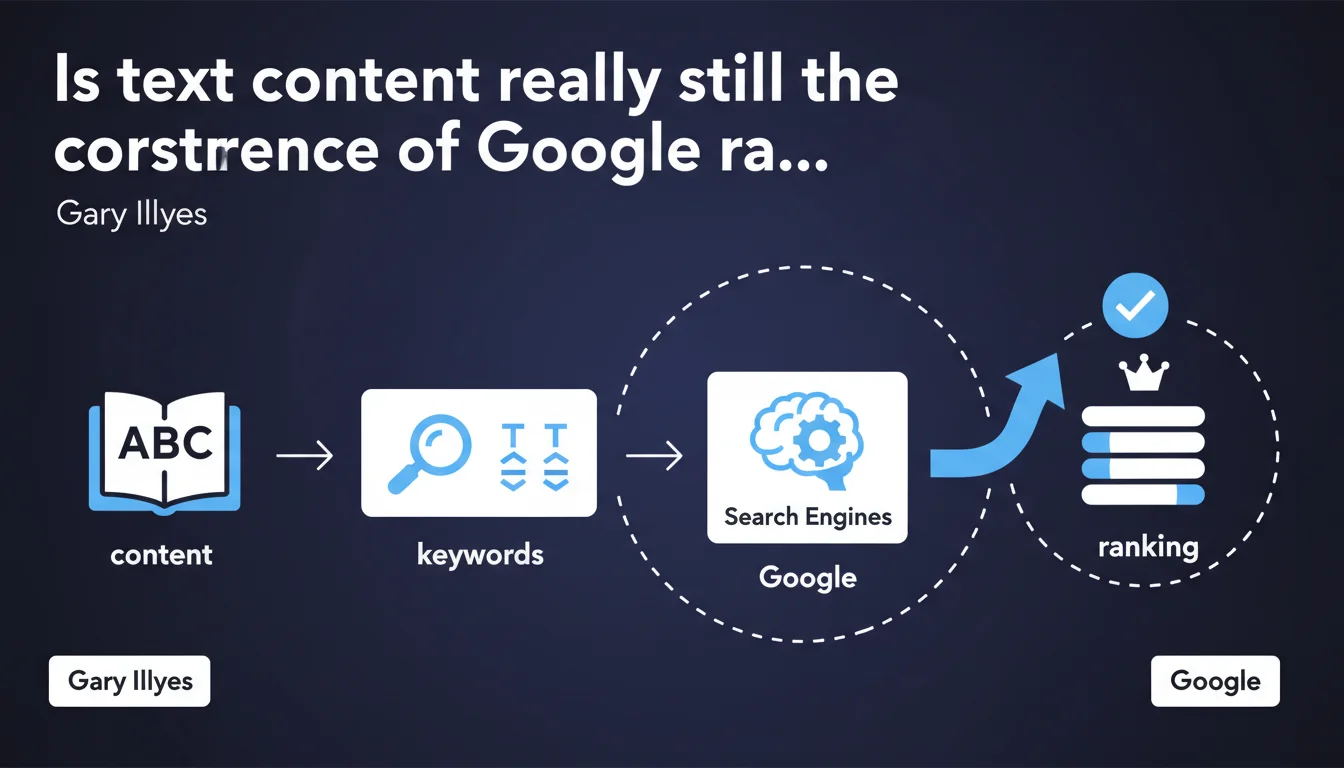
Gary Illyes reminds us that search engines operate primarily on the analysis of textual content: tokens, keywords, semantics. The famous 'content is king' isn't just marketing hype — it's a direct reflection of how ranking algorithms actually work technically. Without analyzable content, it's impossible to rank.
What you need to understand
Why does Google keep insisting on text content?
Because Google's algorithm still relies on linguistic analysis: tokenization, entity identification, semantic understanding, relevance detection. Even with generative AI and language models, the search engine must be able to read, parse, and interpret text.
Visuals, videos, animations? They're useful for user experience, sure — but without associated text (alt tags, transcriptions, descriptions), Google remains blind. Text content remains the only material exploitable for ranking.
What exactly do we mean by 'tokens' and 'keywords'?
A token is the minimal unit that Google extracts from text: a word, a word fragment, sometimes even punctuation. The algorithm breaks down each sentence into tokens, analyzes their frequency, position, and co-occurrence.
Keywords are terms deemed significant for determining a page's topic. But attention — we're no longer talking about mechanical density. Google now evaluates semantic richness: synonyms, lexical fields, variation in formulation.
Does this principle invalidate other ranking factors?
No. Gary Illyes isn't saying that content is the only factor — he's saying it's the foundation. Without analyzable content, backlinks or Core Web Vitals are useless: it's impossible to rank what you don't understand.
Conversely, at equivalent content quality, other signals (authority, UX, freshness, EEAT) become decisive. Content is necessary but not sufficient.
- Text content remains the fundamental element analyzed by Google
- Tokens and semantic structure condition initial ranking
- Without exploitable content, no other SEO signal can compensate
- Non-text elements must be accompanied by text descriptions
- Semantic richness takes priority over mechanical keyword repetition
SEO Expert opinion
Is this statement consistent with real-world SEO practices?
Absolutely. Sites that perform well in SEO consistently have structured, rich, targeted text content. Experiments with ultra-minimalist pages (full image, video without transcription) almost always fail to rank on competitive queries.
But here's the problem: this statement remains very generic. Gary Illyes says nothing about quantitative thresholds (how many words?), optimal keyword density (if it still exists), or the exact weighting between main content and secondary content. [To verify]: how does Google treat AI-generated content, which technically respects this rule but sometimes lacks depth?
What nuances should we add to this principle?
First, content quality isn't measured only by token quantity. Text stuffed with keywords but lacking added value won't rank better than concise but relevant content. Google has multiplied anti-spam filters (Helpful Content, Product Reviews) precisely for this reason.
Second, certain query types now favor other formats: featured snippets favor structured lists, local searches value GMB, visual searches rely on Google Lens. Text content remains central, but its format and structure are evolving.
In which cases doesn't this rule apply strictly?
On image or video searches, text content plays an indirect role: Google relies on metadata (alt, titles, descriptions, transcriptions) but also on page context. An isolated image without surrounding text will struggle to rank.
Same for web applications (SPA, PWA) where content loads dynamically via JavaScript. Technically, Google can crawl JS — but if rendering is too slow or content inaccessible on first load, the crawler risks indexing nothing. The principle remains: content must be readable, textual, and accessible.
Practical impact and recommendations
What should you do concretely to optimize your text content?
First step: audit pages that don't rank. Verify they contain sufficient exploitable text content, not just images or videos. A tool like Screaming Frog lets you spot pages with too low a text/HTML ratio.
Next, enrich semantically: vary formulations, integrate synonyms and related terms, structure with Hn tags. Google increasingly understands context — take advantage to write naturally instead of mechanically stuffing keywords.
What mistakes should you absolutely avoid?
Never sacrifice text content for design. A 100% visual site, even gorgeous, will be invisible to Google. Sliders, animations, infographics must always be accompanied by text (captions, descriptions, transcriptions).
Also avoid the trap of duplicate or thin content. Google values information density: a 50-word paragraph that precisely answers an intent is better than 500 words of generic filler.
How do you verify your site respects this principle?
Test your pages with the URL Inspection Tool in Google Search Console. Look at the version rendered by Googlebot: is text content clearly visible? Are dynamic elements loaded?
Also compare the visible text / HTML code ratio. If your page weighs 200 KB of code for 100 words of content, you have a problem. Prioritize substantial content that's directly accessible.
- Audit underperforming pages to check their text content volume
- Enrich semantically: synonyms, lexical fields, formulation variants
- Structure with Hn tags and lists to facilitate crawler reading
- Add transcriptions for videos, alt descriptions for images
- Test Googlebot rendering via Search Console
- Avoid thin content and artificial keyword stuffing
- Prioritize information density over raw volume
❓ Frequently Asked Questions
Le contenu généré par IA est-il considéré comme du 'vrai' contenu textuel par Google ?
Combien de mots minimum faut-il pour qu'une page soit bien classée ?
Les pages en JavaScript pur (SPA) peuvent-elles bien ranker ?
Faut-il privilégier le texte visible ou peut-on cacher du contenu pour les crawlers ?
Les images et vidéos ont-elles encore un intérêt SEO si seul le texte compte ?
🎥 From the same video 11
Other SEO insights extracted from this same Google Search Central video · published on 24/03/2022
🎥 Watch the full video on YouTube →
💬 Comments (0)
Be the first to comment.