
Official statement
Other statements from this video 11 ▾
- □ Is text content really still the cornerstone of Google rankings?
- □ Have Domain Names Really Lost Their Ranking Power in Google's Eyes?
- □ Should you really avoid generic keywords in SEO?
- □ Should you really prioritize qualified traffic over raw visitor volume?
- □ Should you use rel=canonical instead of noindex to handle similar content?
- □ Are 301/302 redirects really damaging your user experience and SEO?
- □ Should you sacrifice traffic volume to reach the right audience?
- □ Are impressions and clicks really enough to measure your SEO success?
- □ Does meta description really matter for your Google rankings?
- □ Is generic content quietly killing your SEO differentiation?
- □ Does user satisfaction rate actually reveal a hidden SEO targeting issue?
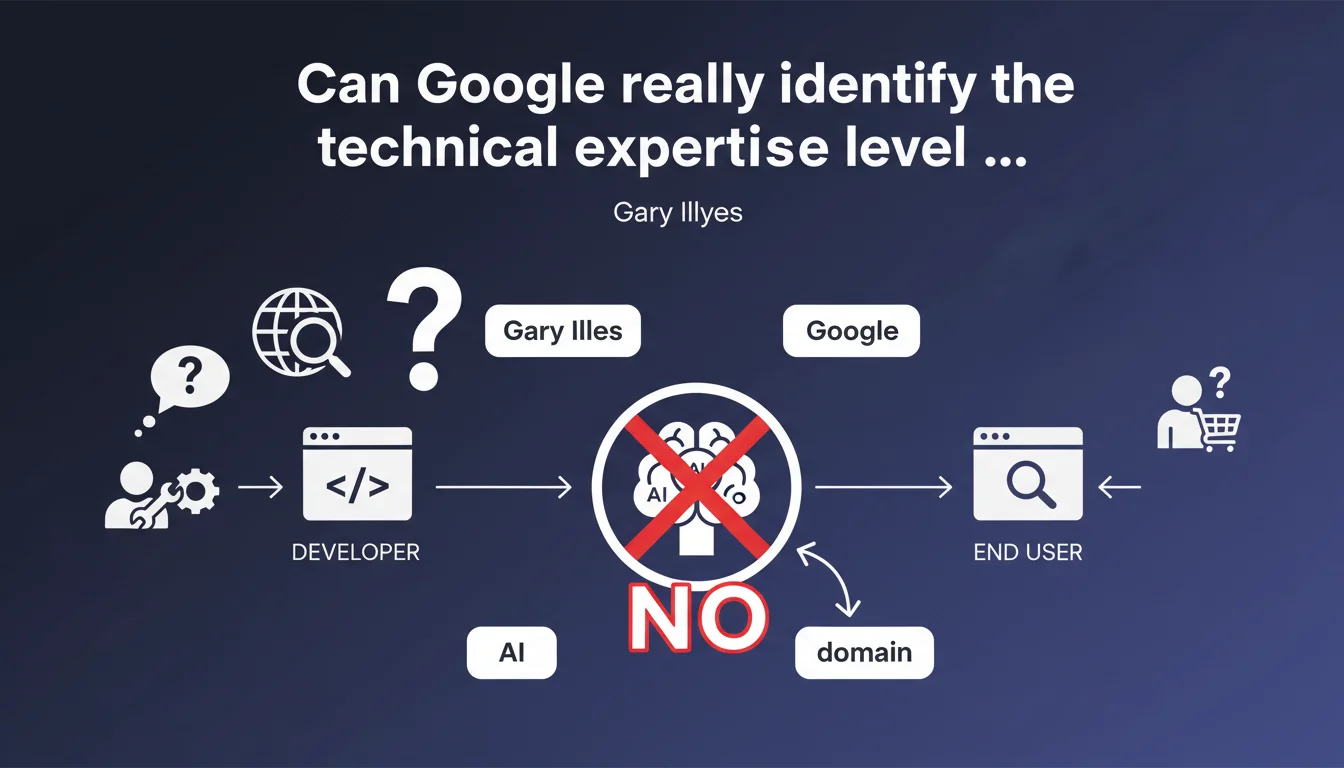
Google claims it cannot determine whether the user behind a search query is a developer or an end consumer. The search engine does not rely on domain names to assess the technical level of the target audience. This statement questions certain technical targeting strategies in SEO content.
What you need to understand
Why doesn't Google differentiate between developers and end users?
Gary Illyes' statement reveals a fundamental limitation of the search engine: the absence of an exploitable user profile during a query. Contrary to what some imagine, Google does not categorize users according to their technical expertise.
This position is explained by the very nature of anonymous search. The engine analyzes search intent, not the identity or skills of the person formulating it. A search for "install Node.js" can come from a senior developer just as much as from a beginner student.
Does the domain name reveal audience level?
Google dismisses here a persistent misconception: a .dev or .tech domain does not influence ranking toward a technical audience. The engine does not presume that visitors to a technical domain are necessarily experts.
This approach avoids targeting biases. An article on "understanding REST APIs" must serve both the experienced developer looking for a reference and the project manager discovering the concept. The domain is just one signal among many, never a marker of user expertise.
What are the implications for content targeting?
The inability to segment by technical level forces a rethinking of content granularity. The same keyword can hide radically different intentions depending on user expertise.
Let's be honest: this statement complicates things for technical sites. Producing content that simultaneously satisfies both novices and experts amounts to editorial balancing. And that's precisely what Google now expects.
- Google does not profile users according to their technical level during a search
- The domain name (.dev, .tech, etc.) does not signal to the engine the level of expertise of the target audience
- Search intent takes priority over any assumptions about user skills
- Content must potentially serve multiple expertise levels simultaneously
- This approach avoids algorithmic biases but complicates editorial strategy
SEO Expert opinion
Is this statement consistent with real-world observations?
Yes and no. In practice, we indeed observe that Google serves highly varied content in technical depth for the same query. A developer searching "authentication JWT" will find both basic tutorials and advanced technical documentation.
But — and this is where it gets tricky — certain patterns partially contradict this claim. Sites with established technical authority (Stack Overflow, MDN, official documentation) systematically capture expert queries. Coincidence or implicit recognition of their qualified audience? [To verify]
What nuances should be applied to this position?
Google may not directly profile the user, but it analyzes broader behavioral context. Search history, previous clicks, and prior navigation constitute numerous clues that refine targeting — even without formally "labeling" someone as a developer.
Gary Illyes' statement seems deliberately restrictive. It says "we cannot know" when the reality is more like "we don't use a binary developer/non-developer label." The nuance matters. Google has access to rich behavioral signals that modulate results without explicit categorization.
Another point: the claim about domain names deserves context. Certainly, a .dev alone is insufficient to qualify an audience, but it fits within a broader semantic signal constellation (vocabulary, technical depth, incoming links from specialized resources) that, when combined, orient positioning.
In what cases does this rule show its limits?
Highly specialized queries reveal the flaws in this universalist approach. Searching "implement OAuth2 PKCE flow" doesn't really attract beginner profiles. Google knows this well and adjusts results accordingly — proof that some form of implicit detection operates.
Similarly, technical documentation sites (API references, detailed changelogs) don't perform well on ultra-specific queries by accident. The engine recognizes their contextual relevance even though it officially refuses to "label" the user.
Practical impact and recommendations
What should you concretely do with this information?
Rethink your editorial architecture assuming that the same page can serve multiple expertise levels. Rather than a single ultra-technical or oversimplified piece of content, structure in layers: accessible introduction, progressive detailed sections, advanced resources at the end of the article.
Leverage internal navigation anchors (clickable table of contents) to allow experts to jump directly to advanced sections while beginners follow the main flow. This approach maximizes user satisfaction regardless of level.
What mistakes should you avoid in your content strategy?
Don't bank on your domain name or thematic positioning to automatically pre-qualify your audience in Google's eyes. A .dev site hosting superficial tutorials will not benefit from any implicit advantage.
Also avoid the opposite pitfall: "soft generalist" content that tries to appeal to everyone while satisfying nobody. Google values depth and specificity, even if it doesn't label the user. A solid technical article with a pedagogical introduction always beats vague content.
How can you verify your content is well-adapted?
Analyze your behavioral metrics by page: reading time, bounce rate, scroll depth. Content that's too basic for an expert query generates fast bounces. Content that's too complex without access points produces the same effect.
Test progressive readability: can a non-specialist understand the introduction and leave with a minimally satisfying answer? Can an expert quickly access technical details without traversing paragraphs of basic explanation?
- Structure content in layers of increasing complexity rather than in separate levels
- Use interactive tables of contents to enable rapid navigation to advanced sections
- Integrate inline definitions or tooltips for technical terms without burdening the main flow
- Don't rely on the domain (.dev, .tech) as a sufficient targeting signal
- Maintain strong thematic coherence rather than diluting to cast a wider net
- Monitor engagement metrics by content depth to identify friction points
- Create navigation pathways that naturally orient toward the desired level of detail
❓ Frequently Asked Questions
Google utilise-t-il l'historique de recherche pour adapter les résultats au niveau technique ?
Un nom de domaine .dev ou .tech influence-t-il le positionnement sur des requêtes techniques ?
Faut-il créer des pages séparées pour différents niveaux d'expertise ?
Comment Google détermine-t-il qu'un contenu répond à une intention technique avancée ?
Cette approche de Google favorise-t-elle les contenus généralistes au détriment des ressources expertes ?
🎥 From the same video 11
Other SEO insights extracted from this same Google Search Central video · published on 24/03/2022
🎥 Watch the full video on YouTube →
💬 Comments (0)
Be the first to comment.