
Official statement
Other statements from this video 11 ▾
- □ Le contenu texte reste-t-il vraiment le pilier du classement Google ?
- □ Google peut-il vraiment identifier le niveau technique de votre audience ?
- □ Les noms de domaine ont-ils vraiment perdu leur pouvoir de classement dans Google ?
- □ Faut-il vraiment éviter les mots-clés génériques en SEO ?
- □ Faut-il privilégier rel=canonical à noindex pour gérer les contenus similaires ?
- □ Les redirections 301/302 sont-elles vraiment un problème pour l'expérience utilisateur ?
- □ Faut-il sacrifier du trafic pour cibler la bonne audience ?
- □ Pourquoi les impressions et les clics ne suffisent-ils pas à mesurer le succès SEO ?
- □ La meta description est-elle vraiment inutile pour le classement Google ?
- □ Pourquoi le contenu générique tue-t-il votre différenciation SEO ?
- □ Le taux de satisfaction utilisateur révèle-t-il un problème de ciblage SEO ?
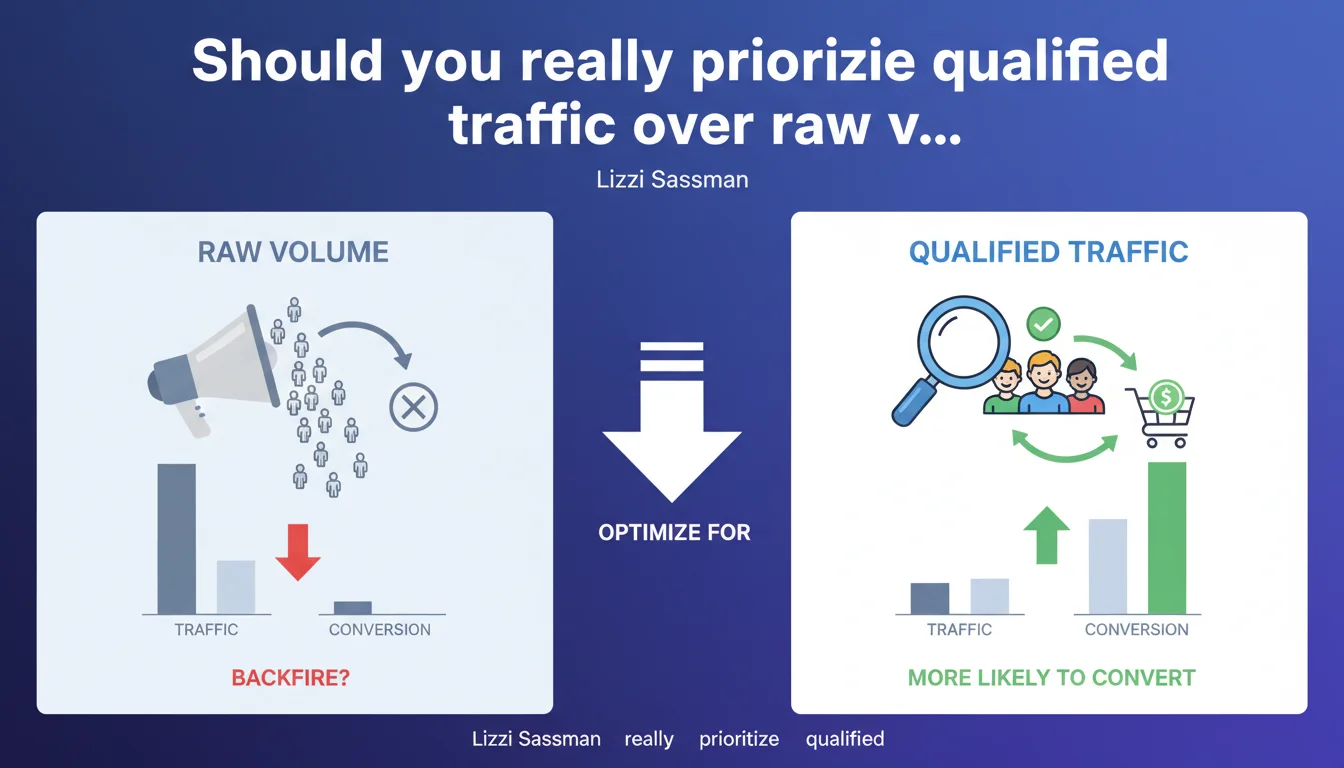
Google argues that attracting targeted visitors who match your actual audience is better than maximizing raw traffic volume. The logic: unqualified traffic generates bounce-backs, dilutes your conversion metrics, and can even hurt your site's relevance perception. The catch is defining what "qualified" actually means for your specific business.
What you need to understand
Does Google actually oppose traffic volume to quality?
Lizzi Sassman's statement introduces a dichotomy between raw volume and traffic relevance. The underlying idea: ranking first for high-volume queries that don't align with your offering generates wasted traffic. These visitors leave immediately, inflate your bounce rate, and never convert.
Google suggests that optimizing for maximum volume can be counterproductive. Concretely, this targets strategies that stack high-traffic keywords without thinking about the user's actual search intent or whether your site can truly answer it.
What counts as "qualified" traffic under this logic?
A qualified visitor matches your target audience — someone whose intent aligns with what you offer. If they want to buy and you sell, that's qualified. If they want free content and you're a premium B2B provider, it's not.
The problem: Google provides no metric to measure this "qualification". Conversion rate? Time on site? Pages per session? Nothing concrete. We're left in the dark — convenient for Google, less so for us.
Does this approach challenge traditional SEO?
Not really. It's a reminder of common sense: SEO isn't just about piling up organic traffic. The KPIs that matter are conversion rate, revenue per session, actual customer acquisition cost.
But it's also Google's way of saying: "If your traffic isn't converting, don't blame us — you're targeting wrong." A convenient argument when sites see traffic collapse without clear reason.
- Prioritize search intent over raw query volume
- Measure qualification through business metrics (conversion, average order value, engagement)
- Avoid the generic keyword trap if your offering is specialized
- Don't confuse visibility with performance — a visible site that doesn't convert is worthless
SEO Expert opinion
Is this statement actually consistent with what we observe in practice?
Yes and no. In principle, it's indisputable: targeted traffic converts better than generic traffic. But in reality, Google massively rewards volume. Sites that dominate position zero on ultra-generic queries capture the vast majority of traffic, qualified or not.
Recent algorithm updates favor large players with high domain authority, even when their content is less targeted. Result: ultra-niche, highly-qualified sites get crushed by generalist media sites that cast a wide net. [To verify]: the consistency between this messaging and the actual ranking factors.
What nuances should we add to this rule?
First, pre-qualifying traffic upstream isn't always possible. For an editorial site monetized through display ads, volume wins — even if 80% of visitors bounce after 10 seconds. For a B2B SaaS, it's the opposite: 100 qualified visitors beat 10,000 curious ones.
Second, this logic assumes you control search intent. But Google alone decides what it shows for any given query. You might target qualified traffic, yet if Google determines your page answers a broader intent too, you'll receive unqualified traffic. And you can't prevent it.
When does this logic break down?
For high-funnel informational content, volume makes sense. A company blog aiming for awareness and acquisition through educational content needs to cast a wide net. Conversion doesn't happen on the first visit — it takes multiple touchpoints.
Similarly, for marketplaces and aggregators, volume is a health indicator. Amazon isn't hunting "qualified" traffic in the strict sense: it wants traffic, period. Qualification happens after, through internal search and recommendations.
Practical impact and recommendations
What concrete steps should you take to attract qualified traffic?
Start by segmenting your keywords by intent. Distinguish informational queries (top of funnel), navigational (brand awareness), and transactional (direct conversion). Prioritize transactional if your goal is sales or lead generation.
Next, cross-reference your Analytics data with conversion data. Identify pages generating traffic but zero conversions. Either optimize the content to better qualify visitors, or repurpose those pages for different goals (awareness, internal linking).
Finally, use long-tail modifiers to target specific intents: "CRM software for small businesses" is more qualified than "CRM". You lose volume, you gain conversion rate. It's a deliberate trade-off.
What mistakes should you avoid with this approach?
Don't swing to the opposite extreme: over-restricting your targeting kills visibility. If you only target ultra-niche queries with 10 searches per month, you'll never get traffic at all. You need balance.
Another trap: confusing qualified traffic with brand traffic. If 80% of your traffic comes from brand-name queries, yes, it's qualified — but that proves nothing. These people already know you. Real qualification shows on cold, non-brand traffic.
Finally, don't blindly trust automated intent prediction tools. Google Search Console labels queries as informational or transactional, but it's crude. Analyze actual visitor behavior, not just tool labels.
How do you measure if your traffic is truly qualified?
Look at conversion rate by channel and landing page. If a page gets 1,000 visits but zero conversions, it's unqualified — unless its role is purely informational.
Track adjusted engagement rate: time spent, pages viewed, interactions (CTA clicks, downloads, form submissions). Qualified visitors don't bounce after 5 seconds.
Compare SEO customer acquisition cost vs. paid. If your Google Ads convert at 3% and organic at 0.5%, either your organic traffic is poorly qualified or your landing page is wrong. Test both hypotheses.
- Segment keywords by intent (informational, transactional, navigational)
- Cross-reference traffic and conversion data to find pages draining unqualified visitors
- Prioritize long-tail queries aligned with your offering
- Measure conversion rate per landing page, not just overall volume
- Analyze actual visitor behavior (time on site, pages viewed, interactions)
- Compare SEO vs. paid customer acquisition cost to spot qualification gaps
- Balance volume and qualification — don't sacrifice visibility entirely
❓ Frequently Asked Questions
Le trafic qualifié est-il toujours plus rentable que le volume brut ?
Comment savoir si mon trafic est qualifié ou non ?
Google pénalise-t-il les sites qui attirent du trafic non qualifié ?
Faut-il abandonner les mots-clés génériques à fort volume ?
Cette déclaration change-t-elle la stratégie SEO classique ?
🎥 From the same video 11
Other SEO insights extracted from this same Google Search Central video · published on 24/03/2022
🎥 Watch the full video on YouTube →
💬 Comments (0)
Be the first to comment.