
Official statement
Other statements from this video 11 ▾
- □ Le contenu texte reste-t-il vraiment le pilier du classement Google ?
- □ Google peut-il vraiment identifier le niveau technique de votre audience ?
- □ Les noms de domaine ont-ils vraiment perdu leur pouvoir de classement dans Google ?
- □ Faut-il vraiment éviter les mots-clés génériques en SEO ?
- □ Faut-il vraiment privilégier le trafic qualifié au volume de visiteurs ?
- □ Faut-il privilégier rel=canonical à noindex pour gérer les contenus similaires ?
- □ Les redirections 301/302 sont-elles vraiment un problème pour l'expérience utilisateur ?
- □ Faut-il sacrifier du trafic pour cibler la bonne audience ?
- □ Pourquoi les impressions et les clics ne suffisent-ils pas à mesurer le succès SEO ?
- □ La meta description est-elle vraiment inutile pour le classement Google ?
- □ Le taux de satisfaction utilisateur révèle-t-il un problème de ciblage SEO ?
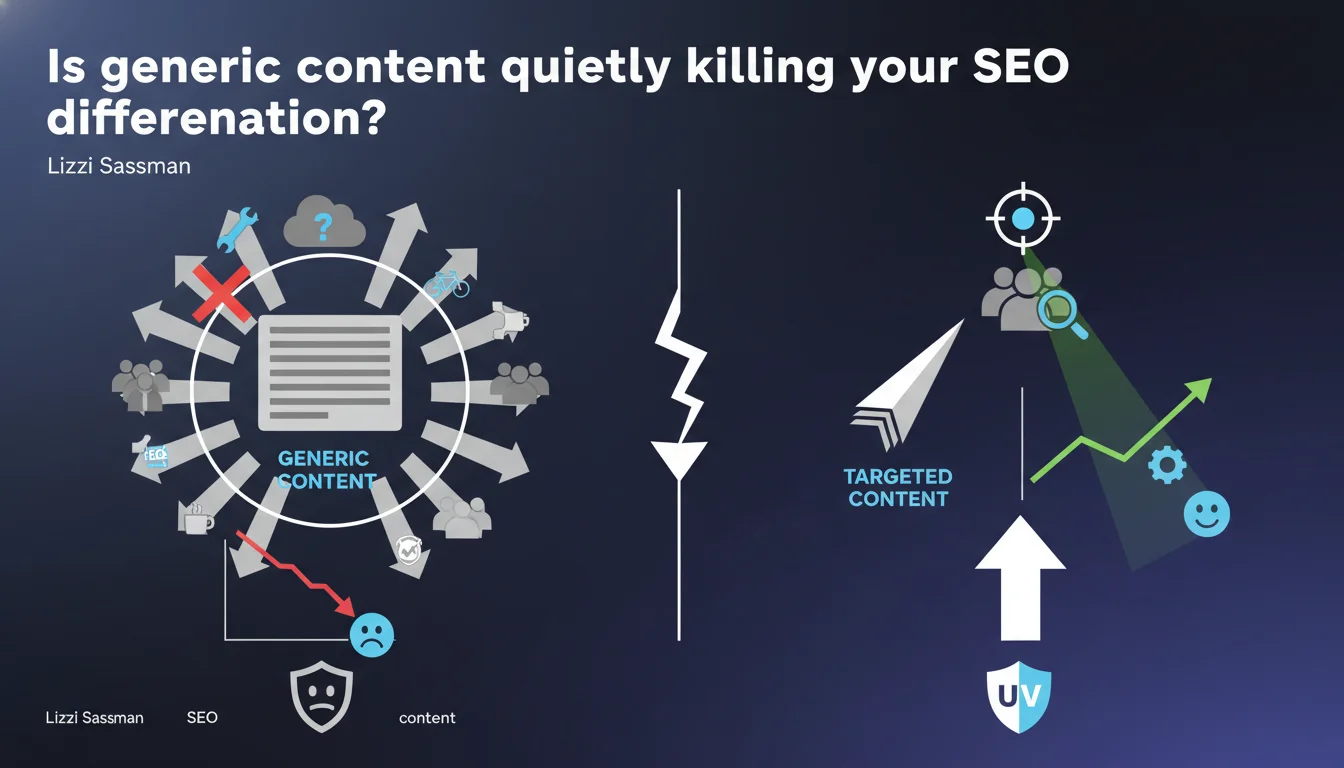
Google states that overly generic content prevents you from standing out and attracts the wrong traffic. The solution: target your audience and subject matter precisely to demonstrate unique value. Fuzzy positioning dilutes your authority and relevance in the search engine's eyes.
What you need to understand
What exactly is Google's complaint about generic content?
The statement points to a recurring problem: creating content that could apply to any website. This type of content doesn't allow algorithms to understand what distinguishes your page from thousands of others covering the same topic.
When your page lacks specificity, Google struggles to determine which precise queries it should rank for. Result: you attract unqualified traffic, with search intentions that don't match your actual offering.
How does Google evaluate a page's differentiation?
Google looks for specialization signals: depth of treatment, unique angle, concrete examples, proprietary data. Pages that merely rephrase what already exists without bringing new perspective are considered interchangeable.
The "unique value" mentioned in the statement doesn't necessarily mean revolutionizing the subject — but rather demonstrating applied expertise to a specific context, audience, or problem.
What are the concrete risks of overly generic positioning?
First risk: dilution of your thematic authority. By trying to cast a wide net, you send mixed signals about your real area of expertise.
Second risk: high bounce rate and low engagement. Visitors arrive on your page with expectations that your generic content cannot satisfy. Google observes these behavioral metrics.
- Generic content prevents Google from understanding your unique positioning
- Imprecise targeting attracts unqualified traffic with poor engagement metrics
- Differentiation comes through specialization and depth, not forced originality
- Google values signals of expertise applied to a specific context
SEO Expert opinion
Does this statement really reflect how Google currently works?
Yes, and field observations have confirmed this for several years. Sites that specialize in precise niches consistently outperform those attempting to cover broad topics superficially.
The problem: Google provides no metric to measure this "differentiation." How do you know if your content is "specific enough"? [To verify] — no official tool quantifies this criterion, you're navigating blindly.
In what cases could this rule be counterproductive?
Be careful not to confuse specificity with ultra-niche targeting. If you target too narrowly, you risk limiting your traffic potential without proportional conversion gains.
Another nuance: certain types of basic informational content (definitions, general concepts) require a relatively generic approach to serve a broad audience. The key is then to demonstrate your authority differently — through structure, examples, links to in-depth resources.
Is precise targeting really enough to avoid bad traffic?
Let's be honest: no. Editorial targeting is only part of the equation. Your title tags, meta descriptions, and even rich snippets massively influence the type of clicks you generate.
Google can easily rank your ultra-targeted page on peripheral queries if its algorithm detects broad semantic relevance. "Bad traffic" is often a problem of misalignment between your editorial intent and algorithmic interpretation.
Practical impact and recommendations
How to evaluate if your content is too generic?
Ask yourself this brutal question: if I hide my site's logo, could this page belong to any competitor? If yes, you have a differentiation problem.
Analyze your lowest-performing pages for qualified traffic. Compare them to pages ranking in positions 1-3. Identify specialization elements: proprietary numerical data, case studies, detailed methodologies, unique angles.
What concrete actions should you take to differentiate your content?
Stop creating content "for everyone." Define precise personas with specific problems, and write for them — not for an abstract audience.
Systematically integrate concrete examples, figures from your experience, screenshots, detailed processes. What truly differentiates is proof that you've applied what you describe.
- Audit your top 20 pages: list what concretely differentiates them from competition
- Define 2-3 ultra-precise personas and tailor your content to their specific challenges
- Enrich each page with at least one proprietary element: data, methodology, field experience
- Review your title tags/meta to reflect your specific angle, not a generic topic
- Analyze pages generating unqualified traffic and tighten their editorial targeting
- Create content clusters around precise sub-topics rather than isolated pages on broad subjects
How do you measure the effectiveness of this differentiation?
Monitor engagement metrics evolution (time on page, visit depth, conversions) rather than raw traffic volume. Better-targeted content attracts fewer visitors but more qualified ones.
Compare your rankings on specific long-tail queries versus generic keywords. If you're progressing on the former at the expense of the latter, that's a good sign — you're gaining thematic relevance in Google's eyes.
❓ Frequently Asked Questions
Le contenu générique est-il systématiquement pénalisé par Google ?
Comment savoir si mon trafic est « du mauvais type » ?
Faut-il réécrire tout son contenu existant pour le rendre plus spécifique ?
La différenciation passe-t-elle uniquement par le contenu textuel ?
Peut-on cibler précisément tout en conservant un volume de trafic important ?
🎥 From the same video 11
Other SEO insights extracted from this same Google Search Central video · published on 24/03/2022
🎥 Watch the full video on YouTube →
💬 Comments (0)
Be the first to comment.