
Official statement
Other statements from this video 11 ▾
- □ Le contenu texte reste-t-il vraiment le pilier du classement Google ?
- □ Google peut-il vraiment identifier le niveau technique de votre audience ?
- □ Les noms de domaine ont-ils vraiment perdu leur pouvoir de classement dans Google ?
- □ Faut-il vraiment éviter les mots-clés génériques en SEO ?
- □ Faut-il vraiment privilégier le trafic qualifié au volume de visiteurs ?
- □ Faut-il privilégier rel=canonical à noindex pour gérer les contenus similaires ?
- □ Les redirections 301/302 sont-elles vraiment un problème pour l'expérience utilisateur ?
- □ Pourquoi les impressions et les clics ne suffisent-ils pas à mesurer le succès SEO ?
- □ La meta description est-elle vraiment inutile pour le classement Google ?
- □ Pourquoi le contenu générique tue-t-il votre différenciation SEO ?
- □ Le taux de satisfaction utilisateur révèle-t-il un problème de ciblage SEO ?
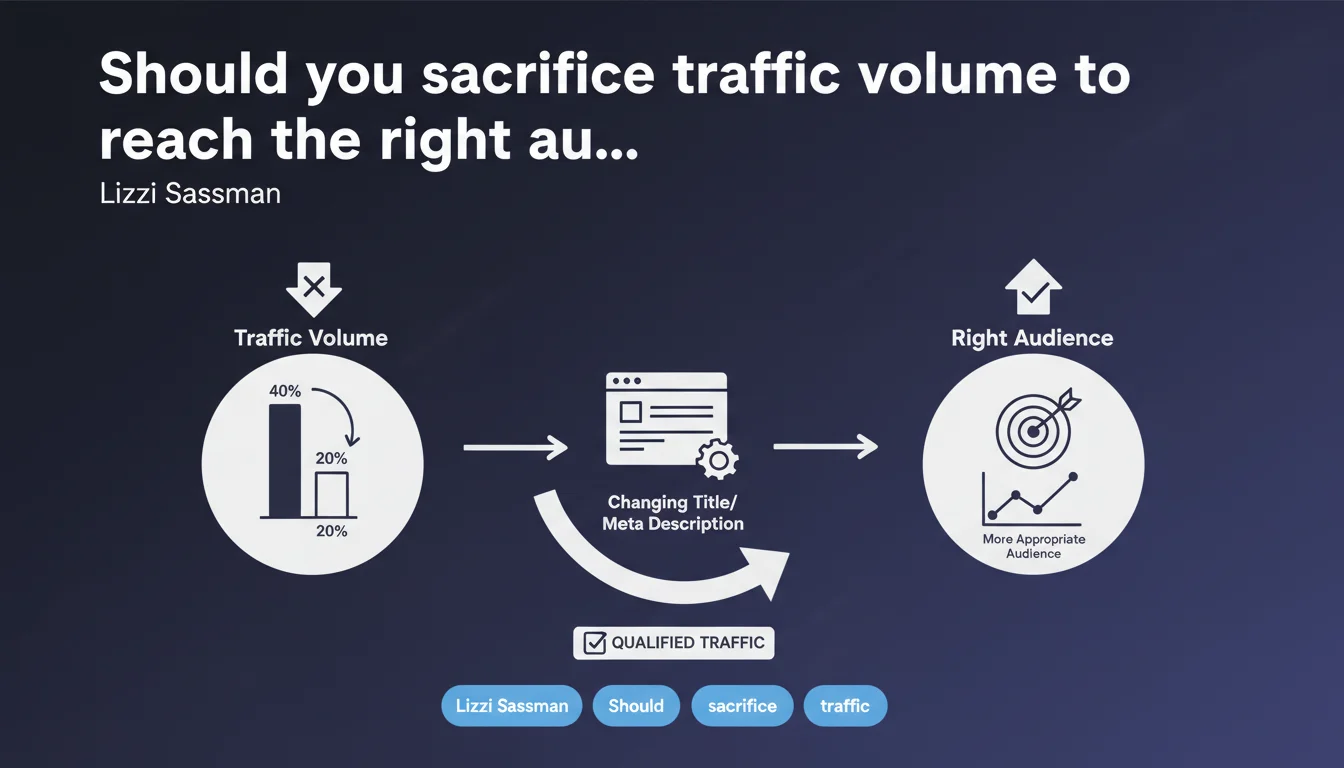
Google confirms that optimizing title and meta description for a more precise audience can cut traffic in half while improving its quality. The documented case shows organic traffic dropping from 40% to 20%, with better-qualified visitors. A strategic trade-off between volume and relevance.
What you need to understand
What's the context behind this statement?
Lizzi Sassman references a documented case where adjusting title tags and meta descriptions cut traffic in half. Far from being a failure, it's presented as a success: the site was attracting too many unqualified visitors.
This position contrasts sharply with typical SEO logic where traffic volume remains the top metric. Google is emphasizing here that audience quality trumps quantity — a principle theoretically accepted but rarely applied with such conviction.
Why can losing traffic actually be a good thing?
Irrelevant traffic damages behavioral signals: high bounce rate, low time on page, zero conversions. These metrics can hurt your rankings over time.
By tightening your targeting through title and description, you filter visitors before they click. Only those genuinely interested will engage — and that's exactly what the algorithm rewards. Fewer clicks, but clicks that matter.
Does this approach work for every website?
No, and that's the catch. A media site monetized through display advertising needs volume. Cutting traffic in half, even to improve quality, destroys its business model.
This strategy works best for high-value conversion sites: niche e-commerce, SaaS, B2B services. Where one qualified visitor is worth infinitely more than ten curious browsers.
- Title and description act as a filter before the click
- Reducing unqualified traffic improves behavioral signals
- Only relevant if your model depends on conversion quality
- Ad-dependent media sites should proceed with caution
- Google values audience relevance more than raw volume
SEO Expert opinion
Is this statement consistent with real-world practices?
In the field, we observe that overly generic titles attract broad but disengaged traffic. By tightening your wording, you lose impressions but gain qualified CTR — which can stabilize or improve your rankings.
The problem? Google provides no conversion metrics to back up this case. We know traffic dropped by half, but nothing about conversion rates, revenue generated, or even bounce rate. [To verify]: is this a real business win or just reduced traffic?
What nuances should we consider?
First point: this optimization only makes sense if you already have significant volume. Cutting 500 monthly visitors in half is self-sabotage. You need a solid base to afford this trade-off.
Second nuance: don't confuse precise targeting with over-specialization. Too restrictive a title can exclude profitable adjacent segments. The balance is delicate — and Google provides no methodology to find it.
When doesn't this rule apply?
News sites, general media, ad-funded content platforms: here, volume remains a central KPI. Voluntarily shrinking your audience means cutting off your lifeline.
Same goes for brand awareness or market expansion strategies. Sometimes broadening your audience — even at the cost of high bounce rates — serves a long-term visibility goal. It depends on your project lifecycle.
Practical impact and recommendations
What should you do concretely?
Start by auditing your existing traffic. Identify pages generating lots of visits but few conversions or engagement. These are your top candidates for tighter targeting.
Then test more specific title and description variations. Add qualifying terms: "for beginners," "B2B solution," "premium pricing." Compare metrics over at least 4 to 6 weeks — SEO doesn't react in 48 hours.
What mistakes should you avoid?
Don't sacrifice traffic on principle. This approach only makes sense if you have data proving your current audience doesn't convert. Without solid analytics, you're flying blind.
Also avoid over-optimizing all your pages at once. Work through iterations: test on one segment, measure impact, adjust. Across-the-board traffic drops without measured gains are a disaster, not a strategy.
How do you measure success with this optimization?
Conversion rate is your north star. If you lose 50% of traffic but double your transformation rate, you win. If the rate stays flat, you're losing revenue.
Also monitor time on page, bounce rate, and pages per session. Improved behavioral signals mean you're attracting the right audience — even in smaller numbers.
- Audit high-traffic pages with low engagement or conversion
- Test more specific and qualifying titles and descriptions
- Measure impact over a minimum period of 4 to 6 weeks
- Compare conversion rates before/after, not just volume
- Work through iterations — never change everything at once
- Verify that traffic loss is offset by measurable quality gains
- Exclude this strategy for volume-dependent ad models
❓ Frequently Asked Questions
Dois-je vraiment accepter de perdre du trafic pour mieux cibler ?
Comment savoir si mon trafic actuel est non qualifié ?
Sur quelles pages appliquer cette stratégie en priorité ?
Combien de temps faut-il attendre pour mesurer l'effet ?
Google peut-il réécrire mon titre même si je l'optimise pour cibler ?
🎥 From the same video 11
Other SEO insights extracted from this same Google Search Central video · published on 24/03/2022
🎥 Watch the full video on YouTube →
💬 Comments (0)
Be the first to comment.