
Official statement
Other statements from this video 11 ▾
- □ Le contenu texte reste-t-il vraiment le pilier du classement Google ?
- □ Google peut-il vraiment identifier le niveau technique de votre audience ?
- □ Les noms de domaine ont-ils vraiment perdu leur pouvoir de classement dans Google ?
- □ Faut-il vraiment éviter les mots-clés génériques en SEO ?
- □ Faut-il vraiment privilégier le trafic qualifié au volume de visiteurs ?
- □ Faut-il privilégier rel=canonical à noindex pour gérer les contenus similaires ?
- □ Faut-il sacrifier du trafic pour cibler la bonne audience ?
- □ Pourquoi les impressions et les clics ne suffisent-ils pas à mesurer le succès SEO ?
- □ La meta description est-elle vraiment inutile pour le classement Google ?
- □ Pourquoi le contenu générique tue-t-il votre différenciation SEO ?
- □ Le taux de satisfaction utilisateur révèle-t-il un problème de ciblage SEO ?
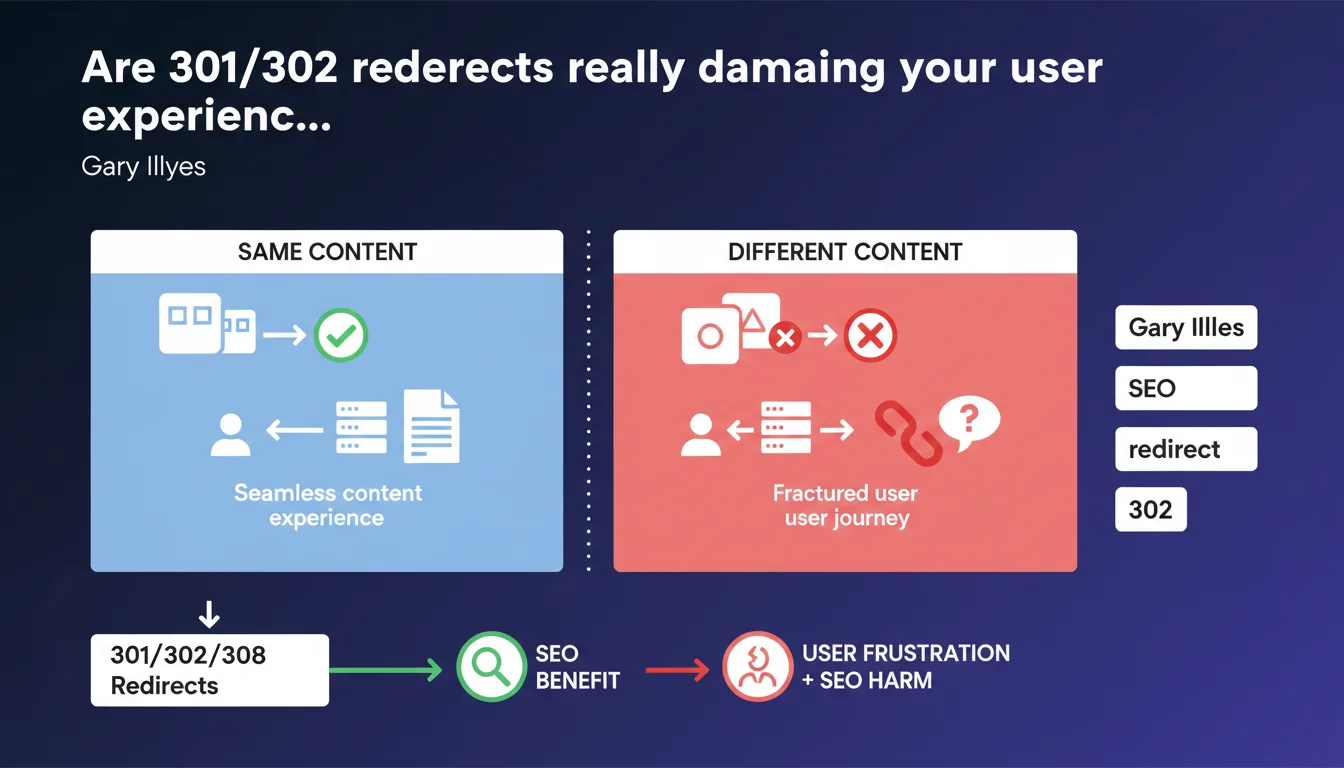
Gary Illyes reminds us that a 301, 302, or 308 redirect blocks user access to the original content. This practice is only legitimate if both pages display strictly identical content — not merely similar or complementary. A warning against misusing redirects to consolidate distinct content pieces.
What you need to understand
Why does Google insist on the distinction between identical and related content?
The core of this statement rests on a simple principle: a permanent or temporary redirect eliminates any possibility for users to consult the original URL. If the content is not strictly equivalent, you deprive the user of potentially useful information.
Google makes a distinction here between identical content (same message, same angle, same added value) and related but different content (two complementary articles on a similar topic, for example). In the latter case, a redirect has no justification.
What are the concrete situations where this rule applies?
Typically, 301/302/308 redirects are appropriate during a site migration, a URL change for technical reasons, or consolidating duplicate pages. If you have two URLs displaying the exact same text, the redirect is justified.
Conversely, if you published an article in 2020 on topic X, then another in 2023 on the same subject but from a different angle, redirecting the old one to the new removes potentially relevant content. The user — and Google — loses a distinct viewpoint.
- Legitimate redirects: strictly identical content, URL migration, technical duplication fixes
- Abusive redirects: consolidating complementary content, merging similar but non-identical pages
- Main risk: impoverishing your editorial offering by hiding unique content under the guise of simplification
Does Google penalize misuse of redirects?
The statement mentions no explicit penalty. However, the impact on user experience is clear: less accessible content, less diversity. This can indirectly affect behavioral signals and the site's qualitative perception.
Another consequence: if you systematically redirect distinct pages to a single one, you artificially reduce your ranking surface. Multiple URLs ranked on query variants become one — potentially less effective.
SEO Expert opinion
Is this rule really enforced on the ground by Google?
Let's be honest: we regularly observe sites that massively consolidate similar content via 301 without visible penalties. Google doesn't seem to systematically detect whether two pieces of content are "truly identical" or just close.
The search engine relies on duplication signals, editorial quality, user behavior. If a redirect improves metrics (bounce rate, time on page), it will probably be tolerated — even valued. [To verify]: no official data confirms an automated system for detecting "abusive" redirects.
In what cases does this guideline become counterproductive?
Imagine a news site with two articles on the same event: one published on day one, another two weeks later with a comprehensive summary. Redirecting the first to the second removes an editorial timeframe that may interest some users seeking an immediate reaction.
Similarly, on an e-commerce site, redirecting a discontinued product page to a similar but different model can frustrate customers seeking the original reference. It's often better to display an explicit message with alternative product suggestions than a brutal redirect.
Should you really avoid all redirects between related content?
Gary Illyes's position is clear, but it remains theoretical. In practice, many sites optimize their architecture by consolidating weakly differentiated pages to strengthen the authority of a main URL.
If you have three mediocre articles that don't rank, merging them into robust content and redirecting the old ones can boost your performance. The risk: losing specific backlinks or long-tail rankings. Everything depends on context.
Practical impact and recommendations
What should you concretely do before redirecting a page?
First rule: analyze the search intent of both URLs. If they target different queries or distinct angles, the redirect is inappropriate. Use Google Search Console to verify which queries are ranked on each page.
Next, compare the actual content. Same topic doesn't mean identical content. If one is a step-by-step tutorial and the other a FAQ, you have two complementary formats — not duplicates.
What common mistakes should you absolutely avoid?
The most frequent: redirecting multiple old URLs to a single "hub" page meant to replace them all. If these URLs had specific backlinks and rankings on query variants, you sabotage your semantic structure.
Another trap: systematically redirecting old article versions to the updated version. If the first version contained historical data or dated testimonials, you lose a valuable documentary resource.
- Verify that both pieces of content answer the same search intent (tools: GSC, SERP analysis)
- Compare content line-by-line — don't settle for title or general topic
- Analyze backlinks pointing to the original URL: are they contextualized to this specific content?
- Measure organic traffic on the source page over the past 12 months — a ghost URL can be redirected, an active URL deserves consideration
- Prefer an explicit message + alternative content suggestions if pages are complementary
How can you audit existing redirects to detect issues?
Export all your 301/302/308 redirects from your logs file or favorite crawl tool. Cross-reference with Search Console data to identify redirected URLs that continue to receive impressions — a sign they had legitimate value.
Next, manually sample about ten redirects: consult the original URL via archive.org, compare with the current destination. If you notice significant differences, consider restoring the original content with an update, rather than maintaining a questionable redirect.
❓ Frequently Asked Questions
Une redirection 302 a-t-elle le même impact qu'une 301 selon cette règle ?
Si deux pages sont similaires à 90%, peut-on rediriger ?
Faut-il supprimer toutes les 301 entre contenus liés ?
Google détecte-t-il automatiquement si une redirection est abusive ?
Que faire si j'ai déjà redirigé des contenus complémentaires ?
🎥 From the same video 11
Other SEO insights extracted from this same Google Search Central video · published on 24/03/2022
🎥 Watch the full video on YouTube →
💬 Comments (0)
Be the first to comment.