
Official statement
Other statements from this video 11 ▾
- □ Le contenu texte reste-t-il vraiment le pilier du classement Google ?
- □ Google peut-il vraiment identifier le niveau technique de votre audience ?
- □ Les noms de domaine ont-ils vraiment perdu leur pouvoir de classement dans Google ?
- □ Faut-il vraiment éviter les mots-clés génériques en SEO ?
- □ Faut-il vraiment privilégier le trafic qualifié au volume de visiteurs ?
- □ Les redirections 301/302 sont-elles vraiment un problème pour l'expérience utilisateur ?
- □ Faut-il sacrifier du trafic pour cibler la bonne audience ?
- □ Pourquoi les impressions et les clics ne suffisent-ils pas à mesurer le succès SEO ?
- □ La meta description est-elle vraiment inutile pour le classement Google ?
- □ Pourquoi le contenu générique tue-t-il votre différenciation SEO ?
- □ Le taux de satisfaction utilisateur révèle-t-il un problème de ciblage SEO ?
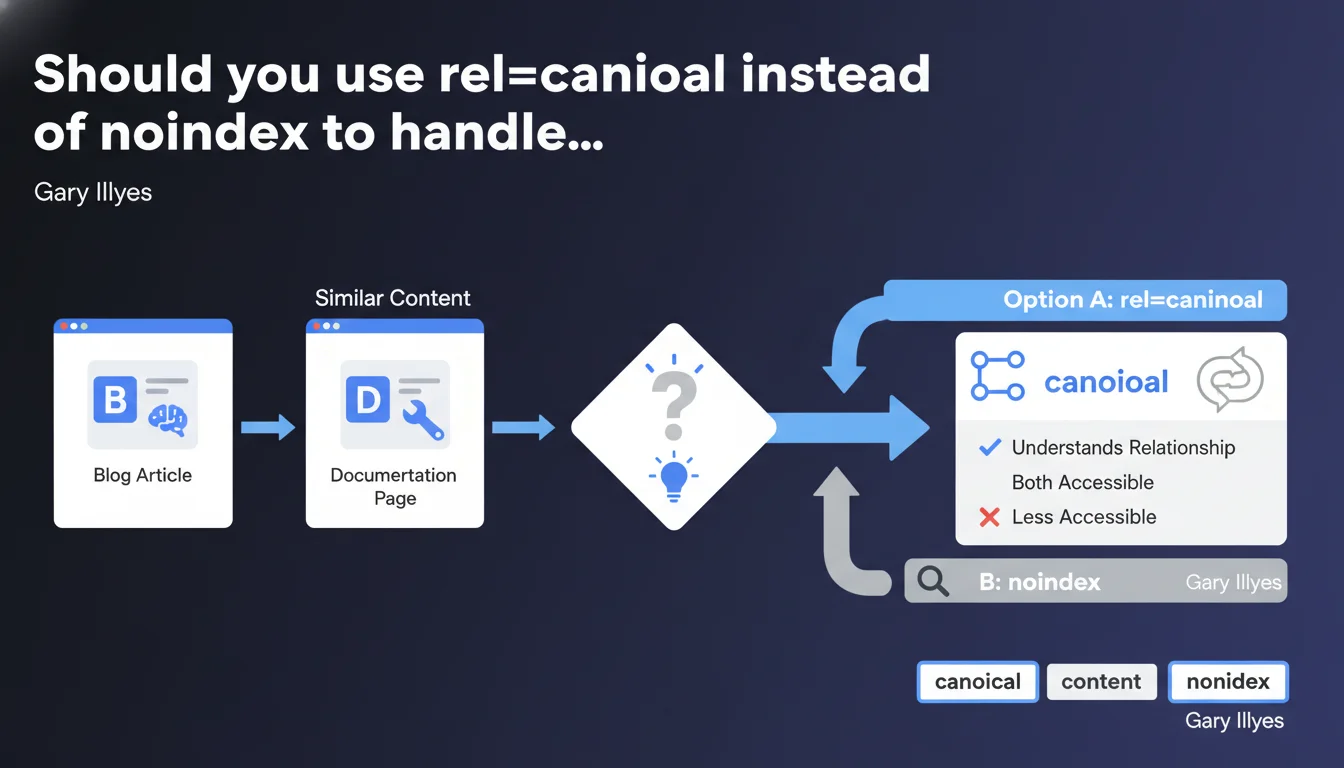
Google recommends using the canonical tag rather than noindex when two pages cover the same subject from different angles. The goal: preserve user accessibility while avoiding cannibalization in search results. This approach allows Google to understand the hierarchy between content without depriving visitors of potentially useful information.
What you need to understand
Why does Google prefer canonical over noindex in this case?
The fundamental difference comes down to user intent. A page marked noindex disappears completely from results, even though it remains accessible via direct navigation. A canonical, on the other hand, signals to Google which version to prioritize while keeping both pages in your site architecture.
Concretely — imagine a simplified blog article about a tool and technical documentation on that same tool. Both serve different audiences, but address the same core subject. With noindex, you lose an opportunity to answer two distinct search intents. With canonical, you centralize SEO juice on the reference page without sacrificing user experience.
What's the logic behind Google's recommendation?
Google prioritizes semantic consistency and the ability to serve the right content to the right searcher. If you systematically noindex variants, you impoverish your semantic coverage — and potentially your ability to rank for related queries.
The canonical allows Google to understand the relationship between content without treating them as pure duplicates. It's an explicit signal: "These two pages exist for good reasons, but here's the one you should prioritize in the SERPs."
In what contexts does this directive really apply?
Gary Illyes talks about content that is "closely related", not strict duplicates. A blog article + a technical documentation page, a how-to guide + an in-depth FAQ, a product sheet + a comparison that includes that product — these are typical use cases.
On the other hand, if you have two strictly identical pages (example: URLs with/without tracking parameters), the canonical remains the reference tool. But that's not the scenario targeted here. This is about legitimate variants that deserve to exist for the user, without cannibalizing your SEO.
- Canonical preserves accessibility of both pieces of content for users
- It centralizes PageRank and SEO signals on the reference page
- It prevents cannibalization in search results
- It helps Google better understand the semantic structure of your site
- Noindex, meanwhile, removes the page entirely from the index — a complete loss of traffic opportunities
SEO Expert opinion
Is this recommendation consistent with real-world observations?
Yes, and it's even a welcome confirmation. We've observed for years that sites that aggressively noindex their content variants lose ground to those who intelligently structure with canonicals. The nuance here is that Google is finally making explicit what was previously a matter of intuition or empirical testing.
Be careful though — the canonical is not a magic pass. If your two pages are too similar or if you abuse the process, Google may decide to ignore your signal. [To be verified]: Google doesn't specify at what point the similarity threshold makes the canonical counterproductive. Experience shows that below 30-40% unique content, results become unpredictable.
What interpretation errors should you avoid?
First mistake: thinking this directive allows you to freely duplicate content by sprinkling canonicals. No. Each page must have its own user value — different angle, distinct level of detail, format adapted to a specific context.
Second mistake: generalizing this logic to all duplicates. If you have paginated pages, filter variants or URLs without added value, noindex is sometimes still more relevant. The canonical works when there's distinct editorial intent, not when it's technical pollution.
In what cases should you still prefer noindex?
When the page has no autonomous user value. Examples: thank you pages post-form submission, intermediate conversion funnel pages, temporary archives, obsolete content you keep for legacy reasons but which adds nothing for the average visitor.
Another edge case: ultra-similar mass-generated content (cloned city pages, automatic filter pages without real differentiation). There, even with canonical, you risk diluting your signals. Sometimes it's better to noindex and concentrate crawl budget on strategic pages.
Practical impact and recommendations
What should you do concretely on your existing content?
Start by auditing your noindexed pages. For each one, ask yourself: does this page provide distinct value to a user segment? If yes, it probably deserves to switch to canonical rather than noindex.
Next, identify your content clusters — those groups of pages revolving around the same central topic. Determine the pillar page (the one with the best ranking potential or most comprehensive content) and point variants to it via rel=canonical.
How to structure the canonical relationship between similar content?
Technically, it's simple: add <link rel="canonical" href="REFERENCE_PAGE_URL" /> to the <head> of the secondary page. But the real challenge is choosing the right reference page.
Decision criteria: volume of existing backlinks, organic traffic potential, content comprehensiveness, page age. When in doubt, prioritize the one that converts best — that's still the ultimate goal.
- Extract all pages currently with noindex tag
- Filter those with residual organic traffic or backlinks
- Evaluate whether each page addresses a distinct user intent
- Identify the pillar page for each thematic cluster
- Implement canonicals pointing to the reference page
- Remove noindex from pages becoming canonical
- Monitor impressions and rankings in Search Console over 4-6 weeks
- Verify that Google respects your canonicals (Coverage report > Excluded > Duplicates)
What technical errors should you avoid during implementation?
Never create canonical chains (page A → page B → page C). Google can ignore them or interpret them unpredictably. All variants should point directly to the reference page.
Also avoid cross-domain canonicals except in very specific cases (content syndicators for example). And above all, never point a canonical to a noindexed, 404 or redirected page — that will send contradictory signals to Google.
In summary: Gary Illyes' directive values editorial intelligence over technical censorship. Rather than hiding your content variants, structure them with canonicals to serve different user intents without cannibalizing your SEO.
However, this type of architectural optimization requires comprehensive vision of your content strategy and detailed analysis of semantic clusters. If you manage a site with hundreds of potentially affected pages, working with a specialized SEO agency can save you precious time — and especially help you avoid manipulation errors that would take months to correct.
❓ Frequently Asked Questions
Peut-on utiliser canonical ET noindex sur la même page ?
Comment vérifier que Google respecte mes canonicals ?
Faut-il canonical une page produit vers une catégorie si elles parlent du même sujet ?
Combien de temps faut-il à Google pour prendre en compte un changement de canonical ?
Une page avec canonical reçoit-elle encore du PageRank via ses backlinks ?
🎥 From the same video 11
Other SEO insights extracted from this same Google Search Central video · published on 24/03/2022
🎥 Watch the full video on YouTube →
💬 Comments (0)
Be the first to comment.