
Official statement
Other statements from this video 11 ▾
- □ Is text content really still the cornerstone of Google rankings?
- □ Can Google really identify the technical expertise level of your audience?
- □ Have Domain Names Really Lost Their Ranking Power in Google's Eyes?
- □ Should you really avoid generic keywords in SEO?
- □ Should you really prioritize qualified traffic over raw visitor volume?
- □ Should you use rel=canonical instead of noindex to handle similar content?
- □ Are 301/302 redirects really damaging your user experience and SEO?
- □ Should you sacrifice traffic volume to reach the right audience?
- □ Does meta description really matter for your Google rankings?
- □ Is generic content quietly killing your SEO differentiation?
- □ Does user satisfaction rate actually reveal a hidden SEO targeting issue?
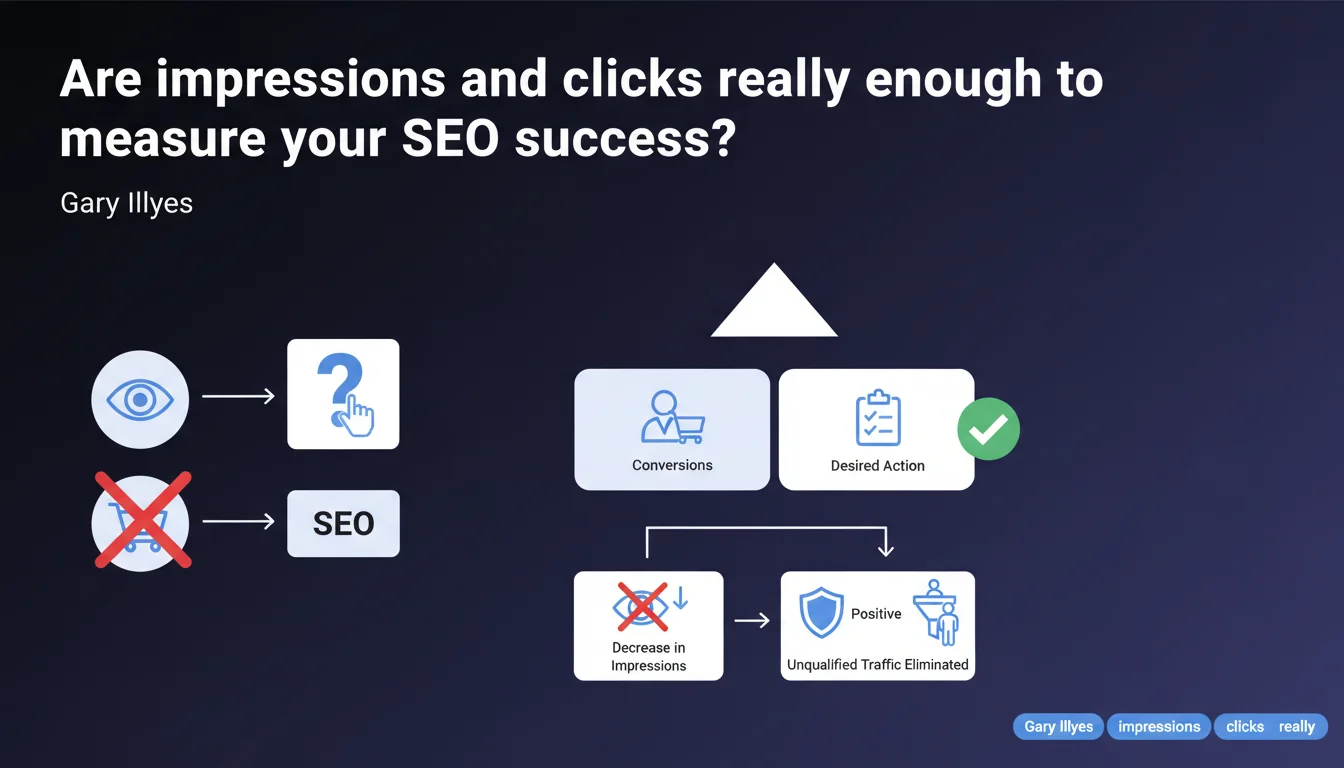
Gary Illyes reminds us that impressions and clicks are just surface-level metrics. What truly matters is conversion and achieving user objectives. A drop in impressions can actually be beneficial if it filters out unqualified traffic.
What you need to understand
Why is Google questioning the traditional metrics of impressions and clicks?
Impressions and clicks are vanity metrics: they flatter the ego but don't reflect business impact. Google Search Console displays this data as a priority, which pushes SEO professionals to monitor them obsessively.
The problem? A website can generate millions of impressions on off-topic queries and get clicks that bounce within 2 seconds. Result: lots of noise, zero signal.
What can a drop in impressions reveal that's actually positive?
Illyes suggests that a decrease in impressions is not necessarily a failure. If this drop coincides with an improvement in conversion rate or engagement, it means your site is now appearing on better-targeted queries.
Concretely? Less visibility on generic informational queries, more presence on qualified transactional queries. That's a winning trade-off.
How do you know if traffic is actually "converting"?
Google doesn't precisely define what "converting" means. For an e-commerce site, it's a sale. For a media outlet, it might be time spent on page or number of pages viewed. For a SaaS, it's a signup.
The core idea: align your SEO KPIs with your business objectives. If your SEO strategy generates traffic that serves no strategic purpose, it's ineffective — regardless of the impressions.
- Impressions and clicks only measure visibility, not impact.
- A drop in impressions can signal improved targeting on qualified queries.
- Conversion and accomplishment of user actions should become your primary metrics.
- Each website has its own definition of "conversion" based on its objectives.
SEO Expert opinion
Is this statement consistent with what we observe in the field?
Yes and no. Experienced SEO professionals have known for a long time that impressions don't pay the bills. But Google Search Console puts these metrics front and center, creating a cognitive dissonance.
In reality, many clients still judge SEO success by GSC curves. A marketing manager watches impressions climb and approves the budget. A drop, even if virtuous, triggers alarms.
What nuances should be added to this recommendation?
Illyes is right in principle, but he overlooks one detail: impressions are an early indicator of visibility. A sudden drop can signal a technical problem (deindexation, penalty) before traffic even crashes.
Completely ignoring impressions means losing a detection radar. The smart approach? Monitor impressions to spot anomalies, but measure success on conversion.
Another nuance: some informational content never converts directly, but it feeds brand awareness and the user journey. A blog article doesn't generate immediate sales, but it can influence a purchase decision three months later. How do you measure that?
In what contexts does this rule not apply directly?
For ad-supported media sites, impressions remain an acceptable proxy for revenue — as long as RPM stays stable. A drop in impressions = drop in revenue, even if "qualified traffic" increases.
For niche sites with limited search volume, a drop in impressions might simply mean you've hit the market ceiling. Don't expect magical conversion gains.
Practical impact and recommendations
What exactly should you do to measure SEO success beyond impressions?
First, define what conversion means for your site. Not a generic Google Analytics conversion — an action that has business value. Then configure tracking to isolate organic traffic that converts.
In GA4, create custom segments: organic traffic + conversion event. Observe which queries trigger these conversions (via GSC cross-referenced with GA4). Focus your SEO efforts on these semantic clusters.
What mistakes should you avoid when analyzing SEO performance?
Never compare raw impressions between two periods without context. Seasonal fluctuations, algorithm updates, and changes in user behavior skew everything.
Avoid judging a page solely on its CTR in GSC. A low CTR can be normal if the page ranks in positions 8-10. What matters is the conversion rate of the traffic it receives, not the percentage of clicks on impressions.
- Identify your actual business objectives (sale, lead, signup, download, etc.)
- Set up conversion tracking in GA4 or your analytics tool
- Create custom segments to isolate organic traffic that converts
- Cross-reference GSC and Analytics to identify qualified queries
- Monitor impressions as an alert indicator, but measure success on conversion
- Analyze the complete user journey, not just the last interaction
- Accept that a drop in impressions can be positive if it improves traffic quality
❓ Frequently Asked Questions
Faut-il complètement ignorer les impressions dans Google Search Console ?
Comment identifier le trafic organique qui convertit réellement ?
Une baisse d'impressions est-elle toujours positive si les conversions augmentent ?
Quel délai pour voir l'impact d'une optimisation sur les conversions plutôt que sur les impressions ?
Comment convaincre un client que la baisse d'impressions n'est pas un problème ?
🎥 From the same video 11
Other SEO insights extracted from this same Google Search Central video · published on 24/03/2022
🎥 Watch the full video on YouTube →
💬 Comments (0)
Be the first to comment.