
Official statement
Other statements from this video 11 ▾
- □ Le contenu texte reste-t-il vraiment le pilier du classement Google ?
- □ Google peut-il vraiment identifier le niveau technique de votre audience ?
- □ Faut-il vraiment éviter les mots-clés génériques en SEO ?
- □ Faut-il vraiment privilégier le trafic qualifié au volume de visiteurs ?
- □ Faut-il privilégier rel=canonical à noindex pour gérer les contenus similaires ?
- □ Les redirections 301/302 sont-elles vraiment un problème pour l'expérience utilisateur ?
- □ Faut-il sacrifier du trafic pour cibler la bonne audience ?
- □ Pourquoi les impressions et les clics ne suffisent-ils pas à mesurer le succès SEO ?
- □ La meta description est-elle vraiment inutile pour le classement Google ?
- □ Pourquoi le contenu générique tue-t-il votre différenciation SEO ?
- □ Le taux de satisfaction utilisateur révèle-t-il un problème de ciblage SEO ?
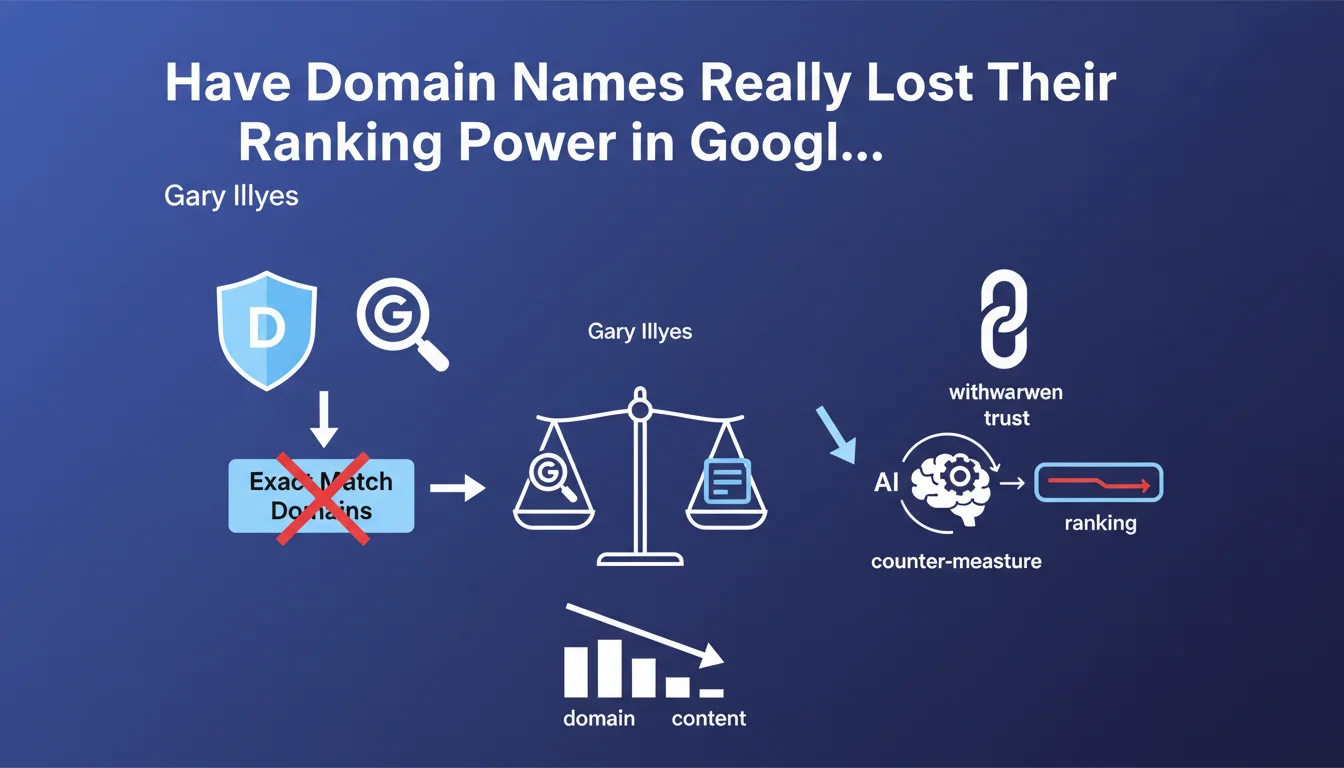
Google has reduced the impact of keywords present in domain names on rankings, particularly since the Exact Match Domain (EMD) adjustment. Domains containing search terms no longer benefit from the automatic boost they once provided. This evolution aims to counter SEO exploitation practices based solely on strategic domain name selection.
What you need to understand
What exactly is the Exact Match Domain adjustment?
Exact Match Domains (EMD) refer to domain names containing precisely the targeted keywords — think auto-insurance-cheap.com or plumber-paris-15.uk. For years, owning such a domain gave a significant ranking advantage, almost mechanical in nature.
Google has progressively deployed a specific algorithm to neutralize this advantage, believing it rewarded domain name purchases more than actual content quality. The objective? Rebalance competition in favor of sites offering genuine added value rather than simple name-query alignment.
Why did Google reduce the trust given to domain names?
The answer comes down to one word: manipulation. EMDs had become a vector for large-scale abuse. Thousands of low-quality sites were created solely to exploit this relevance signal.
By reducing the weight of keywords in the domain, Google forces webmasters to build real authority through content, backlinks, and user experience. Trust can no longer be bought with a domain name — it must be earned.
Does this loss of trust affect all domains equally?
No. The adjustment primarily targets low-quality domains that relied only on their name. If your EMD offers solid content, strong authority signals, and flawless user experience, the impact will be marginal.
Established brand domains — even if they contain keywords — are generally not penalized. Amazon.co.uk contains "amazon," but it's the brand that carries the authority, not the keyword.
- Low-quality EMDs have lost most of their ranking advantage
- Branded domains with authority do not experience systematic demotion
- Weight is transferred to qualitative signals: content, backlinks, UX
- The adjustment aims to neutralize mechanical exploitation of domain names
- Owning an EMD is no longer a viable standalone SEO strategy
SEO Expert opinion
Does this statement match what we observe in the field?
Yes, and the data confirms it. Since the progressive rollout of the EMD algorithm, we see a diversification of search results. SERPs are no longer dominated by low-quality keyword-stuffed domains.
That said — and this is crucial — owning an EMD is not a handicap either. The signal has become neutral rather than negative. If your overall strategy is solid, the domain name won't penalize you. It simply won't carry you anymore.
What nuances should be added to this statement?
Gary Illyes speaks of "reduced trust," but it remains vague. In concrete terms? Google doesn't specify whether this signal is at zero or simply diluted among others. [To verify] on actual cases with comparative ranking data.
Another point: this statement doesn't clarify whether the adjustment applies uniformly across all sectors. In certain local or highly specific niches, EMDs seem to retain a slight advantage — probably because other signals (backlinks, brand authority) are weak for all players.
In what cases does this rule not fully apply?
Established brands largely escape this adjustment. Booking.com contains "booking," but no one considers it a manipulative EMD. Brand authority overshadows the keyword signal.
Similarly, in sectors with low competition or ultra-specific searches, an EMD can still benefit from slight residual boost — not because Google favors it, but because alternatives lack differentiating signals.
Practical impact and recommendations
Should you avoid EMDs when choosing a new domain?
Not necessarily. The EMD is neither an advantage nor a disadvantage — it has become a neutral choice from an SEO perspective. The real question: does your domain build a memorable brand identity?
If "auto-insurance-paris.com" seems generic and interchangeable, you'll struggle to build authority and recognition. However, if this name aligns with a genuine local content strategy, it can work — as long as you don't count solely on the domain to rank you.
What should you do if you already own an underperforming EMD?
Let's be honest: changing domains is risky. You lose history, existing backlinks (even if weakened), and introduce migration risk. Before migrating, ask yourself: is my site underperforming because of the domain, or because of content/authority?
If your EMD already has some authority and backlinks, invest instead in improving content, acquiring quality links, and optimizing user experience. The ROI will be better than a hasty migration.
What mistakes should you absolutely avoid?
Don't create a new site simply because you found an available EMD. Those days are gone. Build a content strategy, a value proposition, an identity first — the domain comes after.
Another trap: over-optimizing anchor text in backlinks to compensate for the domain boost loss. Google watches this closely, and you risk an over-optimized anchor penalty.
- Prioritize a brandable and memorable domain name over a generic EMD
- If you already own an EMD, focus on content and authority rather than migration
- Never rely on domain name alone as your sole ranking lever
- Avoid over-optimized anchors in your backlinks to compensate
- Invest in qualitative signals: expertise, content depth, UX
- Measure your domain's real authority via third-party metrics (DR, DA) before any decision
❓ Frequently Asked Questions
Un EMD peut-il encore bien se classer dans Google ?
Dois-je changer de nom de domaine si j'ai un EMD ?
Les domaines brandés sont-ils favorisés par Google ?
L'ajustement EMD affecte-t-il aussi les sous-domaines et sous-répertoires ?
Existe-t-il encore des secteurs où les EMD conservent un avantage ?
🎥 From the same video 11
Other SEO insights extracted from this same Google Search Central video · published on 24/03/2022
🎥 Watch the full video on YouTube →
💬 Comments (0)
Be the first to comment.