
Official statement
Other statements from this video 11 ▾
- □ What's the point of perfect structured data if Google can't actually crawl your pages?
- □ Why does Google rely on Schema.org as its primary language for understanding your content?
- □ Should you really multiply structured data on your pages to please Google?
- □ Why does Google recommend JSON-LD over Microdata or RDFa for structured data implementation?
- □ Should you really rely on CMS plugins to handle your structured data automatically?
- □ Is the Rich Results Test really enough to validate your structured data?
- □ Does Google Search Console really alert you to every structured data problem?
- □ Can structured data errors actually hurt your search rankings?
- □ Can off-topic structured data really penalize your website?
- □ Why are unique identifiers crucial for disambiguation in Google's algorithm?
- □ Can conflicting structured data really kill your rich snippets?
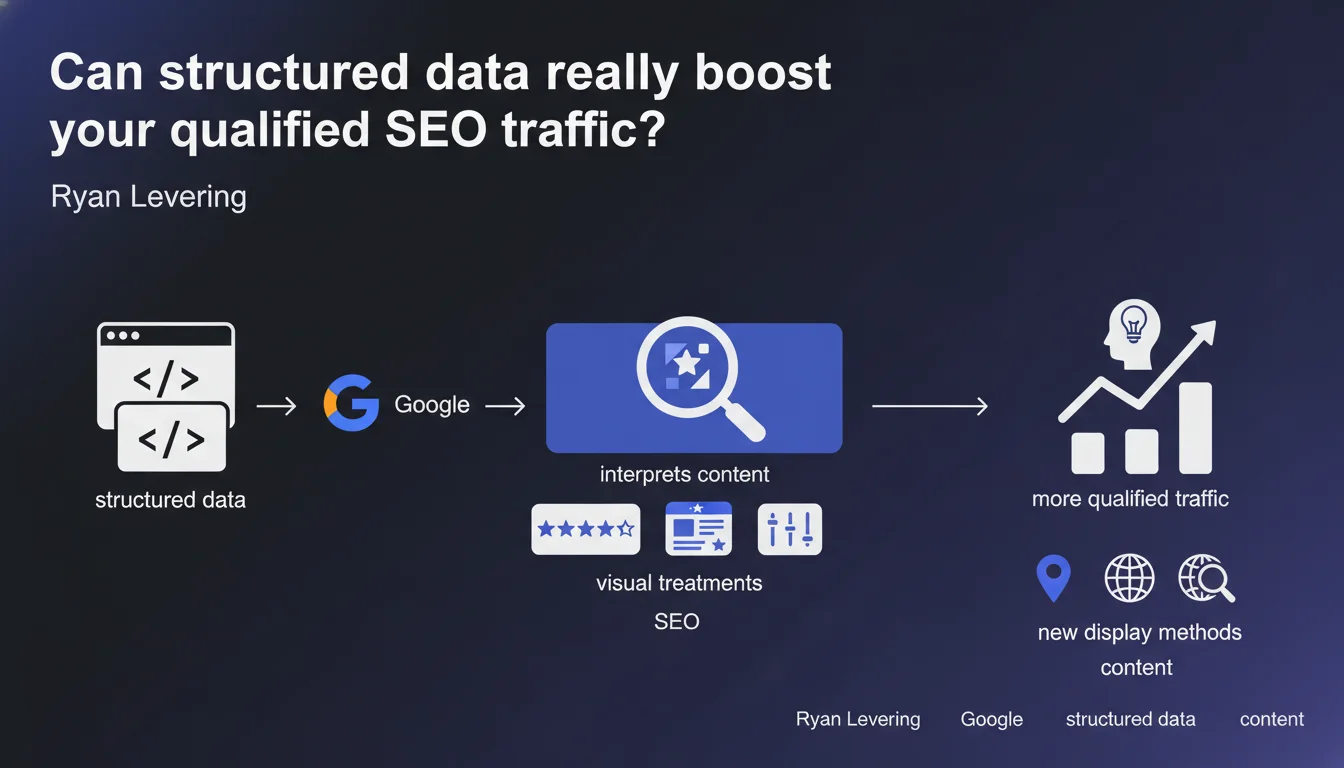
Google claims that structured data enables enriched visual treatments (review stars, filters) in the SERPs, which would increase qualified traffic. The mechanism: by structuring your data, you help Google better interpret your content and display it in new ways to more users.
What you need to understand
What exactly does "enriched visual treatment" mean?
Google is talking about rich snippets and other featured snippets here: rating stars, product prices, availability, breadcrumbs, accordion FAQs, recipes with cooking times, and so on. These visual elements make your result more attractive and take up more space in the SERP.
The underlying idea is straightforward: an enriched result catches attention better, improves CTR, and can even qualify traffic upstream — a user who sees 4.8 stars and "In stock" immediately understands whether they should click or not.
Why does Google emphasize "more precise" content interpretation?
Without structured data, Google has to guess what certain elements on your page mean. Schema.org gives it an explicit framework: "This is a product, here's its price, here's its average rating."
This clarification allows Google to make fewer mistakes — and most importantly, to trigger advanced features it cannot activate on unstructured plain text. This is especially true for queries with commercial or specific informational intent.
Which types of sites benefit most from these enriched treatments?
- E-commerce: product rich snippets (price, availability, reviews)
- Recipes and food content: prep time, calories, rating
- Local events: dates, locations, ticketing
- Press articles: AMP stories, top stories carousel
- FAQs and guides: FAQ accordions directly in the SERP
- Reviews and local services: stars, opening hours, geolocation
SEO Expert opinion
Is this statement consistent with what we observe in practice?
Yes — and it's rare to be able to say that without reservations. A/B tests consistently show CTR gains on enriched results, often between 10% and 30% depending on the sector. The qualified traffic gain is real, especially in e-commerce.
But be careful: implementing Schema.org doesn't automatically guarantee the display of a rich snippet. Google remains the master of triggering, and certain types of structured data are ignored if the content doesn't comply with its Quality Guidelines.
What nuances does Google omit from this statement?
First omission: structured data is not a direct ranking factor. It improves visibility and CTR, but doesn't push a page higher in organic results. It's an amplifier, not a raw positioning lever.
Second point: not all rich snippets are equal. [To verify]: Google never communicates precise figures on impact by snippet type, and some (like breadcrumbs) have minimal visual impact compared to review stars.
In what cases do structured data bring nothing?
If your sector doesn't benefit from specific rich snippets (technical B2B, very niche areas), the visual impact will be zero. Similarly, if you're already in position zero with a textual featured snippet, adding Schema.org may change nothing in the short term.
Another limitation: on mobile, SERP space is saturated with Google Ads and Google Shopping blocks. Even with impeccable structured data, your result can be pushed below the fold.
Practical impact and recommendations
What do you need to implement concretely?
Start by identifying priority content types on your site: products, articles, FAQs, events, recipes, etc. Then implement the corresponding Schema.org tags (Product, Article, FAQPage, Event, Recipe…).
Use the JSON-LD format rather than microdata or RDFa — it's Google's recommended method, easier to maintain and debug. Place the JSON-LD in the <head> or at the end of <body>.
How do you verify that everything is working correctly?
Run your URLs through Google's Rich Results Test (formerly the structured data testing tool). Also check Search Console, "Enhancements" section, to detect errors or warnings.
Monitor the appearance (or lack thereof) of rich snippets in actual SERPs — sometimes the code is valid but Google triggers nothing. [To verify]: there's no guarantee of display, even with perfect markup.
What errors should you absolutely avoid?
- Never mark up invisible content for users — Google penalizes structured data spam
- Avoid auto-generated or unverifiable reviews — Google can blacklist your site from rich snippets
- Don't duplicate the same structured data across all pages (each page = specific context)
- Test regularly after each template or CMS update
- Don't forget mandatory properties for each Schema type (e.g.,
offersandaggregateRatingfor Product)
Structured data is a mature SEO lever that delivers measurable gains when properly implemented. But the devil is in the details: JSON-LD syntax, guideline compliance, ongoing maintenance, error monitoring.
These optimizations can quickly become complex to implement alone, especially on large e-commerce or editorial sites. Turning to a specialized SEO agency helps you avoid common pitfalls, prioritize quick wins, and maintain lasting compliance with Google's evolving guidelines.
❓ Frequently Asked Questions
Les données structurées améliorent-elles le positionnement dans Google ?
Tous les sites peuvent-ils obtenir des rich snippets ?
Quel format de données structurées utiliser : JSON-LD, microdata ou RDFa ?
Combien de temps avant de voir apparaître les rich snippets après implémentation ?
Peut-on perdre un rich snippet déjà affiché ?
🎥 From the same video 11
Other SEO insights extracted from this same Google Search Central video · published on 23/08/2022
🎥 Watch the full video on YouTube →
💬 Comments (0)
Be the first to comment.