
Official statement
Other statements from this video 11 ▾
- □ Les données structurées améliorent-elles vraiment le trafic SEO qualifié ?
- □ Pourquoi vos données structurées sont-elles inutiles si Google ne crawle pas votre contenu ?
- □ Pourquoi Google privilégie-t-il Schema.org pour comprendre vos contenus ?
- □ Pourquoi Google recommande-t-il JSON-LD plutôt que Microdata ou RDFa pour les données structurées ?
- □ Faut-il vraiment déléguer les données structurées aux plugins CMS ?
- □ Le Rich Results Test suffit-il vraiment pour valider vos données structurées ?
- □ Search Console alerte-t-elle vraiment sur tous les problèmes de données structurées ?
- □ Les erreurs de données structurées peuvent-elles pénaliser votre référencement ?
- □ Les données structurées hors sujet peuvent-elles vraiment pénaliser votre site ?
- □ Pourquoi les identifiants uniques sont-ils cruciaux pour la désambiguïsation dans Google ?
- □ Les données structurées en conflit peuvent-elles vraiment tuer vos rich snippets ?
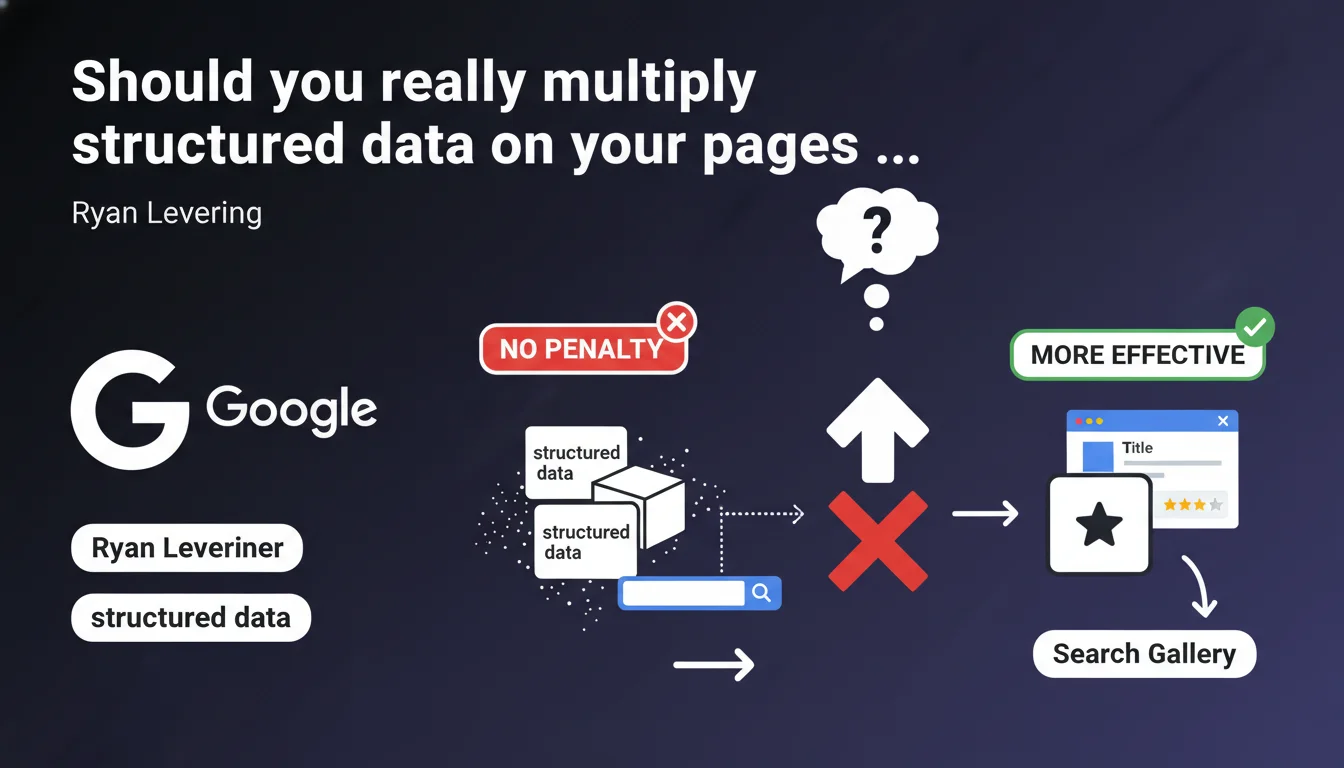
Google claims it never penalizes a site for having too much precise structured data. However, focusing your efforts on the types that Google actually uses in its rich results — those documented in the Search Gallery — remains the most profitable strategy.
What you need to understand
Does Google punish Schema.org overuse?
No. According to Ryan Levering, an engineer at Google, no penalty applies to sites that implement precise and exhaustive structured data, even if it exceeds what Google actively uses.
This statement dispels a recurring fear: that an excess of JSON-LD or Microdata markup could harm crawling, dilute relevance, or trigger an algorithmic filter. Google seems to say that more structured context equals better, as long as it remains accurate.
What exactly does Google "use"?
Google only exploits a fraction of Schema.org types to generate rich snippets, knowledge panels, or SERP features. Google's Search Gallery explicitly lists compatible types: Article, Product, Recipe, Event, FAQ, HowTo, and so on.
In practical terms? Everything outside this official list can be crawled, understood, and stored — but will generate no enriched display. This is "passive" markup: it feeds Google's knowledge graph without immediate visible return.
Why does Levering insist on effectiveness?
Because development time is a scarce resource. Implementing dozens of Schema.org types — LocalBusiness, Corporation, SoftwareApplication — requires code, maintenance, and testing. If Google doesn't value them in SERPs, the ROI is virtually zero.
The Google engineer therefore guides practitioners toward a pragmatic approach: mark up what matters for your visibility goals, not what flatters your semantic perfectionism.
- No penalty for an excess of correct structured data
- Google only exploits a limited subset of Schema.org in SERPs
- Google's Search Gallery documents the types actively used
- Focusing efforts on these types maximizes return on investment
- "Off-list" markup remains crawled but with no immediate visible impact
SEO Expert opinion
Does this statement reflect real-world reality?
Yes, largely. Audits show that a site packed with valid Schema.org — even on exotic types — doesn't suffer an algorithmic penalty. Google consumes this data without hesitation.
However, the notion of "precise" deserves clarification. If your structured data contradicts visible content or generates warnings in Search Console, the risk of deindexing rich snippets exists. Google doesn't penalize excess, but it sanctions deception.
Is the Search Gallery exhaustive?
No. [To verify] — certain Schema.org types seem to influence the knowledge graph or entity understanding without appearing explicitly in the gallery. Example: Organization, Person, or Brand, which structure a site's identity without triggering a dedicated snippet.
Google also regularly tests new types in closed beta or within certain geographic verticals. What doesn't appear in the gallery today could become active tomorrow. But betting on it remains speculative.
When does this advice become counterproductive?
When superfluous markup bloats the DOM or complicates maintenance. A 200-line JSON-LD per page, stuffed with unused types, slows parsing and multiplies failure points — bugs, inconsistencies, deployment errors.
The minimalist approach — mark up only what serves your business objectives — often proves more robust than obsessive exhaustiveness.
Practical impact and recommendations
Which structured data types should you prioritize today?
Start with an audit of the SERP features you're targeting. E-commerce? Product + AggregateRating + Offer. Media? Article + BreadcrumbList + ImageObject. Local service? LocalBusiness + GeoCoordinates + OpeningHours.
Google's Search Gallery remains your starting reference. Each listed type corresponds to a rich snippet or feature that Google actively displays. Concentrate your resources there before exploring more exotic types.
How do you avoid common errors?
First source of error: the gap between markup and visible content. If your JSON-LD announces a price that differs from the one displayed in HTML, Google can disable your rich snippets. Validate systematically with the Rich Results Test and monitor Search Console.
Second pitfall: redundant or nested markup. Multiplying Article, NewsArticle, BlogPosting types on the same page without clear logic breeds confusion. One well-configured primary type outperforms ten approximate types.
How do you measure the real impact of your structured data?
Google Search Console — Rich Results section — shows you which types actually generate displays. Track clicks, impressions, and CTR by snippet type. If a type triggers nothing after three months, abandon it or fix it.
Third-party tools like SEMrush or Ahrefs identify competitors who display snippets you don't have. Target these gaps rather than stacking useless types.
- List SERP objectives (rich snippets, knowledge panels, carousels) by page type
- Implement Schema.org types documented in Google's Search Gallery
- Validate each implementation with the Rich Results Test
- Sync structured data and visible content (prices, dates, authors)
- Monitor Search Console — Rich Results section — to detect errors and warnings
- Measure CTR and impressions by snippet type over 3 months
- Eliminate types that generate no enriched display
- Document your markup strategy to facilitate maintenance
❓ Frequently Asked Questions
Google peut-il ignorer mes données structurées même si elles sont valides ?
Dois-je supprimer les types Schema.org non listés dans la galerie de recherche ?
Les données structurées influencent-elles le classement organique ?
Combien de types Schema.org différents puis-je utiliser sur une même page ?
Que faire si Search Console affiche des warnings sur mes données structurées ?
🎥 From the same video 11
Other SEO insights extracted from this same Google Search Central video · published on 23/08/2022
🎥 Watch the full video on YouTube →
💬 Comments (0)
Be the first to comment.