
Official statement
Other statements from this video 11 ▾
- □ Les données structurées améliorent-elles vraiment le trafic SEO qualifié ?
- □ Pourquoi vos données structurées sont-elles inutiles si Google ne crawle pas votre contenu ?
- □ Pourquoi Google privilégie-t-il Schema.org pour comprendre vos contenus ?
- □ Faut-il vraiment multiplier les données structurées sur vos pages pour plaire à Google ?
- □ Pourquoi Google recommande-t-il JSON-LD plutôt que Microdata ou RDFa pour les données structurées ?
- □ Faut-il vraiment déléguer les données structurées aux plugins CMS ?
- □ Le Rich Results Test suffit-il vraiment pour valider vos données structurées ?
- □ Search Console alerte-t-elle vraiment sur tous les problèmes de données structurées ?
- □ Les erreurs de données structurées peuvent-elles pénaliser votre référencement ?
- □ Les données structurées hors sujet peuvent-elles vraiment pénaliser votre site ?
- □ Pourquoi les identifiants uniques sont-ils cruciaux pour la désambiguïsation dans Google ?
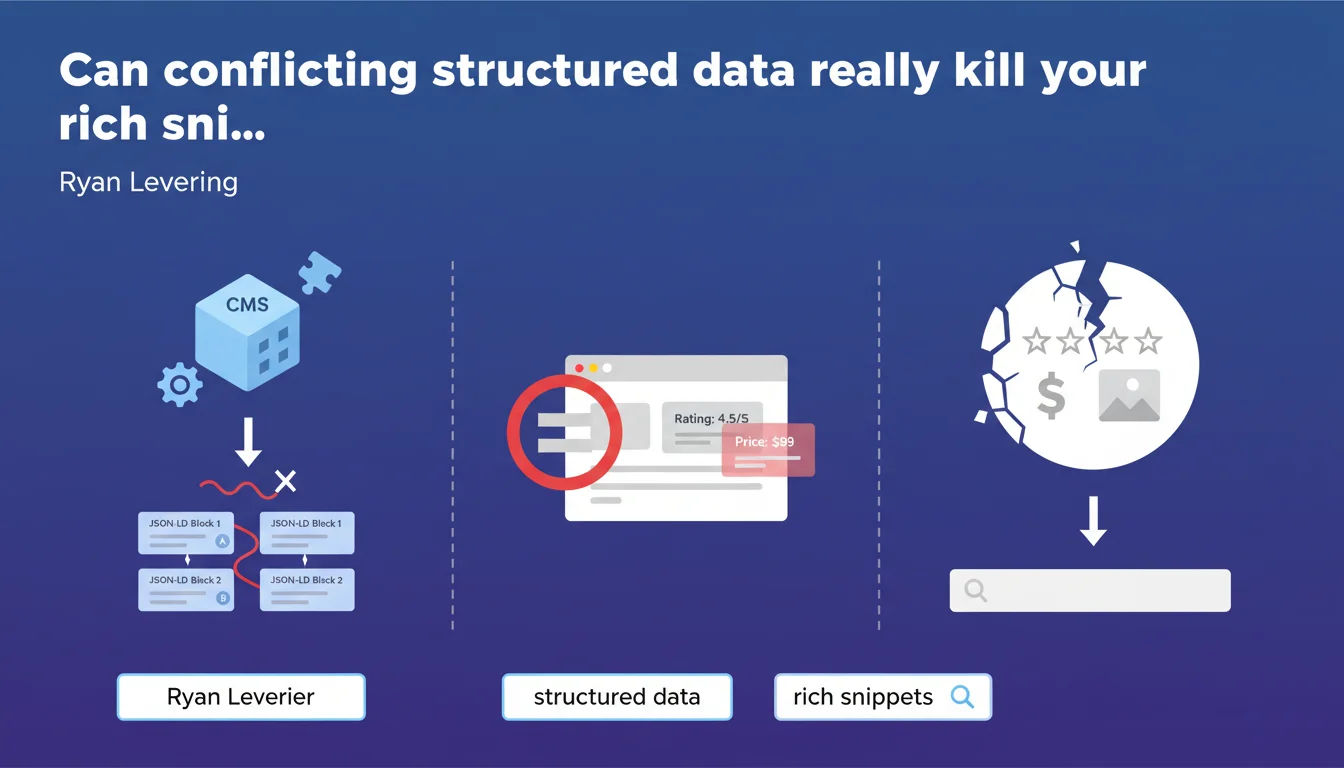
Google confirms that having multiple sources of structured data generating the same information with contradictory values can exclude your page from enhanced results. A very common problem caused by the stacking of CMS plugins or multiple JSON-LD scripts that interfere with each other.
What you need to understand
What triggers this structured data conflict?
The classic scenario: you install a WordPress plugin for product reviews, then another for breadcrumbs, and your theme already injects JSON-LD for the organization. Result? Three distinct JSON-LD blocks that can all declare contradictory information about the same element.
Google then detects different values for the same field — for example, a price at €49 in one block and €59 in another, or average ratings that vary. The engine has no way to guess which one is correct and prefers to remove the enriched feature rather than display potentially false information.
Why doesn't Google simply choose the right version?
Because it has no reliable way to determine which source is the most legitimate or up-to-date. One plugin may generate data from the database, another from the cache, a third from an external API. Google has no access to your technical stack to decide.
Google's position is clear: if the signals are contradictory, then there's a data quality problem on the publisher's side. And that's a dealbreaker for enriched results that must display verified information.
Does this only affect certain types of structured data?
No, the problem affects all types of schema.org: Product, Recipe, Event, FAQ, Article, Organization... As soon as there's redundancy with divergence, you're exposed. The most sensitive types are those that display precise metrics: price, ratings, dates, stock quantities.
- Multiple plugins or JSON-LD blocks generating the same properties create conflicts detectable by Google
- The engine prefers to exclude the page from enriched results rather than risk displaying incorrect data
- All types of schema.org are affected, not just product sheets
- The solution involves conducting a technical audit of structured data sources on your CMS
SEO Expert opinion
Is this statement consistent with real-world observations?
Absolutely. For years, we've been seeing multi-plugin WordPress sites lose their stars or rich cards with no apparent reason. The enriched results testing tool doesn't always report these conflicts as blocking errors — it often validates each JSON-LD block individually without cross-checking values.
Ryan Levering confirms here what many practitioners have suspected: Google does perform a cross-check of data when deciding whether or not to display a visual feature. Not just syntax validation.
What nuances should be added to this statement?
Google doesn't explicitly state which divergence threshold it tolerates. Is a slight variation in a secondary field enough to break everything? Or must contradictions concern critical properties like price or rating? [To verify] — the statement remains vague about exact criteria.
Another point: Ryan talks about "CMS plugins or separate JSON-LD blocks", but what about conflicts between JSON-LD and microdata (microdata, RDFa) on the same page? The logic should be identical, but Google doesn't specify this here.
In which cases does this problem not apply?
If you have multiple truly distinct entities on a page — for example a blog article (Article type) AND an organization (Organization type) — no problem. The conflict only exists when two sources attempt to describe the same entity with different values.
Practical impact and recommendations
How can I detect if my site is affected by this issue?
First step: run a typical page through Google's rich results validator. But don't stop there — look at the raw HTML source code and count how many JSON-LD blocks are present. Compare their contents manually.
Also use Search Console to check whether pages with valid structured data aren't appearing in enriched results anyway. A gap between "valid pages" and "pages displayed as rich snippets" may signal this type of silent conflict.
What should I do concretely to fix it?
Identify all sources that inject JSON-LD: theme, SEO plugins (Yoast, Rank Math, SEOPress), business plugins (WooCommerce, EDD), page builders (Elementor, Divi), third-party scripts. Then, methodically disable to keep only one single source of truth per schema type.
If you can't disable certain plugins, look in their settings for options to disable structured data injection. Most major SEO plugins now allow fine-grained control over what is generated or not.
- Audit the rendered HTML of your typical pages to count the JSON-LD blocks present
- Progressively disable redundant plugins and test the impact on enriched results
- Centralize structured data generation on a single reliable source
- Verify that generated values are dynamic and synchronized with your product/content database
- Regularly monitor Search Console to detect any regression in enriched results
❓ Frequently Asked Questions
Est-ce qu'avoir plusieurs blocs JSON-LD pour des entités différentes pose problème ?
Les outils de validation Google détectent-ils ces conflits automatiquement ?
Peut-on mélanger JSON-LD et microdonnées sans risque ?
Si je corrige les conflits, mes rich snippets reviennent-ils immédiatement ?
Tous les types de résultats enrichis sont-ils concernés par ce problème ?
🎥 From the same video 11
Other SEO insights extracted from this same Google Search Central video · published on 23/08/2022
🎥 Watch the full video on YouTube →
💬 Comments (0)
Be the first to comment.