
Official statement
Other statements from this video 11 ▾
- □ Can structured data really boost your qualified SEO traffic?
- □ What's the point of perfect structured data if Google can't actually crawl your pages?
- □ Should you really multiply structured data on your pages to please Google?
- □ Why does Google recommend JSON-LD over Microdata or RDFa for structured data implementation?
- □ Should you really rely on CMS plugins to handle your structured data automatically?
- □ Is the Rich Results Test really enough to validate your structured data?
- □ Does Google Search Console really alert you to every structured data problem?
- □ Can structured data errors actually hurt your search rankings?
- □ Can off-topic structured data really penalize your website?
- □ Why are unique identifiers crucial for disambiguation in Google's algorithm?
- □ Can conflicting structured data really kill your rich snippets?
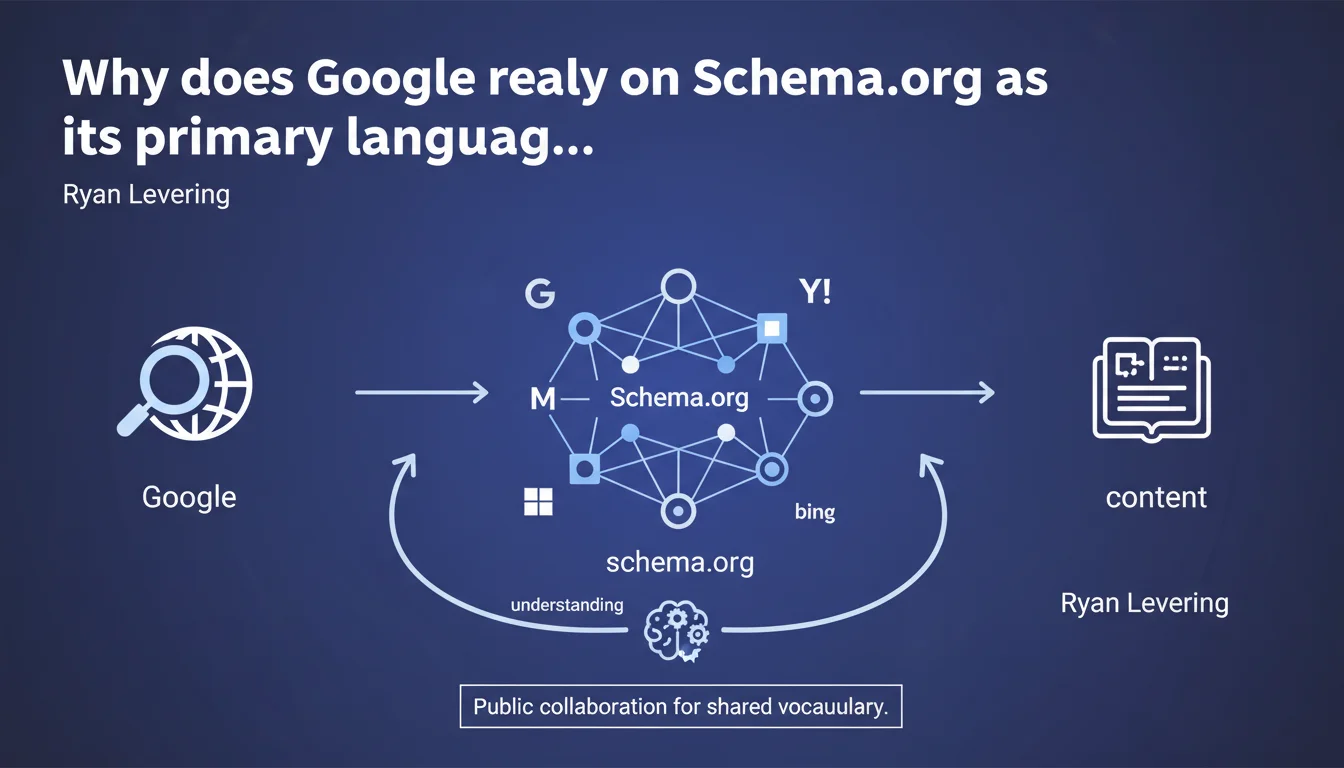
Google primarily relies on Schema.org to decode and interpret the content of web pages. This official statement confirms that the Schema.org vocabulary is not just a bonus for rich snippets, but rather the reference language that Google uses to understand the nature and structure of your data. Any other format risks being poorly understood or even ignored entirely.
What you need to understand
What is Schema.org and why did this vocabulary become the standard?
Schema.org was born from a collaboration between Google, Microsoft, Yahoo and Yandex to standardize data description on the web. The objective was simple: create a common language that all search engines could understand without ambiguity.
This vocabulary covers hundreds of entity types — articles, products, events, people, recipes, organizations, etc. — with precise properties for each one. Google doesn't say it completely ignores other formats, but it clearly states that Schema.org is its primary reference.
What does "primarily" mean in this statement?
The term "primarily" leaves room for interpretation. Google can technically understand certain data without Schema.org — through classic HTML crawling, meta tags, or even semantic analysis of content. But the statement indicates that Schema.org remains the most reliable means of communicating with the search engine.
In plain terms: if you want information to be correctly identified and leveraged, use Schema.org. Other approaches are gambles, not guarantees.
What are the concrete benefits of using Schema.org?
First, clarity: you explicitly tell Google what each element of your page is (author, date, price, rating, etc.). Second, eligibility for rich snippets: stars, FAQs, breadcrumbs, events… all depend on Schema.org.
Finally, cross-search engine consistency: what you deploy for Google also works on Bing, Yandex and others. It's a shared investment.
- Schema.org is the reference vocabulary for Google, not just an optional feature
- The term "primarily" suggests there may be edge cases, but no details are provided
- Using Schema.org improves Google's understanding of your content and unlocks rich snippets
- This format is interoperable: it works across multiple search engines
- Not using Schema.org amounts to letting Google guess — with the risk of error or omission
SEO Expert opinion
Is this statement consistent with real-world observations?
Yes, completely. In practice, no other structured data format rivals Schema.org in terms of support and richness. Microformats (microdata, RDFa) are technically accepted, but Google has largely abandoned them in favor of JSON-LD + Schema.org.
Tests show that pages with well-implemented Schema.org more often get rich snippets than those without it. This is factual, not a belief.
What nuances should be noted?
Google says "primarily," which leaves a door open. But no credible alternative is documented. If Google understands data without Schema.org, it's through internal heuristics — not a method you can control or optimize.
Another point: Schema.org doesn't guarantee rich snippet display. Google can understand your data without displaying it. Understanding and display are two distinct steps. [To verify]: Google doesn't precisely document the selection criteria for displaying enriched results.
In what cases does this rule not apply?
Hard to say — Google provides no details on exceptions. If you manage a site in a very minority language or ultra-niche subject matter, perhaps Google relies more on raw semantic analysis. But this is only a hypothesis.
In practice, Schema.org remains relevant in 99% of cases. The rare exceptions don't merit taking the risk of abandoning it.
Practical impact and recommendations
What exactly should you do to leverage Schema.org?
Start by identifying the entity types present on your site: articles, products, events, FAQs, breadcrumbs, etc. Then implement the corresponding markup in JSON-LD — this is the format recommended by Google.
Use tools like the Schema Markup Validator or Google's Rich Results Test to verify that your code is valid and eligible for rich snippets. Don't settle for a simple copy-paste: adapt the properties to your actual content.
What errors should you avoid when implementing?
Don't clutter your pages with unnecessary or misleading markup. Google penalizes abuse: false ratings, invented prices, irrelevant FAQs just to occupy the SERP. Follow the official guidelines or you risk a manual penalty.
Another common mistake: duplicating markup across multiple templates without adjusting it. Each page should have Schema.org markup consistent with its actual content, not a generic copy-paste.
How do you verify that your site is compliant and optimized?
Regularly audit your pages with Google tools. Verify that mandatory properties are present (e.g., name, image, datePublished for an Article). Track errors and warnings in Search Console.
Compare your results to competitors: if they display rich snippets and you don't, it's often a markup issue. Test, fix, validate, publish. Then monitor the evolution in search results.
- Identify the entity types relevant to each page (Article, Product, Event, FAQ, etc.)
- Implement JSON-LD markup with all mandatory and recommended properties
- Validate code with Schema Markup Validator and Rich Results Test
- Avoid misleading or irrelevant data (risk of manual penalty)
- Regularly audit Search Console to detect errors and warnings
- Compare your results to competitors to identify gaps
- Adapt markup to each page, not generic copy-paste
❓ Frequently Asked Questions
Schema.org est-il obligatoire pour être indexé par Google ?
Faut-il utiliser JSON-LD ou peut-on rester en microdata ?
Schema.org garantit-il l'affichage de rich snippets ?
Peut-on cumuler plusieurs types Schema.org sur une même page ?
Que signifie « principalement » dans cette déclaration ?
🎥 From the same video 11
Other SEO insights extracted from this same Google Search Central video · published on 23/08/2022
🎥 Watch the full video on YouTube →
💬 Comments (0)
Be the first to comment.