
Official statement
Other statements from this video 11 ▾
- □ Les données structurées améliorent-elles vraiment le trafic SEO qualifié ?
- □ Pourquoi vos données structurées sont-elles inutiles si Google ne crawle pas votre contenu ?
- □ Pourquoi Google privilégie-t-il Schema.org pour comprendre vos contenus ?
- □ Faut-il vraiment multiplier les données structurées sur vos pages pour plaire à Google ?
- □ Pourquoi Google recommande-t-il JSON-LD plutôt que Microdata ou RDFa pour les données structurées ?
- □ Faut-il vraiment déléguer les données structurées aux plugins CMS ?
- □ Le Rich Results Test suffit-il vraiment pour valider vos données structurées ?
- □ Search Console alerte-t-elle vraiment sur tous les problèmes de données structurées ?
- □ Les erreurs de données structurées peuvent-elles pénaliser votre référencement ?
- □ Pourquoi les identifiants uniques sont-ils cruciaux pour la désambiguïsation dans Google ?
- □ Les données structurées en conflit peuvent-elles vraiment tuer vos rich snippets ?
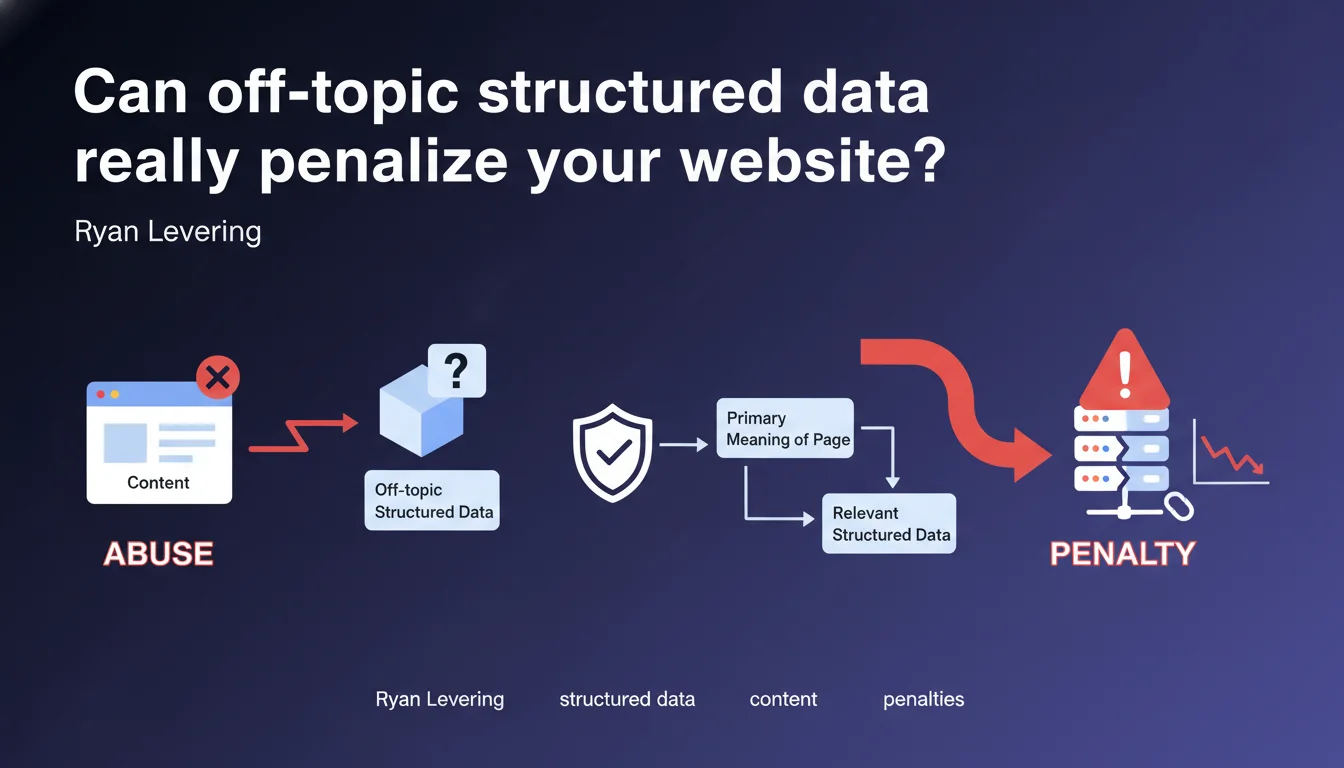
Google considers the use of structured data that has no relation to the actual content of a page as abuse that can result in penalties. The priority: accurately describe the main subject of each page, not stuff schema.org markup to grab rich snippets.
What you need to understand
What exactly does "irrelevant structured data" mean?
We're talking about schema.org markup that doesn't match the visible content on the page. Typically: an article that marks up as Recipe when there's no recipe, a product page that marks up as FAQPage with generic copy-pasted questions, or worse, hidden data that users never see.
Google wants the markup to reflect the primary meaning of the page. If your content is about SEO but you mark it up as if it's a local event, that's structured spam. Period.
Why is Google taking a harder line on this?
Because too many sites have abused rich snippets to gain visibility without earning those enriched results. Fake FAQs that add nothing, fantastical breadcrumbs, auto-generated product reviews — all of it pollutes the search results.
The problem is straightforward: if everyone cheats with markup, SERPs become unreadable. Google loses relevance, users click less. So the algorithm becomes stricter about semantic coherence between markup and actual content.
What are the concrete consequences of structured data abuse?
Ryan Levering mentions penalties, without specifying whether it's a manual action or algorithmic. In real-world practice, we mostly see removal of the relevant rich snippets — not necessarily a global ranking drop.
But watch out: if the abuse is massive and systematic, it can trigger a manual action for spam. I've seen sites lose 40% of traffic after stuffing all their pages with Recipe schema when they're actually selling business coaching.
- Coherence is mandatory: markup must describe what the user actually sees on the page
- Primary meaning: focus on the dominant type of content, not secondary aspects
- No invisible data: if it's in the markup but not in visible HTML, that's structured cloaking
- Possible sanctions: loss of rich snippets, or even manual action for repeated abuse
SEO Expert opinion
Is this statement consistent with what we see in the field?
Overall yes. Google has already penalized sites for misleading markup — particularly with FAQPage that exploded in SERPs a few years ago. Many sites lost their enriched snippets overnight without explanation, then we figured out it was due to illegitimate FAQs.
What's missing from this statement: the precise definition of "irrelevant". [To verify]: how far can you go with secondary aspects of content? If a blog article contains a legitimate FAQ at the end, but the body covers something else, is that acceptable? The gray area remains huge.
What nuances should be applied to this rule?
Let's be honest: it's not all black and white. A page can legitimately contain multiple types of content. A long-form article can include a tutorial (HowTo), an FAQ, and user reviews. As long as each markup corresponds to a visible and substantial section, it works.
The real problem is opportunistic markup: adding Recipe just because you mention "mix your backlinks well" in a metaphor. Or marking up Event because you're talking about "the upcoming launch of your SEO audit". If it's a stretch, Google will catch it eventually.
In what cases does this rule not apply strictly?
Multi-faceted pages have more leeway. An e-commerce product page can legitimately combine Product, Review, FAQPage, and BreadcrumbList. As long as each element corresponds to a real section of the page, it's valid.
[To verify]: Google publishes no data on tolerance thresholds. We navigate by sight, based on Search Console feedback and observations of rich snippet gains/losses. Frustrating but that's the game.
Practical impact and recommendations
What should you do concretely to stay compliant?
First, audit your existing markup. Scrutinize each page: does the schema.org actually match the visible content? Remove any markup describing an absent, minor, or misleading element.
Next, focus on the primary meaning. If your page is primarily a blog article, mark it as Article. If it also contains a legitimate FAQ with 5+ substantial questions/answers, add FAQPage. But don't force it — minimal and accurate markup beats a comprehensive yet dubious catalog.
What errors should you absolutely avoid?
Never mark up data invisible to the user. If your markup mentions a price, date, or description, that information must appear in visible HTML. Otherwise it's cloaking, full stop.
Avoid generic FAQs copy-pasted across all your pages. Google easily detects structured content duplication. Each FAQ must be unique, relevant to the page, and provide real value to the user reading it.
- Test each page with Google's Rich Results Test
- Compare markup to elements actually visible on the page
- Remove any markup describing absent or marginal content
- Favor a single primary type per page (Article, Product, etc.)
- Add secondary types only if the content clearly justifies it
- Document your markup choices to maintain editorial consistency
- Monitor Search Console for any structured data alerts
How do you verify that your site is compliant and sustainable?
Run a complete technical crawl with Screaming Frog or OnCrawl, extracting all structured data. Manually compare it to actual content — yes, it's tedious, but it's the only way to be certain.
Set up monthly monitoring: watch for rich snippet appearance/disappearance in SERPs, Search Console alerts, and CTR variations on pages with enriched markup. A sudden drop often signals a compliance issue.
❓ Frequently Asked Questions
Peut-on baliser plusieurs types schema.org sur une même page ?
Quels sont les risques concrets d'un balisage non pertinent ?
Comment savoir si mon balisage FAQ est considéré comme légitime ?
Faut-il supprimer tout le balisage en cas de doute ?
Les données structurées invisibles sont-elles toujours considérées comme du spam ?
🎥 From the same video 11
Other SEO insights extracted from this same Google Search Central video · published on 23/08/2022
🎥 Watch the full video on YouTube →
💬 Comments (0)
Be the first to comment.