
Official statement
Other statements from this video 11 ▾
- □ Can structured data really boost your qualified SEO traffic?
- □ What's the point of perfect structured data if Google can't actually crawl your pages?
- □ Why does Google rely on Schema.org as its primary language for understanding your content?
- □ Should you really multiply structured data on your pages to please Google?
- □ Why does Google recommend JSON-LD over Microdata or RDFa for structured data implementation?
- □ Should you really rely on CMS plugins to handle your structured data automatically?
- □ Does Google Search Console really alert you to every structured data problem?
- □ Can structured data errors actually hurt your search rankings?
- □ Can off-topic structured data really penalize your website?
- □ Why are unique identifiers crucial for disambiguation in Google's algorithm?
- □ Can conflicting structured data really kill your rich snippets?
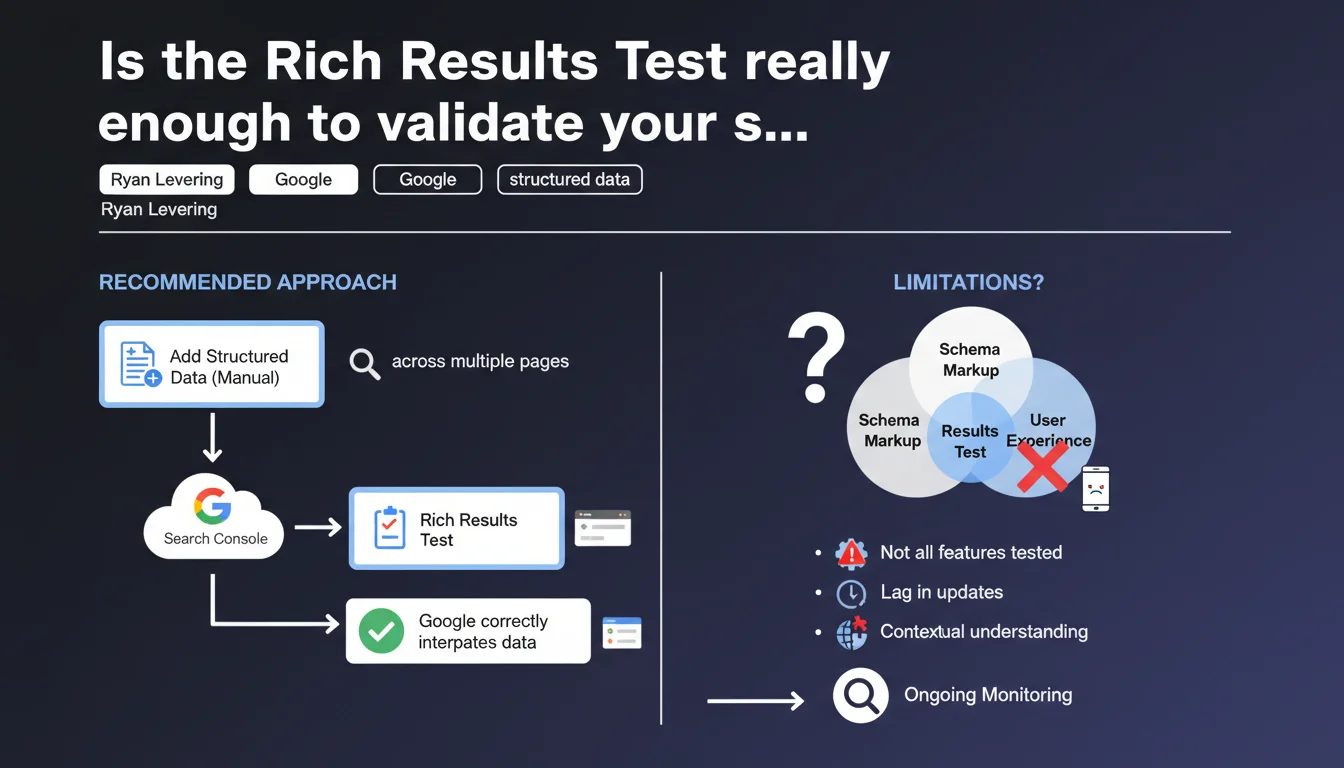
Google recommends adding structured data manually across multiple pages and testing it with the Rich Results Test in Search Console. The tool displays only the elements that Google actually uses to generate rich display features. This iterative approach allows you to verify the actual interpretation by the search engine, not just syntactic validity.
What you need to understand
Why does Google insist on manual and progressive testing?
The statement emphasizes an iterative approach: add structured data to a few pages first, test, adjust, then scale up. This approach prevents implementation errors from spreading across your entire site.
The Rich Results Test doesn't just validate JSON-LD or Microdata syntax — it shows what Google actually extracts and interprets. That's the difference between "technically valid" and "usable by Google".
What's the difference between technical validity and real interpretation?
Markup can be syntactically correct according to Schema.org without actually triggering rich results in the SERPs. Google only supports a subset of the types and properties available in Schema.org.
The Rich Results Test lists only the elements Google actually uses for specific features. If a property doesn't appear in the report, it probably has no impact on your display.
Should you test all pages or just a representative sample?
The recommendation covers "multiple pages," not necessarily all of them. The idea is to cover the main template types: product pages, articles, FAQs, events, recipes, etc.
Once the markup is validated on a template, implementation can be extended to all similar pages. But watch out for local variations or exceptions that could break your markup.
- Test first on a few representative pages before global deployment
- The Rich Results Test shows only what Google actually uses
- Technically valid markup can be ignored by Google if it doesn't match any supported features
- Favor an iterative approach: test, fix, deploy
- Check each template type (product, article, FAQ, etc.) individually
SEO Expert opinion
Is this recommendation aligned with real-world practices?
Yes, absolutely. SEOs who deploy structured data at scale without prior testing often discover interpretation issues well after production — unrecognized fields, silent warnings, or worse: rich results that disappear after a few weeks.
Let's be honest: the Rich Results Test isn't foolproof. Sometimes it validates markup that, in production, generates no rich results at all. [To verify] on a significant volume of pages before claiming success.
What are the limits of this manual approach?
For a site with thousands of pages and dozens of different templates, manual testing quickly becomes time-consuming. The tool doesn't offer bulk testing or an API to automate checks.
Additionally, the Rich Results Test doesn't catch all potential issues. For example, content inconsistencies between your markup and visible HTML can go unnoticed but trigger manual penalties later.
When isn't this method sufficient?
When markup is dynamically generated via a CMS, complex templating system, or client-side JavaScript, the risk of errors is higher. Validation on a few pages doesn't guarantee global consistency.
Another limitation: the Rich Results Test only checks eligibility for rich display features, not actual impact on click-through rates or SEO performance. It's a technical test, not a performance test.
Practical impact and recommendations
What should you do concretely to test your structured data effectively?
First, identify your strategic page types: e-commerce products, blog articles, FAQ pages, events, recipes, business listings, etc. For each, select 3-5 representative URLs — neither the best nor the worst.
Test each URL with the Rich Results Test (formerly Structured Data Testing Tool). Check not only for the absence of errors, but especially the list of properties actually recognized by Google. If a key property is missing from the report, it means Google isn't using it.
What errors should you avoid during implementation?
Never deploy markup site-wide without prior validation on a sample. Errors spread quickly and can degrade overall SERP display, or even trigger manual actions.
Another classic pitfall: copy-pasting a Schema.org example without adapting it to your page's real context. Google detects flagrant inconsistencies between your markup and visible content, and can completely ignore the markup.
- Select 3-5 representative URLs per template type
- Test with the Rich Results Test, not just a generic JSON-LD validator
- Check the list of properties recognized by Google, not just absence of errors
- Fix warnings even if they don't block validation — they can limit rich display
- Monitor progress in the Enhancements report in Search Console after deployment
- Never markup invisible or non-visible content in your HTML
- Test after every major CMS or templating system change
How do you ensure implementation stays consistent over time?
Set up regular monitoring via Search Console's "Enhancements" report. Markup errors can appear after a CMS update, template change, or human error.
Automate markup generation as much as possible to avoid oversights or inconsistencies between similar pages. But be careful: automation without control can spread errors site-wide.
❓ Frequently Asked Questions
Le Rich Results Test remplace-t-il l'ancien Structured Data Testing Tool ?
Un balisage valide garantit-il l'affichage d'un résultat enrichi ?
Faut-il tester chaque page individuellement ou seulement les templates ?
Que faire si le Rich Results Test ne détecte aucun élément utilisable ?
Les warnings dans le Rich Results Test bloquent-ils l'affichage enrichi ?
🎥 From the same video 11
Other SEO insights extracted from this same Google Search Central video · published on 23/08/2022
🎥 Watch the full video on YouTube →
💬 Comments (0)
Be the first to comment.