
Official statement
Other statements from this video 11 ▾
- □ Les données structurées améliorent-elles vraiment le trafic SEO qualifié ?
- □ Pourquoi vos données structurées sont-elles inutiles si Google ne crawle pas votre contenu ?
- □ Pourquoi Google privilégie-t-il Schema.org pour comprendre vos contenus ?
- □ Faut-il vraiment multiplier les données structurées sur vos pages pour plaire à Google ?
- □ Pourquoi Google recommande-t-il JSON-LD plutôt que Microdata ou RDFa pour les données structurées ?
- □ Faut-il vraiment déléguer les données structurées aux plugins CMS ?
- □ Le Rich Results Test suffit-il vraiment pour valider vos données structurées ?
- □ Search Console alerte-t-elle vraiment sur tous les problèmes de données structurées ?
- □ Les données structurées hors sujet peuvent-elles vraiment pénaliser votre site ?
- □ Pourquoi les identifiants uniques sont-ils cruciaux pour la désambiguïsation dans Google ?
- □ Les données structurées en conflit peuvent-elles vraiment tuer vos rich snippets ?
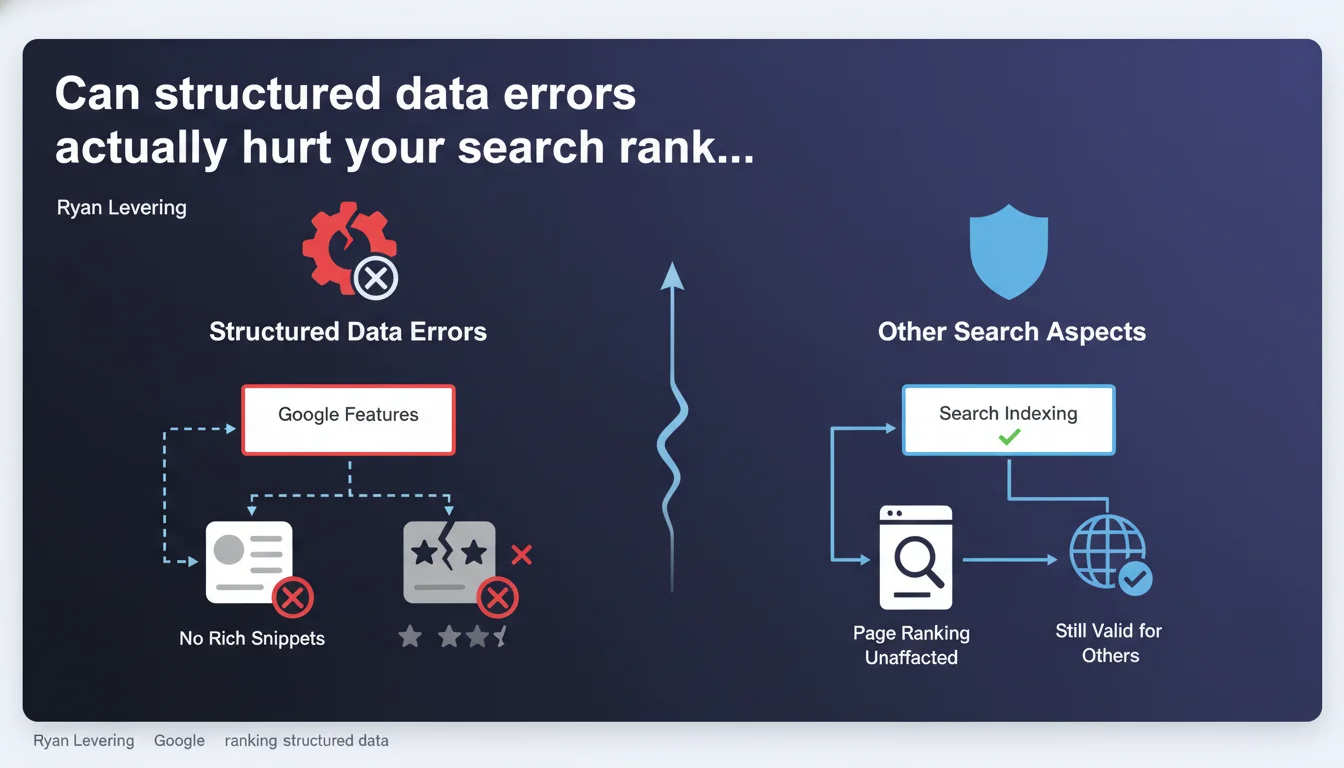
Google states that structured data problems only affect eligibility for rich snippets and search features, with no negative impact on organic ranking. In other words: a Schema.org error won't tank your positions. This statement aims to reassure webmasters who fear that imperfect markup will damage their overall SEO.
What you need to understand
What does Google's statement really mean?
Ryan Levering draws a clear distinction: structured data is not a ranking factor in itself. It serves only to qualify your content for rich displays — rich snippets, recipe cards, expandable FAQs, and so on.
If your Schema.org markup contains errors, Google doesn't penalize you in the general index. Your page keeps its organic positions. However, you lose access to the advanced features that this markup could have unlocked.
Why is Google clarifying this point now?
Many SEO professionals panic when Search Console returns red alerts about structured data. This fear isn't entirely irrational — for years, the prevailing wisdom suggested that a "clean" site had to be flawless on every technical front.
Google is reframing: a markup problem does not trigger an algorithmic filter. You can have 200 Schema errors and continue ranking normally. It's a welcome clarification to prevent frantic corrections that serve no purpose for rankings.
What are the limitations of this assurance?
The nuance lies in the phrasing: "will not negatively affect other aspects of your page". In other words, structured data remains a lever for optimizing CTR and visibility in the SERP — precisely through rich snippets.
Losing these rich displays means losing potential traffic, even if your positions remain stable. It's not a penalty in the strict sense, but the business impact can be severe.
- Schema errors do not impact organic ranking of the page in the index
- They block access to rich snippets and other advanced search features
- Data may remain valid for other engines like Bing or Yandex, even if Google rejects it
- No algorithmic filter is applied due to defective markup
- Real impact is measured in CTR, not positions
SEO Expert opinion
Is this statement consistent with real-world observations?
Yes. For years, we've seen sites rank in the top 3 with massive Schema errors. Correlations between "markup quality" and "positions" are nonexistent in large-scale studies.
However, the impact on CTR is documented: an FAQ rich snippet can generate +30% more clicks on certain queries. So technically, Google is telling the truth — but the distinction between "no penalty" and "no business impact" is subtle.
What nuances should be added to this statement?
The devil is in the details. Google says that structured data problems "do not negatively affect other aspects". Let's be honest: that doesn't mean they have zero indirect effect.
A concrete example — if your Event markup is broken, you won't appear in Google's Events tab. Result: zero traffic from that source, even though your pages remain indexed normally. It's a huge missed opportunity without being an "algorithmic penalty" in the strict sense.
Another point: [To be verified] — some reports suggest that massive Schema errors coincide with crawl decreases. Correlation or causation? Impossible to determine with public data. Google has never confirmed a direct link.
In what cases might this rule have exceptions?
The statement applies to markup errors, not manipulation attempts. If you stuff your pages with fraudulent Schema to undeservedly land rich snippets, Google can apply a manual action — and that's a real penalty.
Second exception: if your markup is so broken it prevents correct parsing of your content, you risk indexation problems. But this is rare — you'd really need to break the DOM or inject invalid JSON-LD that crashes the renderer.
Practical impact and recommendations
Should you fix all structured data errors?
Prioritize. Not all errors are equal. If your Product Schema is broken on an e-commerce listing, you lose rating stars in search results — that's critical. By contrast, a minor warning on an Organization Schema has almost no impact.
Focus first on the types of data that trigger rich displays on your target queries. Quick checklist: Product, Review, Recipe, Event, FAQ, HowTo, Article. Everything else can wait.
How do you verify that Google is actually using your markup?
Don't rely solely on the Schema.org validator. Google has its own eligibility criteria — often stricter. Use the Rich Results Test in Search Console, under the "Enhancements" section.
Most importantly, monitor actual impressions. If you have valid FAQ markup but zero impressions in the "FAQ" report, it means Google isn't displaying it. Possible causes: content too short, irrelevant questions, or simple algorithmic choice.
What errors should you avoid at all costs?
Never manipulate structured data to display information that's invisible on the page. Google easily detects hidden or misleading Schema — and that triggers a manual action guaranteed.
Also avoid duplicating identical markup across thousands of pages without variation. Rich snippets are awarded selectively — flooding Google with identical Schema accomplishes nothing.
- Audit your structured data via Search Console, "Enhancements" section
- Fix errors first on Product, Review, FAQ, Recipe, Event types
- Verify that marked-up content is visible in the page's HTML
- Test each Schema type with Google's official tool, not just Schema.org
- Monitor rich snippet impressions in performance reports
- Only mark up what's actually on the page — never phantom data
- If your CMS auto-generates Schema, verify the markup quality
❓ Frequently Asked Questions
Une erreur de Schema.org peut-elle faire baisser mes positions Google ?
Dois-je corriger toutes les alertes de la Search Console sur les données structurées ?
Mon Schema est valide selon Schema.org mais rejeté par Google. Pourquoi ?
Les données structurées fonctionnent-elles sur Bing et autres moteurs si Google les rejette ?
Peut-on être pénalisé pour Schema.org frauduleux ou trompeur ?
🎥 From the same video 11
Other SEO insights extracted from this same Google Search Central video · published on 23/08/2022
🎥 Watch the full video on YouTube →
💬 Comments (0)
Be the first to comment.