
Official statement
Other statements from this video 9 ▾
- □ Pourquoi le rendu côté client (CSR) met-il votre indexation Google en danger ?
- □ Pourquoi un échec de rendu JavaScript peut-il retarder votre indexation de plusieurs semaines ?
- □ Le JavaScript est-il vraiment indexé par Google ou faut-il encore s'en méfier ?
- □ Pourquoi le rendu côté client pose-t-il un problème structurel pour le crawl Google ?
- □ Le rendu côté serveur est-il vraiment plus fiable que le rendu client ?
- □ Faut-il abandonner le rendu côté client pour améliorer son référencement naturel ?
- □ Est-ce que Google traite vraiment les codes 429, 503 et 500 de la même manière ?
- □ Les domaines Web3 (.eth) sont-ils crawlables par Google ?
- □ Pourquoi vos utilisateurs tapent-ils le nom de votre marque dans Google plutôt que votre URL ?
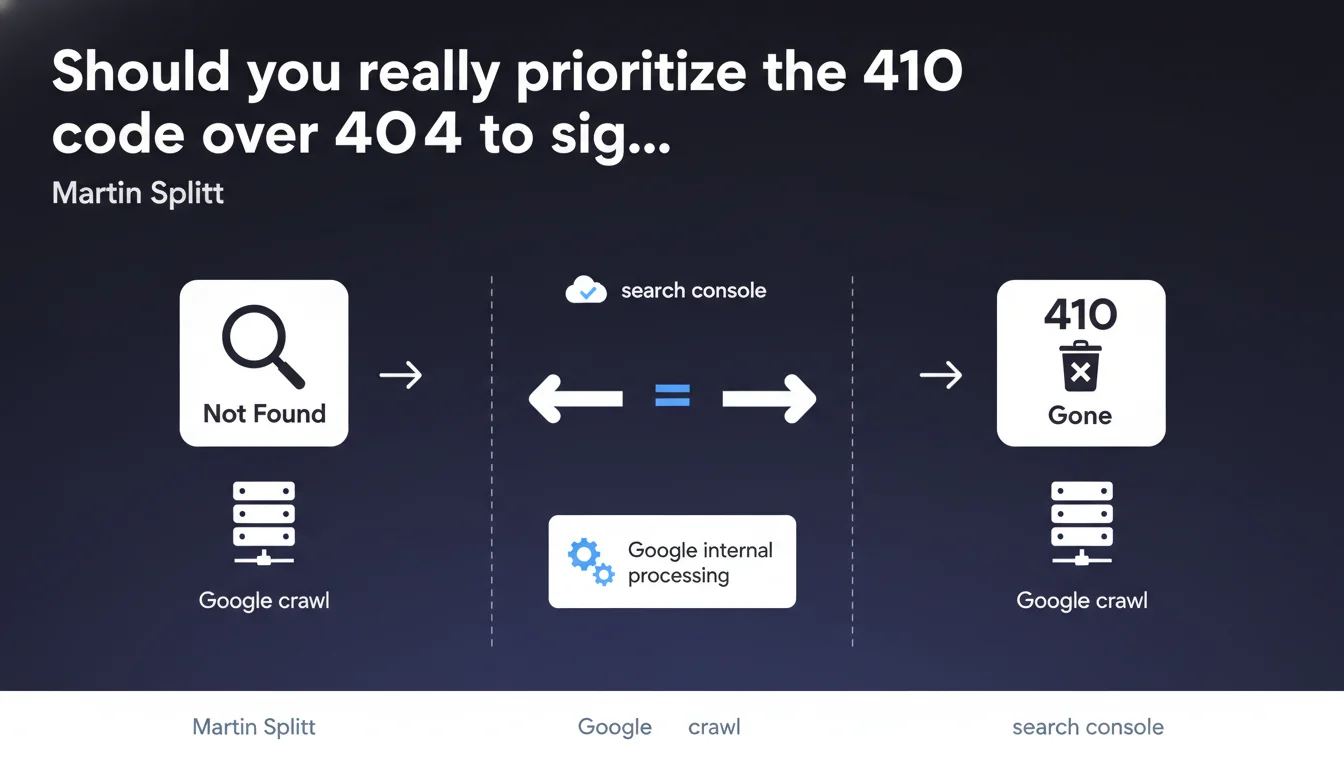
Google treats HTTP 404 and 410 status codes exactly the same way internally. No difference in crawling, indexing, or how they appear in Search Console. The age-old debate about the superiority of 410 to accelerate deindexing is therefore obsolete.
What you need to understand
What's the theoretical difference between a 404 and a 410?
The 404 code means "Not Found" — the resource doesn't exist or no longer exists, but could come back someday. It's the standard response for a URL that can't be found.
The 410 code ("Gone") is more definitive: the resource has permanently disappeared. For years, the SEO community believed that this stronger signal would accelerate the removal of the URL from Google's index.
What exactly does Martin Splitt say about this treatment?
Splitt states that both codes trigger the same internal process at Google. No priority treatment for 410, no shortened timeframe for deindexing.
Search Console actually displays both codes under the same label in coverage reports. This interface choice reflects the technical reality well: no operational distinction between these two statuses.
Why has this confusion persisted for so long?
HTTP specifications and W3C recommendations describe 410 as a permanent signal. Logically, some concluded that Google must interpret it differently.
But there's a gap between protocol theory and the actual implementation of a search engine. Google never officially confirmed a distinct treatment before this statement — but never denied it either, which perpetuated the myth.
- The 404 and 410 codes trigger the same deindexing process at Google
- Search Console makes no distinction between the two in its reports
- 410 does not accelerate the removal of a URL from the index
- This clarification ends years of debate within the SEO community
SEO Expert opinion
Is this statement consistent with real-world observations?
Let's be honest: many empirical tests have never demonstrated a significant difference between 404 and 410. Deindexing timeframes varied mainly depending on crawl frequency and site authority, not on the HTTP code returned.
What Splitt confirms here is what the most rigorous practitioners already suspected. But how many migrations were slowed down by pointless debates over "should we put 410 everywhere"? How many hours wasted configuring specific rules for... zero benefit?
Are there nuances to consider depending on context?
Google may treat both codes the same, but that's not true for all systems. Some monitoring tools or CDNs still differentiate between 404 and 410 in their alerts and metrics.
And then there's the semantic aspect: returning a 410 on a permanently out-of-stock product page is cleaner than a 404, even if Google doesn't care. [To verify]: some third-party crawlers or archiving services may respect the distinction better — but in terms of pure SEO, it has no impact.
In which cases does this rule change nothing about your strategy?
If you're managing an e-commerce site with thousands of seasonal references, you'll continue to return 404s on temporarily out-of-stock products and 301s toward alternatives for abandoned products. The choice of code depends on your architecture, not on any hypothetical Google preference.
However, if you had hard-coded complex rules to generate 410s on certain "important" URLs hoping for express deindexing, you can simplify all of that. Less technical complexity = fewer potential bugs.
Practical impact and recommendations
What should you do concretely following this clarification?
First: stop wasting time debating 404 vs 410 in your teams. Document this official position from Google and move on.
Second: audit your server rules. If you have convoluted configurations to handle 410 differently, simplify. A well-managed 404 is more than enough to signal that a page no longer exists.
What mistakes should you avoid after this announcement?
Don't confuse this equivalence with permission to leave 404s scattered everywhere. A high 404 error rate remains a sign of poor maintenance and can indirectly harm your crawl budget if Googlebot spends its time on dead ends.
Another pitfall: returning 404 or 410 on pages that should be redirected. If a URL has SEO juice, history, backlinks — redirect to the best alternative, don't let the potential die.
How should you adjust your error management strategy?
Focus on the speed of detecting unintentional 404s rather than on the choice of code. Effective monitoring in Search Console + automated alerts are worth more than unnecessary HTTP subtleties.
For voluntarily deleted pages, maintain a clear process: 301 if an alternative exists, 404/410 otherwise. And most importantly, clean up your broken internal links — that's what really impacts user experience and crawl efficiency.
- Document officially that 404 = 410 for your technical team
- Simplify server rules if you had specific treatments for 410
- Audit and correct unintentional 404s in Search Console
- Set up 301 redirects to relevant alternatives whenever possible
- Remove internal links pointing to 404/410s to optimize crawl budget
- Automate monitoring of new 404 errors to respond quickly
❓ Frequently Asked Questions
Dois-je remplacer tous mes 410 par des 404 suite à cette annonce ?
Un 410 accélère-t-il vraiment la désindexation par rapport à un 404 ?
Search Console affiche-t-il différemment les 404 et les 410 ?
Y a-t-il encore des cas où le 410 est préférable au 404 ?
Que faire si j'ai beaucoup de 404 dans Search Console ?
🎥 From the same video 9
Other SEO insights extracted from this same Google Search Central video · published on 30/05/2023
🎥 Watch the full video on YouTube →
💬 Comments (0)
Be the first to comment.