
Official statement
Other statements from this video 9 ▾
- □ Pourquoi le rendu côté client (CSR) met-il votre indexation Google en danger ?
- □ Pourquoi un échec de rendu JavaScript peut-il retarder votre indexation de plusieurs semaines ?
- □ Le JavaScript est-il vraiment indexé par Google ou faut-il encore s'en méfier ?
- □ Pourquoi le rendu côté client pose-t-il un problème structurel pour le crawl Google ?
- □ Le rendu côté serveur est-il vraiment plus fiable que le rendu client ?
- □ Faut-il abandonner le rendu côté client pour améliorer son référencement naturel ?
- □ Faut-il vraiment privilégier le code 410 au 404 pour signaler une page supprimée ?
- □ Est-ce que Google traite vraiment les codes 429, 503 et 500 de la même manière ?
- □ Les domaines Web3 (.eth) sont-ils crawlables par Google ?
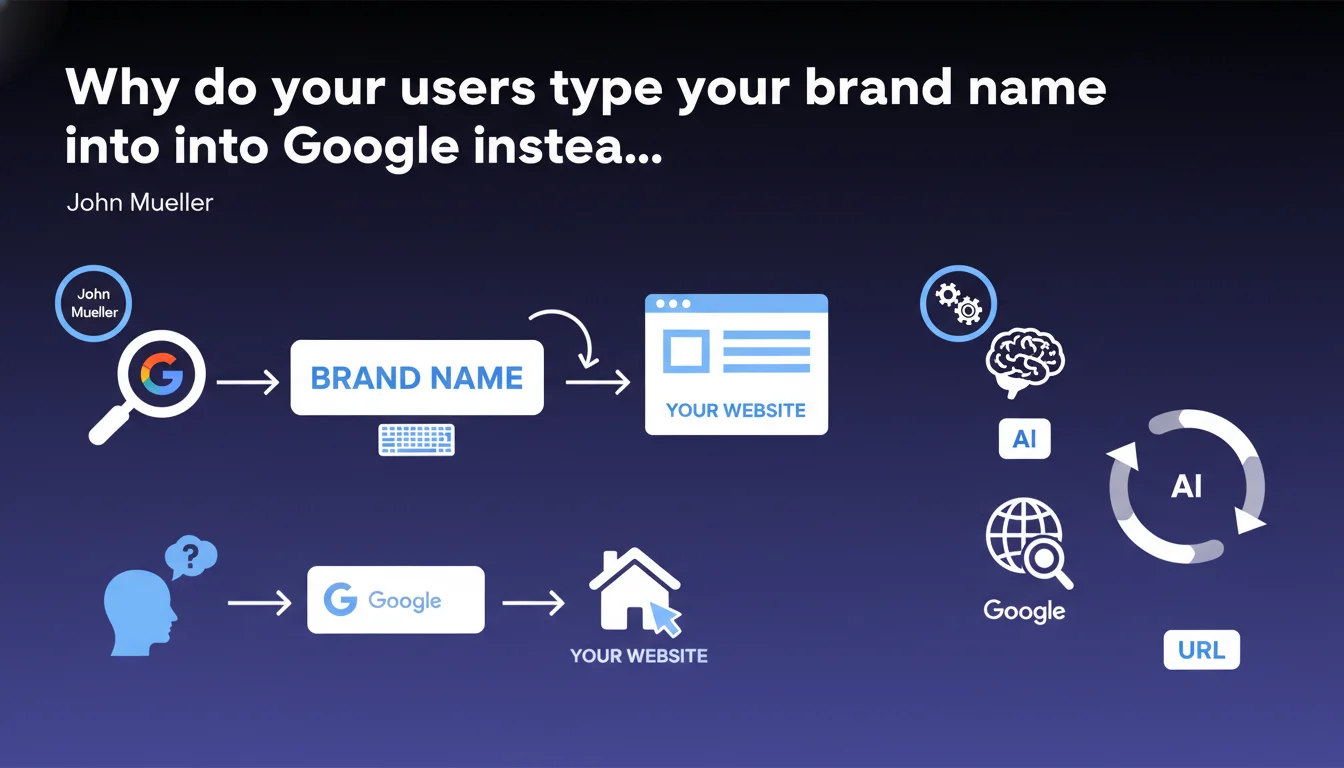
Navigation queries (searching for a brand name rather than typing the URL directly) represent a massive share of Google traffic. This real-world observation confirms that users prefer to use the search engine as their primary navigation interface, even when they already know their destination. For SEO, this means that controlling your brand SERP is no longer optional.
What you need to understand
What exactly is a navigation query?
A navigation query occurs when a user types a brand, company, or specific website name into Google rather than entering the URL directly into the address bar. For example: "amazon", "ebay", "ikea" instead of amazon.com, ebay.com, etc.
This behavior is explained by several factors: the Google search bar has become the default entry point on mobile, autocomplete makes searching easier, and many users no longer distinguish between the URL bar and the search field.
Why is Google emphasizing this particular finding?
Because this data validates the importance of brand authority score in ranking algorithms. If millions of users directly search for "Nike" or "Decathlon", Google infers that these brands deserve preferential treatment in generic search results.
It's also a strong signal for SEO professionals: neglecting your brand SERP exposes you to immediate risks. A competitor can hijack your ads, third-party sites can steal your branded traffic, negative results can appear on the first page.
Is this observation really new?
No. Public Google Trends data has shown for years that brand queries dominate search volumes in most sectors. What's changing is that Google is officially formalizing this and drawing explicit algorithmic conclusions from it.
For an SEO practitioner, this confirms what we observe in the field: branded traffic can represent 40 to 70% of total organic traffic depending on the site. Ignoring this reality means leaving a massive portion of your acquisition unmonitored.
- Navigation queries represent a dominant share of global search volume
- Users prefer Google as a navigation interface even when they know the URL
- This behavior reinforces the importance of brand in ranking algorithms
- Controlling your brand SERP becomes a critical SEO priority, not an option
SEO Expert opinion
Does this statement really change the game for practitioners?
Not fundamentally. Any SEO professional already knows that branded queries generate massive volumes. What's interesting is that Google is publicly formalizing this mechanism — which reinforces the legitimacy of investing in brand visibility.
The problem is that Mueller provides no precise figures. "Very frequent", "massively" — that's vague. Third-party studies (Ahrefs, SEMrush) show ratios of 40-70% depending on sectors, but Google confirms nothing. [Verify] this with your own Search Console data.
In which cases does this logic not work?
For pure-play SEO sites without prior brand awareness, this observation is almost useless. If nobody knows your brand, nobody will search for it directly. You must first capture generic traffic, convert, build loyalty — and only then benefit from navigation traffic.
Another limitation: sectors with strong Amazon/marketplace dominance. Many users type "nike" but land on Amazon, not nike.com. The navigation query exists, but the SEO benefit is captured by a third party.
What's the concrete implication for long-term SEO strategies?
This strengthens the idea that modern SEO = brand SEO + technical SEO + content. You can no longer rely solely on optimizing pages for generic keywords. You must build a recognizable brand that generates direct searches.
In practice? Invest in offline branding (advertising, PR, events), optimize user experience to encourage brand recall, work on loyalty signals (newsletters, apps, user accounts). SEO becomes one lever among many in a broader brand strategy.
Practical impact and recommendations
What concrete actions should you take to optimize your brand SERP?
First step: audit your brand SERP. Type your brand name into Google (in private browsing) and list everything that appears: your site, your ads, your social profiles, but also comparison sites, forums, negative reviews, competitors squatting your name.
Then identify visibility gaps. If a competitor ranks in position 2 with a page titled "Alternatives to [your brand]", that's an immediate problem. If 1-star reviews appear on the first page, same issue. If Google displays an incomplete or incorrect Knowledge Panel, fix it via Google Business Profile.
What mistakes should you absolutely avoid?
Classic mistake: not monitoring your brand SERP regularly. A competitor can launch a search campaign on your name, a negative article can emerge, an algorithm change can shift result order. Set up alerts (Google Alerts, rank tracking tools) to be notified immediately.
Another trap: neglecting long-tail branded queries. Users don't just search "Nike", they also search "Nike return policy reviews", "Nike customer service phone", "Nike promo code". If you don't cover these variations with optimized content (FAQs, service pages, promotional landing pages), someone else will.
How do you measure the impact of these optimizations?
In Google Search Console, filter your queries by brand name and analyze: search volume, CTR, average position. A CTR below 60-70% on your branded queries signals a problem (competitors capturing clicks, unattractive snippets, internal cannibalization).
Also compare direct traffic vs branded organic traffic in Google Analytics. If direct traffic drops but branded traffic explodes, this confirms Mueller's mechanism. Conversely, if branded traffic stagnates despite brand awareness efforts, your brand strategy isn't working.
- Audit your brand SERP in private browsing (desktop + mobile)
- Set up automatic alerts on your brand name (Google Alerts, rank tracking)
- Create content covering long-tail branded queries (FAQs, customer service, promotions)
- Verify and optimize your Knowledge Panel / Google Business Profile
- Monitor CTR of your branded queries in Search Console (target > 60%)
- Block competitors using your brand name in search ads (Google Ads reporting)
- Monitor negative third-party reviews and content that could rank for your brand
❓ Frequently Asked Questions
Faut-il acheter son propre nom de marque en Google Ads si on rank déjà en position 1 en organique ?
Comment empêcher un concurrent d'utiliser mon nom de marque dans ses annonces Google Ads ?
Les requêtes de navigation impactent-elles le score de qualité global d'un site ?
Un site sans notoriété peut-il compenser l'absence de trafic branded ?
Comment différencier trafic direct et trafic branded masqué dans Analytics ?
🎥 From the same video 9
Other SEO insights extracted from this same Google Search Central video · published on 30/05/2023
🎥 Watch the full video on YouTube →
💬 Comments (0)
Be the first to comment.