
Official statement
Other statements from this video 9 ▾
- □ Pourquoi le rendu côté client (CSR) met-il votre indexation Google en danger ?
- □ Pourquoi un échec de rendu JavaScript peut-il retarder votre indexation de plusieurs semaines ?
- □ Le JavaScript est-il vraiment indexé par Google ou faut-il encore s'en méfier ?
- □ Pourquoi le rendu côté client pose-t-il un problème structurel pour le crawl Google ?
- □ Le rendu côté serveur est-il vraiment plus fiable que le rendu client ?
- □ Faut-il abandonner le rendu côté client pour améliorer son référencement naturel ?
- □ Faut-il vraiment privilégier le code 410 au 404 pour signaler une page supprimée ?
- □ Est-ce que Google traite vraiment les codes 429, 503 et 500 de la même manière ?
- □ Pourquoi vos utilisateurs tapent-ils le nom de votre marque dans Google plutôt que votre URL ?
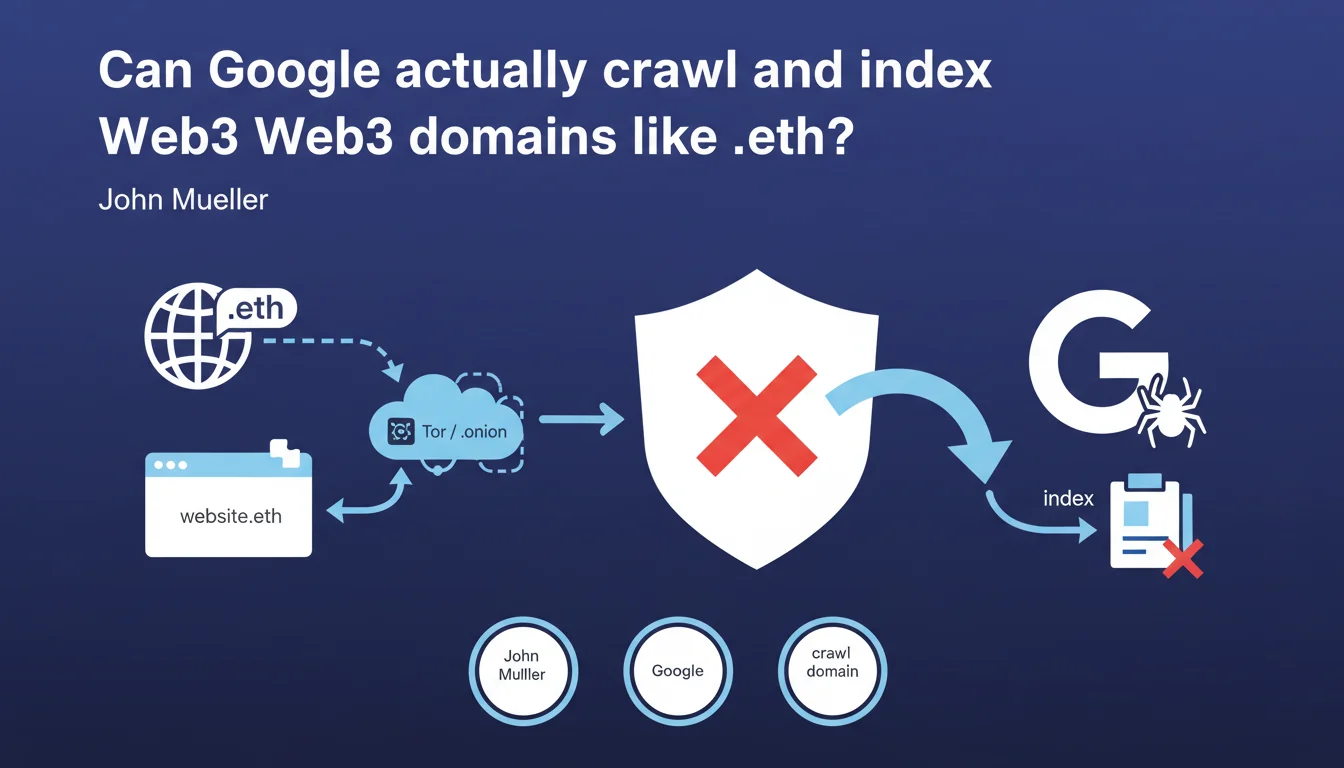
Web3 domains such as .eth are neither crawlable nor indexable by Google. They function as unofficial TLDs, much like Tor network addresses with their .onion suffix. Even if a browser plugin allows users to resolve them on the client side, Googlebot cannot access them.
What you need to understand
What exactly is a Web3 domain?
Web3 addresses like .eth (Ethereum Name Service) are decentralized identifiers that replace crypto wallet addresses with human-readable names. In practical terms, instead of "0x742d35Cc6634C0532925a3b844Bc9e7595f0bEb", you get "yoursite.eth".
The problem? These domains are not official TLDs recognized by ICANN. They require a browser extension (like MetaMask) or alternative DNS to be resolved. For Googlebot, they simply don't exist.
Why does Google compare .eth domains to .onion addresses?
The comparison with the Tor network (.onion) is telling. Both systems rely on infrastructure that runs parallel to standard DNS. Googlebot cannot access the Tor network for security and architectural reasons — the same logic applies to Web3 domains.
In both cases, these are invented namespaces that operate outside the standard DNS resolution system. Google simply doesn't have the tools to crawl them, even if it wanted to.
What is Google's official position on these domains?
John Mueller was clear: these domains are not indexable, period. No ambiguity, no "maybe in the future". Google's current infrastructure doesn't support these unofficial TLDs.
- Web3 .eth domains are TLDs not recognized by ICANN
- They require alternative DNS resolution that Googlebot doesn't use
- Even with a browser plugin, Google cannot crawl these addresses
- The situation is identical to .onion domains on the Tor network
- No indexation possible, regardless of configuration
SEO Expert opinion
Is this statement consistent with observed practices?
Yes, absolutely. In practice, no site hosted exclusively on a .eth domain appears in SERPs. And it makes sense: Googlebot is a standard HTTP/HTTPS crawler, it cannot resolve addresses that require a blockchain or specific resolver.
The comparison with .onion is relevant. Google has always refused to index the dark web, even though technically it could deploy crawlers on Tor. Here, it's the same — but without even the technical possibility to do it easily.
Can Web3 exist without organic search visibility?
That's where the contradiction lies. The Web3 paradox stems from this tension: how do you build a decentralized ecosystem and maintain visibility simultaneously? If you bet everything on a .eth domain, you're invisible to 95% of global web traffic.
Some crypto projects work around this by maintaining a traditional domain (.com, .io) that points to their Web3 content. But then, where's the promised decentralization? You're back in the centralized system you wanted to escape from.
Are there possible workarounds?
On paper, HTTP gateways to Web3 exist (like eth.link or eth.limo). They allow you to access .eth content through a traditional domain. But watch out: these are centralized proxies, so the exact opposite of Web3 philosophy.
And even then, [To verify]: do these gateways generate duplicate content? How to handle canonicalization? Does Google consider the proxy or the source? No official documentation on this. Minefield.
Practical impact and recommendations
What should you do if you're working on a Web3 project?
Let's be pragmatic. If your client wants organic traffic, they must maintain a traditional domain in parallel. No alternative. The .eth can serve as a decentralized identity, a community showcase, but not as an SEO acquisition channel.
Concretely? Host the main content on a .com (or other official TLD), optimize it normally, and use the .eth as a complementary identity for the crypto community. That's the only viable approach today.
What mistakes should you absolutely avoid?
Never promise a client that you can "rank their .eth site". It's technically impossible. If an agency sells you that, run — or they don't understand the subject.
Another trap: thinking an HTTP gateway solves everything. These third-party services can disappear, change their rules, or create unmanageable duplicate content problems. You're building on sand.
How to structure an SEO strategy for a Web3 player?
The answer is simple: dual infrastructure. A traditional domain for discovery and acquisition (SEO, content, backlinks), a .eth domain for decentralized identity and on-chain interactions.
- Maintain an official TLD domain (.com, .io, .org) for all content intended for search ranking
- Optimize this traditional domain with standard SEO best practices (technical, content, link building)
- Use the .eth as a complementary identity for the crypto community only
- Never rely on a third-party gateway as a sustainable SEO solution
- Clearly document to the client the technical limitations of Web3 in terms of visibility
- If the project requires a complex hybrid strategy, budget accordingly for architecture work
❓ Frequently Asked Questions
Un domaine .eth peut-il être indexé par Google avec une extension navigateur ?
Les passerelles comme eth.link permettent-elles de contourner le problème ?
Google pourrait-il un jour crawler les domaines Web3 ?
Faut-il abandonner les domaines .eth pour un projet qui vise le grand public ?
Les autres domaines Web3 (.crypto, .nft) sont-ils dans le même cas ?
🎥 From the same video 9
Other SEO insights extracted from this same Google Search Central video · published on 30/05/2023
🎥 Watch the full video on YouTube →
💬 Comments (0)
Be the first to comment.