
Official statement
What you need to understand
What is Google's official position on the Last-Modified header?
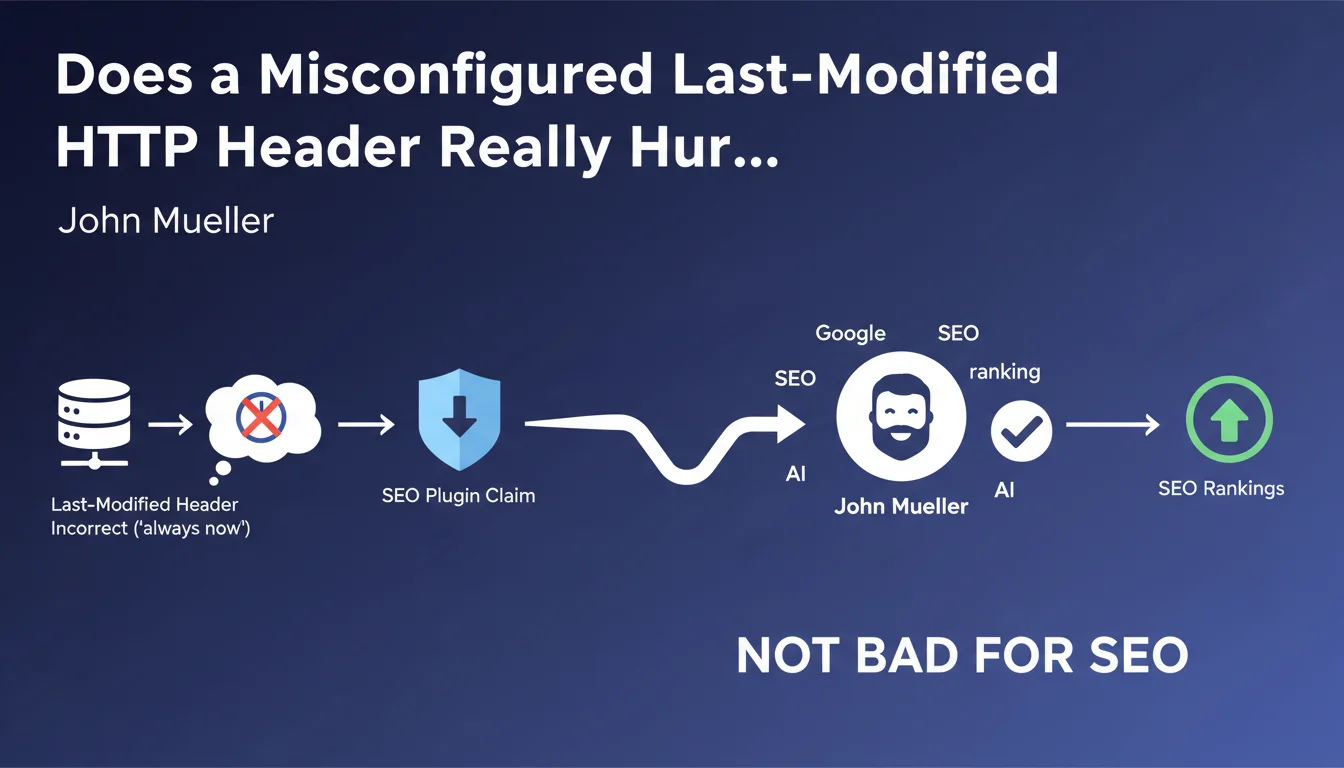
Google has clarified its position regarding the Last-Modified HTTP header which indicates the date a page was last modified. Contrary to some beliefs, a misconfiguration of this header has no direct negative impact on SEO.
More specifically, even if you systematically set the last modified date to "now" via a plugin, this will not trigger an algorithmic penalty and will not affect your ranking in search results.
Why does this header exist if it's not a ranking factor?
The Last-Modified header primarily serves to optimize page crawling by search engine robots. It allows Googlebot to determine whether a page has been modified since its last visit.
This header is part of the technical signals used for crawl budget management, but does not constitute a ranking criterion. Google clearly distinguishes between technical crawl elements and ranking factors.
What are the real consequences of a bad configuration?
An incorrect Last-Modified date can mislead Googlebot about content freshness. If all your pages display a "now" date, the robot may believe that your entire site is constantly changing.
This can lead to inefficient crawling where Googlebot unnecessarily revisits unchanged pages, thus wasting your crawl budget. For small sites, the impact remains negligible, but for large sites, it can slow down the indexing of real updates.
- A misconfigured Last-Modified header does not penalize SEO directly
- It can affect crawl efficiency and crawl budget management
- The impact is more significant on large-scale sites with many pages
- Google uses other signals to determine content freshness
- This clarification prevents unnecessary optimizations based on SEO myths
SEO Expert opinion
Is this statement consistent with practices observed in the field?
This clarification from Google is perfectly consistent with what we've observed in SEO audits for years. Many sites with poor configuration in this area rank very well, confirming the absence of direct impact on ranking.
However, the important nuance concerns high-volume sites. On e-commerce platforms with tens of thousands of products or media sites with significant archives, poor Last-Modified management can indeed slow down the discovery of critical new pages.
What nuances should be added to this statement?
Google carefully distinguishes between SEO impact and crawl impact. The absence of an SEO penalty does not mean the configuration is without consequences. A poorly optimized crawl budget can delay the indexing of important content.
Furthermore, the Last-Modified header is just one signal among others. Google also uses page content, XML sitemap, detected changes and other factors to evaluate freshness. A bad configuration is therefore compensated by other signals.
In which contexts is this statement particularly important?
This clarification is essential for developers and agencies who spend time correcting configurations wrongly deemed problematic. It allows them to prioritize optimizations that have a real impact.
It also reassures site owners using certain CMS or plugins that misconfigure this header by default. Rather than panicking, they can focus on more impactful optimizations like content, performance or structure.
Practical impact and recommendations
What should you actually do with the Last-Modified header?
For small sites (fewer than 1000 pages), don't worry too much about this header. Focus your efforts on the fundamentals: quality content, performance, user experience and internal linking.
For medium and large sites, correct configuration remains a best practice. Make sure your CMS sends the real last modification date of the content, not today's date or an arbitrary date.
In all cases, verify that your XML sitemap contains accurate modification dates. This signal is often more reliable for Google and compensates for a potential misconfiguration of the HTTP header.
What mistakes should you absolutely avoid?
Don't waste time over-optimizing this aspect at the expense of truly impactful optimizations. The mistake would be to spend significant development resources correcting what is not an SEO priority.
Also avoid completely disabling this header for fear of doing it wrong. Imperfect information is still preferable to no information to help Googlebot prioritize its crawl.
Finally, don't confuse the Last-Modified date with the publication date displayed in your content or structured data. These are distinct elements that serve different objectives.
How can you check and optimize your site's configuration?
Use your browser's developer tools (Network tab) to inspect the HTTP headers of your pages. Verify that the Last-Modified date actually corresponds to the real last modification of the content.
Consult Search Console to identify potential crawl issues. If Google excessively revisits unmodified pages, this may indicate a problem with freshness signals.
- Inspect the HTTP headers of a few representative pages on your site
- Verify that your XML sitemap contains accurate
<lastmod>tags - Analyze crawl statistics in Search Console
- For large sites, prioritize correction if crawl budget is limited
- Don't sacrifice other important optimizations to fix this aspect
- Document the configuration for your technical team
- Test after any CMS modification or plugin installation
A misconfigured Last-Modified header is not an SEO catastrophe, but a secondary technical optimization. On small sites, its impact is negligible. On large platforms, correct configuration improves crawl efficiency without revolutionizing SEO.
The essential thing is to maintain perspective: focus first on content, architecture, performance and user experience. These elements have a much more significant impact on your visibility.
For complex sites requiring advanced crawl budget optimization, fine management of all technical signals can become delicate. The expertise of a specialized SEO agency allows you to audit all these parameters in their context and prioritize actions according to their real impact, avoiding superfluous optimizations while not neglecting truly relevant adjustments for your specific situation.
💬 Comments (0)
Be the first to comment.