
Official statement
Other statements from this video 15 ▾
- □ Faut-il vraiment réduire le nombre de pages pour optimiser son SEO international ?
- □ Comment Google détermine-t-il vraiment la langue d'une page multilingue ?
- □ Pourquoi Google ignore-t-il vos titres de page si la langue ne correspond pas au contenu ?
- □ Google utilise-t-il vraiment l'autorité de domaine pour classer les sites ?
- □ Pourquoi Googlebot refuse-t-il de cliquer sur vos boutons ?
- □ Les interstitiels JavaScript sont-ils vraiment sans risque pour le SEO ?
- □ Un bug technique pendant une Core Update peut-il vraiment faire chuter votre site ?
- □ Les problèmes techniques peuvent-ils vraiment déclencher une chute lors d'un Core Update ?
- □ La traduction de contenu est-elle pénalisée par Google ?
- □ Les traductions automatiques de mauvaise qualité peuvent-elles vraiment saboter votre SEO international ?
- □ Faut-il vraiment utiliser l'API d'indexation pour tous vos contenus ?
- □ Googlebot peut-il accéder à votre fichier .htaccess ?
- □ Google favorise-t-il réellement ses propres plateformes dans les résultats de recherche ?
- □ La meta description influence-t-elle vraiment le classement dans Google ?
- □ Faut-il vraiment choisir ses données structurées en fonction des résultats enrichis visés ?
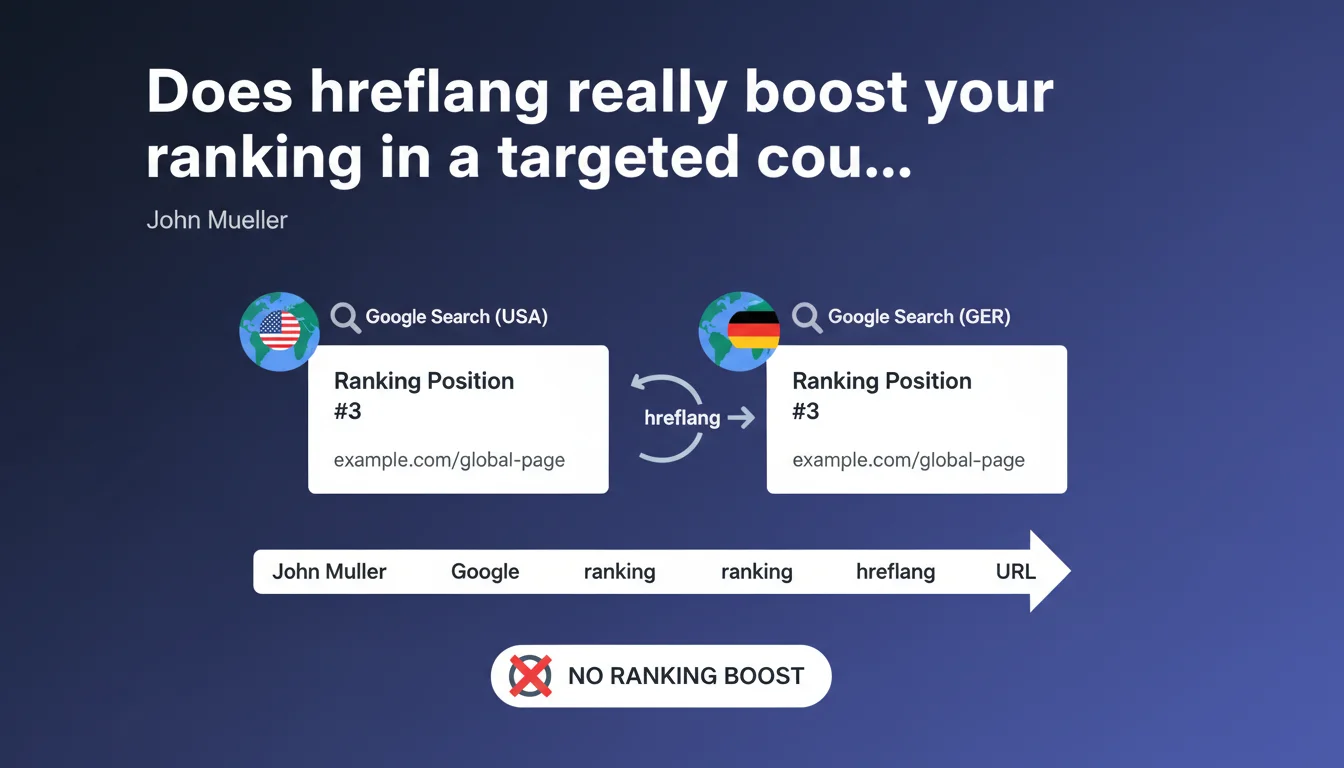
Google is categorical: hreflang confers no ranking advantage for a page in a given country. The attribute merely allows substituting the URL displayed in the SERPs with the appropriate local version, at the same ranking position. The power of the signal comes from the page's content and relevance, not from the hreflang annotation itself.
What you need to understand
What exactly is hreflang supposed to do?
The hreflang attribute tells Google that a page exists in multiple language or geographic versions. In practical terms, you signal that a French URL for France and a French URL for Belgium offer the same content, tailored to each audience.
Google uses this information to display the correct version to the user based on their language and location. A French visitor will see the .fr URL, a Belgian visitor will see the .be URL — even though both pages address the same topic.
Why do some people think hreflang influences ranking?
The confusion stems from a misunderstanding of the mechanism. When a local page rises in results after adding hreflang, people believe in a ranking boost. In reality, what you're observing is simply URL substitution.
The page being ranked might be the .com version — but Google displays the .fr version in its place for the French user. The ranking itself hasn't moved; only the presented URL changes.
What does this statement mean for multilingual sites?
That your internationalization strategy cannot be limited to dropping hreflang tags and waiting for a miracle. Each local version must earn its ranking through its content, backlinks, and relevance.
Hreflang orchestrates the display; it does not create intrinsic SEO value. If your .fr page is weak, hreflang won't make it climb the French results — it will simply direct the user to it if it's already indexed and the .com ranks well.
- Hreflang does not boost the ranking of a local version
- It only enables URL substitution in results based on the user's language/country
- The ranking position remains identical; only the displayed URL changes
- Each language version must build its own SEO authority
- Without an indexed local version, hreflang can do nothing — Google will display the available version
SEO Expert opinion
Does this statement really reflect what we observe in the field?
Yes, and it's confirmed by large-scale testing. I've seen sites add hreflang and observe "rises" of local versions — but digging deeper, it was always the same thing: the .com version was already ranking, and hreflang allowed the .fr to be shown to French users.
The classic trap: confusing improved local visibility with boosted ranking. Hreflang improves user experience, which can indirectly influence CTR and thus behavioral signals — but it's not a direct ranking factor.
What nuances should we add to this rule?
Watch out for the particular case of multilingual duplicate content. If you have a .com version in English and a .fr version in French targeting the same market, hreflang helps Google understand this isn't spam. It prevents cannibalization and allows each version to compete in its language.
But — and this is crucial — it doesn't create ranking out of thin air. If your .fr has no backlinks and mediocre content, it won't rank, even with perfectly implemented hreflang. [To verify] on micro-markets: some observe that local versions with ccTLD domains (.fr, .de) seem to have a slight geographic advantage even without hreflang, but Google has never confirmed this pattern.
In which cases might this rule appear not to apply?
When you launch a new local version and see traffic arrive quickly, you might think hreflang has "helped." But often, it's because Google is transferring signals from the main version to the new one via hreflang — not because it's boosting it.
If the .com ranked position 5 and the .fr appears at position 5 after implementation, it's simply that Google has swapped the URLs. No magic.
Practical impact and recommendations
What should you do concretely for multilingual sites?
First, accept that hreflang is an orchestration tool, not a ranking one. Your focus should remain on the quality and relevance of each local version. Invest in properly translated content, not recycled Google Translate.
Next, build local authority for each version: backlinks from sites in the target country, mentions in local press, presence on geographic directories. Hreflang will facilitate display, but ranking will come from these signals.
What mistakes should you absolutely avoid?
Mistake number one: believing that implementing hreflang is enough to "rank locally." Result: you create 10 language versions with weak content, plant your tags, and nothing happens. Of course — you've given Google nothing to justify a ranking.
Another common trap: using hreflang for identical content in the same language across different domains (.com and .fr both in French). Google can get confused and consider this strategic duplicate content.
How do you verify that your hreflang implementation is correct?
Google Search Console remains your best ally. Go to "International Targeting" to see detected errors: inconsistent tags, non-indexable URLs, missing return links.
Also test manually by changing your geolocation via VPN and observing which URL appears in results. If the wrong version displays, your configuration has a problem.
- Create unique and relevant content for each language or geographic version
- Build local backlinks for each target market (country sites, local press, geo directories)
- Implement hreflang in a bidirectional manner (each URL should point to others and to itself)
- Verify configuration in Google Search Console (International Targeting section)
- Ensure all URLs referenced in hreflang are indexable (no noindex, no 404s)
- Test URL display across different geolocations (VPN, simulators)
- Never rely on hreflang as a ranking lever — it's a URL substitution tool
- Monitor traffic by local version to detect anomalies (wrong version displayed, cannibalization)
❓ Frequently Asked Questions
Si hreflang ne booste pas le ranking, pourquoi l'utiliser ?
Une page en .fr a-t-elle un avantage de ranking en France sans hreflang ?
Que se passe-t-il si j'implémente hreflang mais qu'une version n'est pas indexée ?
Hreflang peut-il nuire au ranking s'il est mal configuré ?
Faut-il créer des versions locales même si le contenu est identique ?
🎥 From the same video 15
Other SEO insights extracted from this same Google Search Central video · published on 29/04/2022
🎥 Watch the full video on YouTube →
💬 Comments (0)
Be the first to comment.