
Official statement
Other statements from this video 15 ▾
- □ Does hreflang really boost your ranking in a targeted country?
- □ Does Google really use only main content to identify language on multilingual pages?
- □ Does Google really ignore your page titles when the language doesn't match your content?
- □ Does Google really use domain authority to rank websites?
- □ Is your content trapped behind buttons that Googlebot refuses to click?
- □ Are JavaScript interstitials really safe for your SEO?
- □ Can a technical bug during a Core Update really cause your site to crash in rankings?
- □ Can technical problems really trigger a ranking drop during a Core Update?
- □ Does Google penalize you for translating content between languages?
- □ Can poor machine translations really sabotage your international SEO strategy?
- □ Should you really use Google's Indexing API for all your content?
- □ Can Googlebot actually access your .htaccess file?
- □ Does Google really give its own platforms an unfair advantage in search results?
- □ Does the meta description really impact your Google rankings?
- □ Should you really choose your structured data based on the rich results you're targeting in the SERPs?
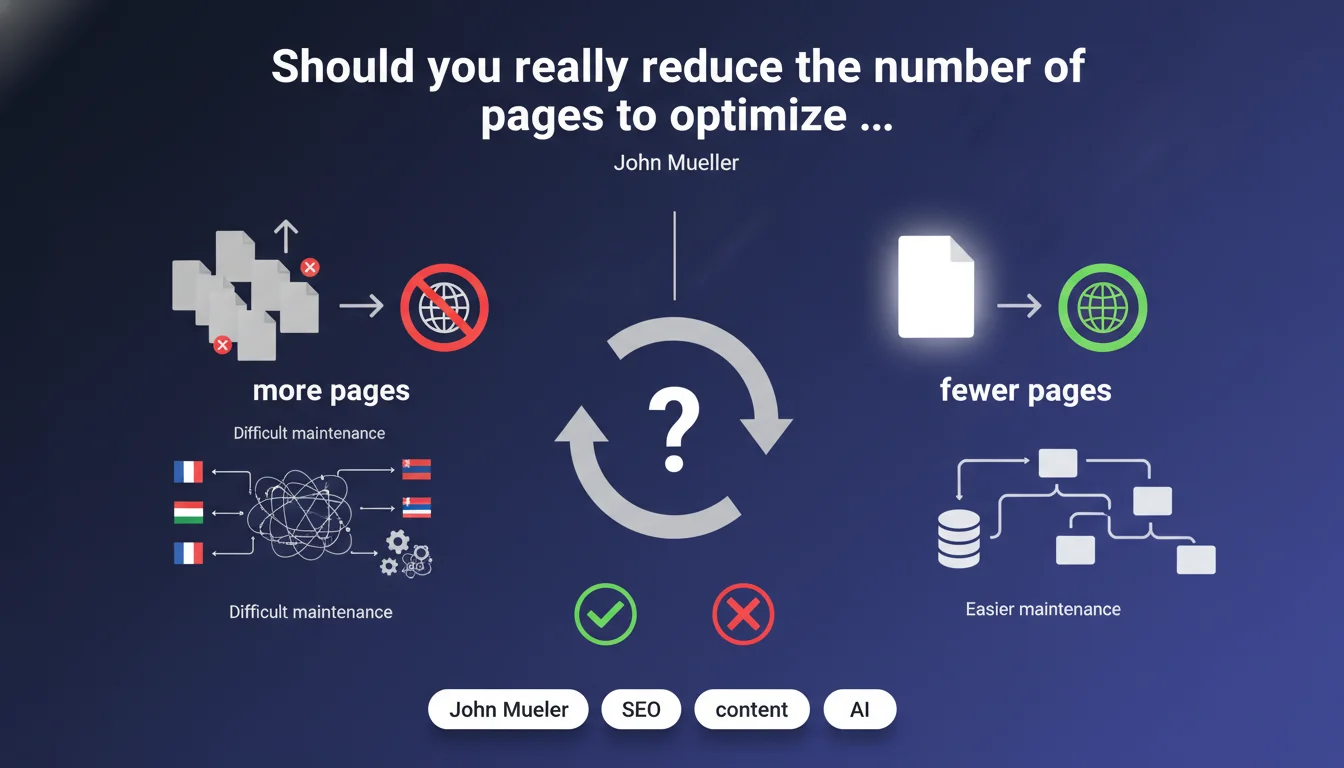
Google states that in internationalization, fewer pages are almost always better than more pages. If content doesn't require a specific local version, it's preferable not to create it to facilitate maintenance and avoid dilution.
What you need to understand
Why does Google recommend fewer pages for international SEO?
John Mueller's statement targets a recurring problem: the chaotic multiplication of local versions that add no real value. Many websites create dozens of language or regional variants without any real content strategy.
The issue is that each additional page consumes crawl budget, dilutes link equity, and complicates technical management (hreflang, redirects, canonicals). If these pages are barely translated duplicates, Google perceives them as low-quality content.
What counts as a "specific local version" according to Google?
Google doesn't define this criterion precisely. [To verify]: we assume that a specific local version addresses a different search intent, uses adapted vocabulary (not just literal translation), and integrates cultural or legal references specific to the target market.
Concretely? A product page in US English vs UK English can justify two versions if prices, availability, or legal notices differ. But duplicating 50 identical corporate pages in Belgian French, Swiss French, and France French... is counterproductive.
What are the risks of proliferating international pages?
- Crawl budget dilution: Googlebot spends time on nearly identical pages instead of exploring your strategic content
- Link equity fragmentation: your backlinks scatter across 15 versions instead of concentrating on 3-4 solid versions
- Technical complexity: multiplication of hreflang errors, redirect loops, uncanonical duplicate content
- Unmanageable maintenance: every content update must be replicated across X versions — prohibitive time/budget cost
- Degraded quality signal: Google detects that you're producing weak content, impacting your entire domain
SEO Expert opinion
Is this statement consistent with real-world observations?
Yes, and it's actually a consensus shared by most professionals. Sites that reduce their number of international pages — by consolidating underperforming versions — often observe improved rankings on the remaining versions.
The paradox: some clients demand one version per country "to be comprehensive." Result? 20 versions with 5 visits/month each, all on page 3-4, instead of 3 well-ranked versions with real traffic. Google has been saying this for years, but many still ignore this principle.
When doesn't this rule apply?
Let's be honest: this recommendation applies to most B2B and e-commerce sites, but certain contexts qualify it. Content media sites with highly localized audiences (regional news, local sports) must create distinct versions.
Marketplace platforms with local vendors, region-specific catalogs, or strict regulations (pharmacy, finance) also justify multiple versions. But attention — justifying doesn't mean "duplicating without effort." Each version should have at least 80% unique content.
What nuances should be added to Google's statement?
[To verify]: Google provides no metrics to determine if a local version is "worth it." Minimum search volume? Conversion rate? Potential for local backlinks? We're navigating blind.
Another rarely mentioned point: local search semantics. In French, "voiture" vs "auto" vs "bagnole" may justify lexical optimizations, but not necessarily distinct pages. The risk: confusing linguistic optimization (desirable) with page multiplication (counterproductive).
Practical impact and recommendations
What should you do concretely to audit your international versions?
Start by mapping your versions: how many languages/regions, what structure (subdomains, subdirectories, ccTLDs), what traffic volume and conversions per version. Export GSC + Analytics for at least 12 months.
Identify "zombie" versions: fewer than 100 organic visits/month, zero conversions, no external backlinks. These consolidation or deletion candidates deserve careful analysis — some may simply be poorly optimized, others are genuinely useless.
How to consolidate without losing existing traffic?
Consolidation happens through strategic 301 redirects. If you're removing /fr-be/ and /fr-ch/ in favor of /fr/, properly redirect each URL to its canonical equivalent. Verify that hreflang tags point to the correct remaining versions.
And that's where it breaks: many sites have broken hreflang implementations (loops, 404s, redirect chains). Before any consolidation, clean up your current implementation — otherwise you risk losing the localization signal.
What errors should you avoid when reducing page count?
- Never delete a version without analyzing its conversion traffic (some lowly visited pages convert very well)
- Avoid redirect chains: /fr-be/ → /fr/ → /fr-fr/ is toxic for link equity
- Don't forget to update XML sitemaps after consolidation (otherwise Google keeps crawling old URLs)
- Verify that hreflang tags no longer point to deleted URLs (common post-consolidation error)
- Communicate internally: marketing, sales, and support teams must know which versions remain active
- Monitor GSC for 3-6 months after consolidation to detect any unexpected traffic loss
❓ Frequently Asked Questions
Faut-il toujours créer une version par pays pour un site e-commerce européen ?
Comment savoir si une version locale justifie d'exister ?
La suppression de versions internationales peut-elle nuire au SEO ?
Peut-on garder plusieurs versions et améliorer leur qualité plutôt que de les supprimer ?
Les balises hreflang restent-elles nécessaires avec moins de versions ?
🎥 From the same video 15
Other SEO insights extracted from this same Google Search Central video · published on 29/04/2022
🎥 Watch the full video on YouTube →
💬 Comments (0)
Be the first to comment.