
Official statement
Other statements from this video 15 ▾
- □ Hreflang booste-t-il vraiment le ranking dans un pays ciblé ?
- □ Faut-il vraiment réduire le nombre de pages pour optimiser son SEO international ?
- □ Comment Google détermine-t-il vraiment la langue d'une page multilingue ?
- □ Pourquoi Google ignore-t-il vos titres de page si la langue ne correspond pas au contenu ?
- □ Google utilise-t-il vraiment l'autorité de domaine pour classer les sites ?
- □ Pourquoi Googlebot refuse-t-il de cliquer sur vos boutons ?
- □ Les interstitiels JavaScript sont-ils vraiment sans risque pour le SEO ?
- □ Un bug technique pendant une Core Update peut-il vraiment faire chuter votre site ?
- □ La traduction de contenu est-elle pénalisée par Google ?
- □ Les traductions automatiques de mauvaise qualité peuvent-elles vraiment saboter votre SEO international ?
- □ Faut-il vraiment utiliser l'API d'indexation pour tous vos contenus ?
- □ Googlebot peut-il accéder à votre fichier .htaccess ?
- □ Google favorise-t-il réellement ses propres plateformes dans les résultats de recherche ?
- □ La meta description influence-t-elle vraiment le classement dans Google ?
- □ Faut-il vraiment choisir ses données structurées en fonction des résultats enrichis visés ?
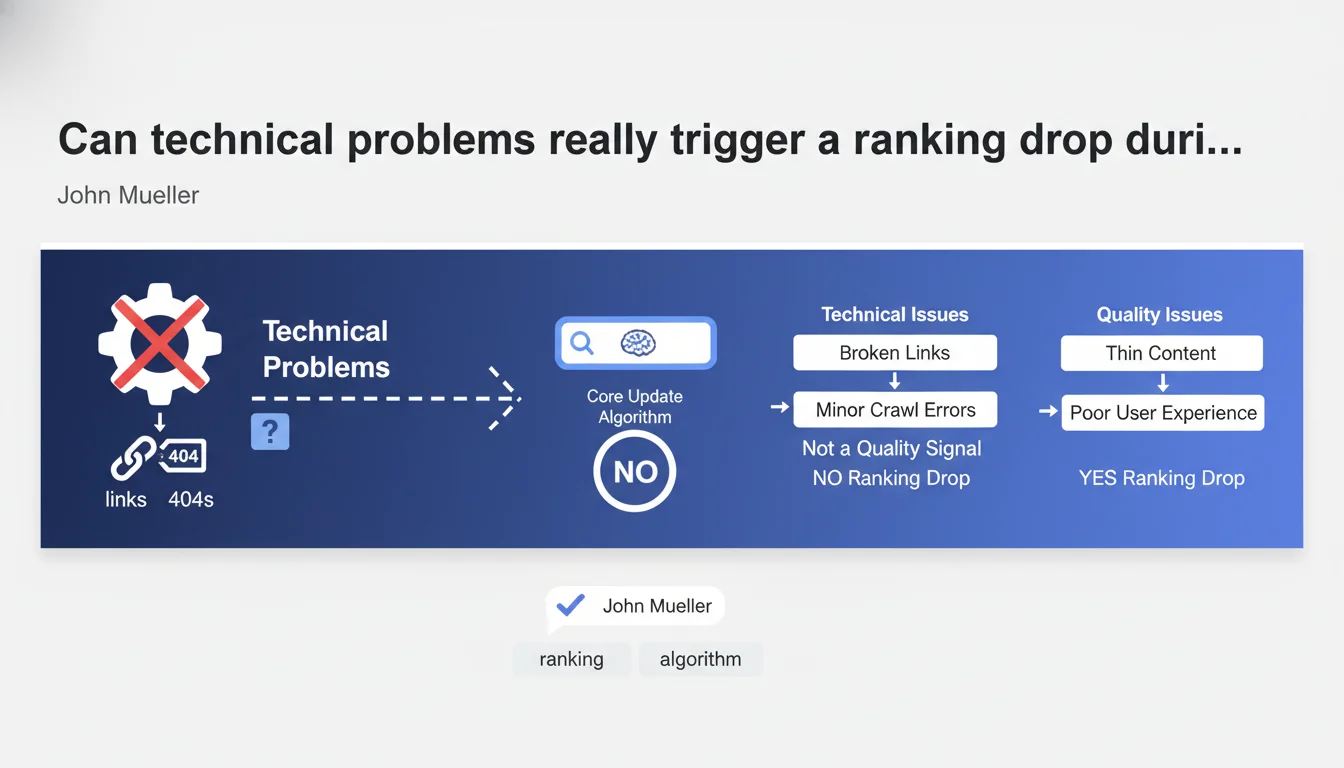
Google states that technical problems (404s, broken links) do not trigger Core Update algorithms, which exclusively target content quality. The distinction is clear: technical on one side, quality on the other — two separate systems that don't overlap.
What you need to understand
How does Google differentiate between technical and quality?
Mueller's statement draws a clear line: Core Updates evaluate editorial quality, not a site's technical health. A lingering 404, scattered broken links, a missing image — none of that triggers an algorithmic blow during a core update.
What matters for these updates is the content relevance, its expertise, its depth. Technical signals fall under other ranking or crawl systems, not global quality updates.
Why does Google emphasize this distinction?
Because post-Core Update recoveries consistently show sites hunting for a technical culprit. "It's my loading time", "I have three extra 404s" — when the real problem lies in the value delivered to users.
Google wants to prevent SEO teams from wasting time fixing minor technical details when the real issue is elsewhere: weak content, flawed editorial angle, insufficient expertise.
What can actually impact a Core Update?
Signals that matter touch on qualitative evaluation: information freshness, demonstration of expertise (E-E-A-T), user satisfaction measured by behavior, editorial consistency.
- Technical problems: handled by other algorithms (crawl, indexation, page experience)
- Quality problems: shallow content, lack of authority, poorly served intent
- Clear distinction: fixing 404s won't save a site hit by a Core Update
- Priority focus: improve editorial substance, not chase minor technical details
SEO Expert opinion
Does this technical-quality separation really hold up in practice?
In theory, yes. Observations align: a site with scattered 404s but solid content doesn't nosedive during a Core Update. However — and here's where it gets tricky — the boundary isn't always as clean in practice.
A site with thousands of 404s, devastated internal linking, orphaned pages everywhere… that eventually degrades user experience. And Google measures UX — through behavioral signals, bounce rate, time on page. So indirectly, massive technical issues can impact perceived quality.
Where does Mueller's statement lack nuance?
Mueller talks about "a few 404s or broken links". But he doesn't define the threshold. Three dead links? Thirty? Three hundred? [To verify]: Google has never published metrics to distinguish "negligible" from "problematic".
Another gray area: massive 5xx server errors, catastrophic loading times. Officially, that's technical — but if it blocks content access or destroys engagement, it inevitably impacts quality perception. The separation blurs.
Should you ignore technical issues when you drop after a Core Update?
No. But you need to prioritize intelligently. If you drop after a Core Update, focus first on content: depth, angle, expertise, intent-response match.
Technical matters — but as a foundation, not as a magic fix. A technically perfect site with mediocre content won't recover. A site with exceptional content but minor technical flaws will perform better — while leaving performance on the table.
Practical impact and recommendations
What should you fix first after a Core Update?
The first action is an editorial audit. Identify pages that lost traffic and ask yourself: does the content truly answer the search intent? Does expertise shine through? Are there proof points, concrete examples, verifiable data?
Compare with pages that gained in SERPs. Look at structure, detail level, angles covered. Often the difference jumps out: a competitor covers three aspects you neglect.
What mistakes should you absolutely avoid?
Don't hunt for 404s as if they're the key to recovery. Yes, fix them — but as part of normal maintenance, not post-Core Update emergency. Otherwise you're burning precious time.
Another trap: believing Core Web Vitals optimization will save you. These signals fall under Page Experience, not Core Updates. They matter, but separately.
How do you structure a concrete action plan?
- Analyze impacted pages and identify drop patterns
- Benchmark against better-ranked competitors: depth, freshness, editorial angle
- Strengthen visible expertise: identified authors, cited sources, verifiable data
- Rewrite or expand weak content, remove those without added value
- Optimize for search intent: each page must precisely serve what users seek
- Monitor behavioral metrics (time on page, bounce) as quality perception proxy
- Keep technical baseline healthy — but as foundational hygiene, not curative fix
❓ Frequently Asked Questions
Un site avec beaucoup de 404 peut-il quand même perdre du trafic lors d'un Core Update ?
Corriger mes problèmes techniques peut-il aider à récupérer après un Core Update ?
Google fait-il vraiment la différence entre technique et qualité dans ses algos ?
Quels signaux de qualité Google privilégie-t-il dans les Core Updates ?
Faut-il ignorer l'audit technique si je chute sur un Core Update ?
🎥 From the same video 15
Other SEO insights extracted from this same Google Search Central video · published on 29/04/2022
🎥 Watch the full video on YouTube →
💬 Comments (0)
Be the first to comment.