
Official statement
Other statements from this video 15 ▾
- □ Hreflang booste-t-il vraiment le ranking dans un pays ciblé ?
- □ Faut-il vraiment réduire le nombre de pages pour optimiser son SEO international ?
- □ Pourquoi Google ignore-t-il vos titres de page si la langue ne correspond pas au contenu ?
- □ Google utilise-t-il vraiment l'autorité de domaine pour classer les sites ?
- □ Pourquoi Googlebot refuse-t-il de cliquer sur vos boutons ?
- □ Les interstitiels JavaScript sont-ils vraiment sans risque pour le SEO ?
- □ Un bug technique pendant une Core Update peut-il vraiment faire chuter votre site ?
- □ Les problèmes techniques peuvent-ils vraiment déclencher une chute lors d'un Core Update ?
- □ La traduction de contenu est-elle pénalisée par Google ?
- □ Les traductions automatiques de mauvaise qualité peuvent-elles vraiment saboter votre SEO international ?
- □ Faut-il vraiment utiliser l'API d'indexation pour tous vos contenus ?
- □ Googlebot peut-il accéder à votre fichier .htaccess ?
- □ Google favorise-t-il réellement ses propres plateformes dans les résultats de recherche ?
- □ La meta description influence-t-elle vraiment le classement dans Google ?
- □ Faut-il vraiment choisir ses données structurées en fonction des résultats enrichis visés ?
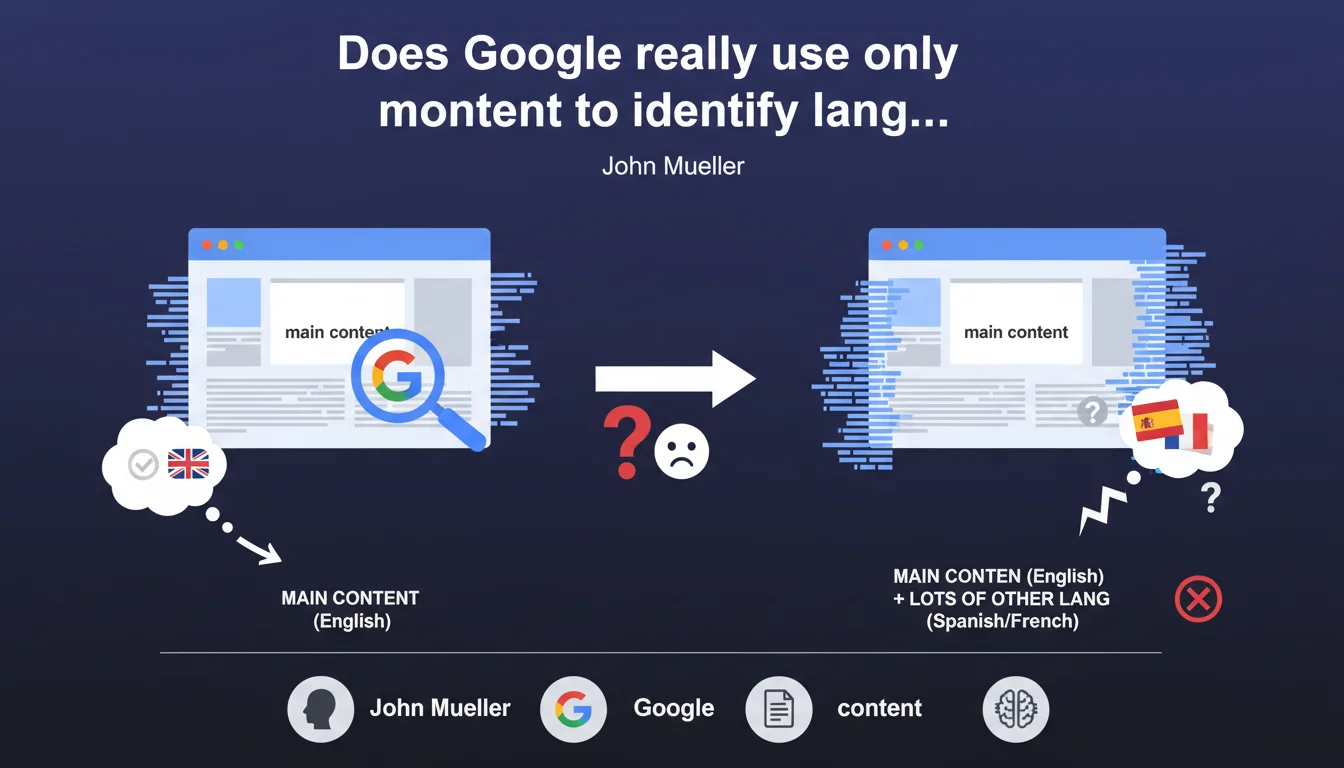
Google identifies a page's language by analyzing main content, not all elements on the page. When a page displays main content in English but integrates substantial sections in another language (comments, widgets, third-party content), the algorithm can become uncertain about the actual page language. Direct consequence: a risk of incorrect geographic and linguistic targeting in SERPs.
What you need to understand
Mueller's statement addresses a frequent issue: how does Google classify a page when multiple languages coexist? The official answer points to main content as the determining factor, but leaves a substantial gray area.
What exactly does Google mean by "main content"?
Main content is the central editorial section of the page — the part that answers the user's search intent. Not the header, not the footer, not the sidebar. We're talking about the article block, the product sheet, the informative text body.
Google uses visual segmentation algorithms to isolate this area. Page Layout Algorithm and DOM understanding systems allow it to distinguish primary content from secondary content. But this detection isn't infallible, especially on complex architectures or single-page applications.
Why does mixing languages create confusion?
Imagine a product page in English with a comments section in Spanish. If this section represents 40% of total text volume, linguistic signals become contradictory. Google may interpret this as a bilingual page — and thus hesitate to serve it in English or Spanish results.
Confusion increases when the main content/secondary content ratio isn't visually clear-cut. Insufficient structural markup (missing lang attributes, vague schema markup) aggravates the problem.
Can this ambiguity affect international ranking?
Absolutely. A page incorrectly identified linguistically can appear in wrong geographic versions of Google or be completely ignored in certain markets. Hreflang doesn't always compensate for this confusion — it indicates alternatives, but if the source page is already miscategorized, the signal remains noisy.
E-commerce sites with multilingual customer reviews or UGC platforms are particularly exposed. Erratic language identification can fragment visibility and dilute thematic authority per market.
- Main content = central editorial area responding to user intent
- The volume of secondary content in another language can create algorithmic confusion
- Direct risk: incorrect geographic targeting and visibility dilution per market
- Lang attributes and hreflang alone don't always resolve ambiguity
- Complex architectures and SPAs make main/secondary content segmentation harder for Google
SEO Expert opinion
Does this statement match real-world observations?
Yes, but with important nuances. We regularly observe multilingual pages being ranked in wrong geographic locations, especially on international e-commerce sites with unfiltered customer reviews in multiple languages. Google does prioritize main content — but its ability to isolate it correctly varies by architecture.
Tests show that on clear HTML structures with explicit semantic markup (main, article, section), detection works well. On heavy JavaScript layouts or content grids without clear visual hierarchy, Google struggles more. [To verify]: the actual impact of the main/secondary content volumetric ratio — Mueller provides no numerical threshold.
What gray areas remain in this explanation?
Mueller deliberately stays vague about thresholds. At what percentage of secondary content in another language does confusion appear? 20%? 50%? No data. This imprecision complicates auditing — you can't precisely quantify the risk.
Second gray area: how does Google handle dynamically generated content (comments loaded via JavaScript, third-party widgets)? Is it systematically excluded from language analysis or can it influence the signal? Testing suggests that client-side rendered but crawler-visible content is taken into account, but without absolute certainty.
Third point: weighting of lang attributes. Mueller doesn't clarify whether a lang="en" attribute on the main tag is sufficient to eliminate all ambiguity when 30% of visible content is in another language. Experience shows it's not — textual signals often override markup.
In what cases does this rule not fully apply?
On pages with high volumes of structured secondary content (forums, Q&A, massive comments sections), the boundary becomes blurred. If a FAQ page contains 10 question-answer pairs in English and 50 comments in Spanish, the "main content" theoretically remains the FAQ — but volumetric ratio can reverse the perceived signal.
International news sites with multilingual "related articles" widgets also hit this limit. An article page in French with a sidebar displaying 15 article titles in German can generate confusion, especially if these titles are present in the crawled DOM.
Practical impact and recommendations
What should you concretely do to avoid language confusion?
First, structurally isolate main content with clear semantic tags: main, article, section with explicit lang attributes. Avoid flat structures where Google must guess which area is primary.
Second, filter or segment multilingual secondary content. If you display comments in multiple languages, use a language-based tabbed system or a default filter aligned with main content language. This reduces the volume of competing text visible to crawlers.
Third, audit volumetric ratios. Analyze your pages with a language detection tool (e.g., NLP libraries like langdetect, fastText) to identify pages where secondary content exceeds 30% of total volume in a different language. Prioritize these for refactoring.
What critical mistakes should you avoid?
Don't fail to linguistically mark distinct sections. A page with English content and Spanish comments must have different lang attributes on each block. Missing markup forces Google to average — and thus hesitate.
Don't confuse hreflang with language confusion resolution. Hreflang indicates geographic alternatives, it doesn't fix a poorly identified source page. If Google ranks your English page as Spanish, hreflang won't solve the root problem.
Avoid uncontrolled third-party widgets injecting content in another language (chats, cross-border product recommendations). If you must keep them, load them via iframe or conditional lazy loading to limit visibility during initial crawl.
- Use HTML5 semantic tags (main, article) with explicit lang attributes
- Visually and structurally segment multilingual secondary content
- Audit volumetric ratio of main/secondary content by language on critical templates
- Mark each section with its specific lang attribute, not just the html tag
- Test pages with automatic language detection tools to identify ambiguities
- Limit injection of multilingual third-party content or isolate it technically (iframe, lazy load)
- Check Search Console performance by country to detect targeting anomalies
- Prioritize high-traffic international pages for in-depth language structure auditing
Google's language detection relies on main content identifiable through structure. A significant volume of secondary content in another language creates confusion that can degrade geographic targeting. Solutions involve clear semantic HTML architecture, granular language markup, and limiting competing content visible to crawlers.
These optimizations span technical architecture, front-end development, and multilingual editorial strategy. For complex international sites, orchestrating these three dimensions simultaneously quickly becomes a headache. If you manage a multilingual product catalog or a UGC platform at scale, consulting with an SEO agency specialized in international can save you time — and crucially, avoid costly cross-border visibility mistakes.
❓ Frequently Asked Questions
Le hreflang suffit-il à compenser une confusion linguistique sur le contenu principal ?
À partir de quel ratio de contenu secondaire dans une autre langue Google se trompe-t-il ?
Les attributs lang sur chaque section suffisent-ils à lever toute ambiguïté ?
Comment détecter si mes pages souffrent de confusion linguistique ?
Les commentaires ou avis clients dans plusieurs langues posent-ils systématiquement problème ?
🎥 From the same video 15
Other SEO insights extracted from this same Google Search Central video · published on 29/04/2022
🎥 Watch the full video on YouTube →
💬 Comments (0)
Be the first to comment.