
Official statement
Other statements from this video 15 ▾
- □ Hreflang booste-t-il vraiment le ranking dans un pays ciblé ?
- □ Faut-il vraiment réduire le nombre de pages pour optimiser son SEO international ?
- □ Comment Google détermine-t-il vraiment la langue d'une page multilingue ?
- □ Pourquoi Google ignore-t-il vos titres de page si la langue ne correspond pas au contenu ?
- □ Google utilise-t-il vraiment l'autorité de domaine pour classer les sites ?
- □ Pourquoi Googlebot refuse-t-il de cliquer sur vos boutons ?
- □ Les interstitiels JavaScript sont-ils vraiment sans risque pour le SEO ?
- □ Un bug technique pendant une Core Update peut-il vraiment faire chuter votre site ?
- □ Les problèmes techniques peuvent-ils vraiment déclencher une chute lors d'un Core Update ?
- □ La traduction de contenu est-elle pénalisée par Google ?
- □ Les traductions automatiques de mauvaise qualité peuvent-elles vraiment saboter votre SEO international ?
- □ Faut-il vraiment utiliser l'API d'indexation pour tous vos contenus ?
- □ Googlebot peut-il accéder à votre fichier .htaccess ?
- □ La meta description influence-t-elle vraiment le classement dans Google ?
- □ Faut-il vraiment choisir ses données structurées en fonction des résultats enrichis visés ?
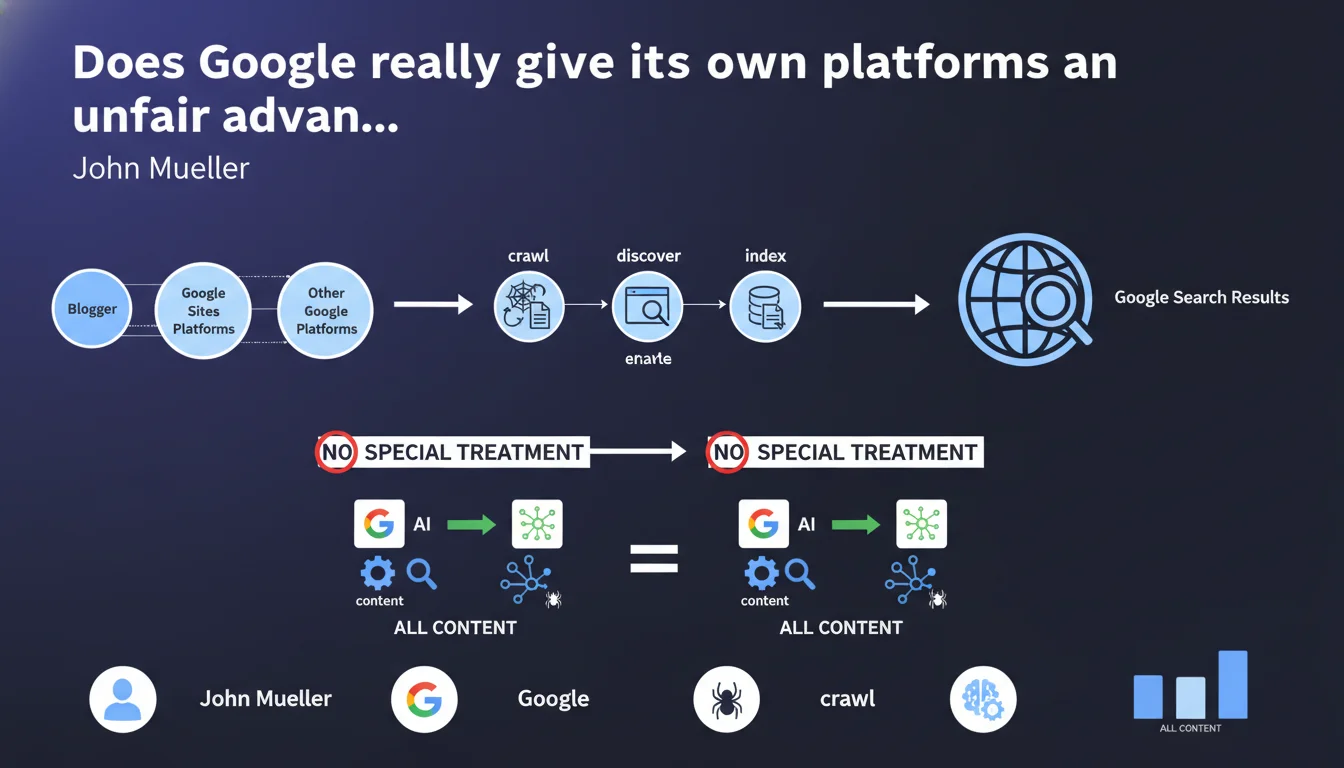
Google claims that Blogger, Google Sites, and its other platforms receive no algorithmic advantage in search results. These contents must be crawled and indexed exactly like any third-party site. A statement that deserves careful verification.
What you need to understand
Why is Google making this clarification?
This statement comes at a time when accusations of abuse of dominant position are multiplying against Google. The European Union and the United States are closely scrutinizing the practices of the Mountain View giant, particularly its tendency to favor its own services in SERPs.
By asserting that Blogger or Google Sites receive no preferential treatment, Mueller is directly addressing this suspicion. The message is clear: no algorithmic shortcuts for in-house platforms.
What does "no special treatment" actually mean in practice?
According to this statement, an article published on Blogger must go through the same steps as a self-hosted WordPress article: discovery via links or sitemap, crawling by Googlebot, quality evaluation, then indexation. No priority queue.
Ranking criteria remain identical — content relevance, quality backlinks, user experience, E-E-A-T. A mediocre Google Sites page should not outrank an excellent third-party page.
What are the key points to remember?
- No priority crawling for Google platforms — they depend on standard crawl budget
- No algorithmic boost in terms of ranking or indexation
- Google content must meet the same quality standards as any other site
- This statement concerns Blogger, Google Sites, but potentially also other Google services hosting content
- The claim remains unverifiable from the outside — only Google has access to its internal algorithms
SEO Expert opinion
Is this statement consistent with what we observe in the field?
Let's be honest: it's complicated to verify. Large-scale studies are lacking to confirm or definitively refute this claim. Some SEOs report having observed slightly faster indexation on Blogger, but this could be explained by other factors — technical structure, loading speed, absence of crawl bugs.
What is certain is that Google Sites and Blogger do not dominate competitive SERPs. If an advantage existed, we would see these platforms systematically crushing WordPress and other CMSs on commercial queries. This is not the case.
Moreover, the question is not so much about classical hosting platforms (Blogger, Sites) as it is about Google services integrated directly into SERPs — Google Shopping, Google Travel, Google Flights, enriched Google Business Profile snippets. There, preferential treatment is obvious and documented. [To be verified] whether this statement covers these services as well or only publishing platforms.
In what cases might this rule not apply completely?
There is a significant nuance: even without direct algorithmic advantage, Google platforms benefit from structural advantages. A Blogger subdomain potentially inherits authority from the main blogger.com domain, which receives millions of backlinks. This is a non-negligible indirect boost.
Similarly, Google perfectly understands the technical architecture of its own platforms. No risk of JavaScript misinterpretation, rendering issues, or crawl errors — the infrastructure is optimal by default. This is not algorithmic preferential treatment, but it remains a real competitive advantage.
Should you use Blogger or Google Sites for your SEO?
No. Even without algorithmic disadvantage, these platforms have major structural limitations for professional SEO — limited customization, restricted technical control, complex migration, missing advanced SEO features.
A well-configured WordPress on performant hosting offers infinitely more flexibility. Mueller's statement simply indicates that you won't be penalized if you use Blogger — not that it's the optimal choice.
Practical impact and recommendations
Should you migrate a site currently on Blogger or Google Sites?
If your site is performing well and you don't need advanced features, there's no rush. The statement confirms that there's no major structural handicap — you're not doomed to stagnate.
However, for a serious commercial project or an ambitious media outlet, migration to a more flexible solution remains relevant. Not for immediate SEO gains, but to unlock optimization levers inaccessible on Google platforms — advanced schema markup, fine crawl control, deep UX customization.
What mistakes should you avoid following this statement?
- Don't interpret "no preferential treatment" as "identical SEO performance" — the quality of your content and strategy remain decisive
- Don't choose Blogger only because it's Google — technical fit for your project comes first
- Don't neglect indirect aspects (inherited domain authority, infrastructure) that still matter
- Don't extrapolate this statement to integrated services (Shopping, Flights, etc.) that clearly receive different treatment
- Don't abandon your SEO efforts under the pretext that "Google says everything is fair" — competition remains fierce
How do you optimize concretely in this context?
Focus on the fundamentals that work regardless of platform — content quality, semantic relevance, user experience, backlink strategy. If Google truly treats all platforms equally, your execution will make the difference.
Regularly audit your indexation and crawl via Search Console. Verify that Google is discovering your content properly, that there are no technical blocks, that important pages are indexed. On Blogger as elsewhere, these checks remain essential.
❓ Frequently Asked Questions
Google favorise-t-il ses propres services dans les résultats de recherche ?
Un site sur Blogger a-t-il les mêmes chances de ranker qu'un site WordPress ?
Est-ce que l'indexation est plus rapide sur les plateformes Google ?
Peut-on vérifier cette déclaration de manière indépendante ?
Faut-il utiliser Google Sites pour améliorer son SEO ?
🎥 From the same video 15
Other SEO insights extracted from this same Google Search Central video · published on 29/04/2022
🎥 Watch the full video on YouTube →
💬 Comments (0)
Be the first to comment.