
Official statement
Other statements from this video 15 ▾
- □ Hreflang booste-t-il vraiment le ranking dans un pays ciblé ?
- □ Faut-il vraiment réduire le nombre de pages pour optimiser son SEO international ?
- □ Comment Google détermine-t-il vraiment la langue d'une page multilingue ?
- □ Pourquoi Google ignore-t-il vos titres de page si la langue ne correspond pas au contenu ?
- □ Google utilise-t-il vraiment l'autorité de domaine pour classer les sites ?
- □ Pourquoi Googlebot refuse-t-il de cliquer sur vos boutons ?
- □ Les interstitiels JavaScript sont-ils vraiment sans risque pour le SEO ?
- □ Un bug technique pendant une Core Update peut-il vraiment faire chuter votre site ?
- □ Les problèmes techniques peuvent-ils vraiment déclencher une chute lors d'un Core Update ?
- □ La traduction de contenu est-elle pénalisée par Google ?
- □ Les traductions automatiques de mauvaise qualité peuvent-elles vraiment saboter votre SEO international ?
- □ Faut-il vraiment utiliser l'API d'indexation pour tous vos contenus ?
- □ Googlebot peut-il accéder à votre fichier .htaccess ?
- □ Google favorise-t-il réellement ses propres plateformes dans les résultats de recherche ?
- □ Faut-il vraiment choisir ses données structurées en fonction des résultats enrichis visés ?
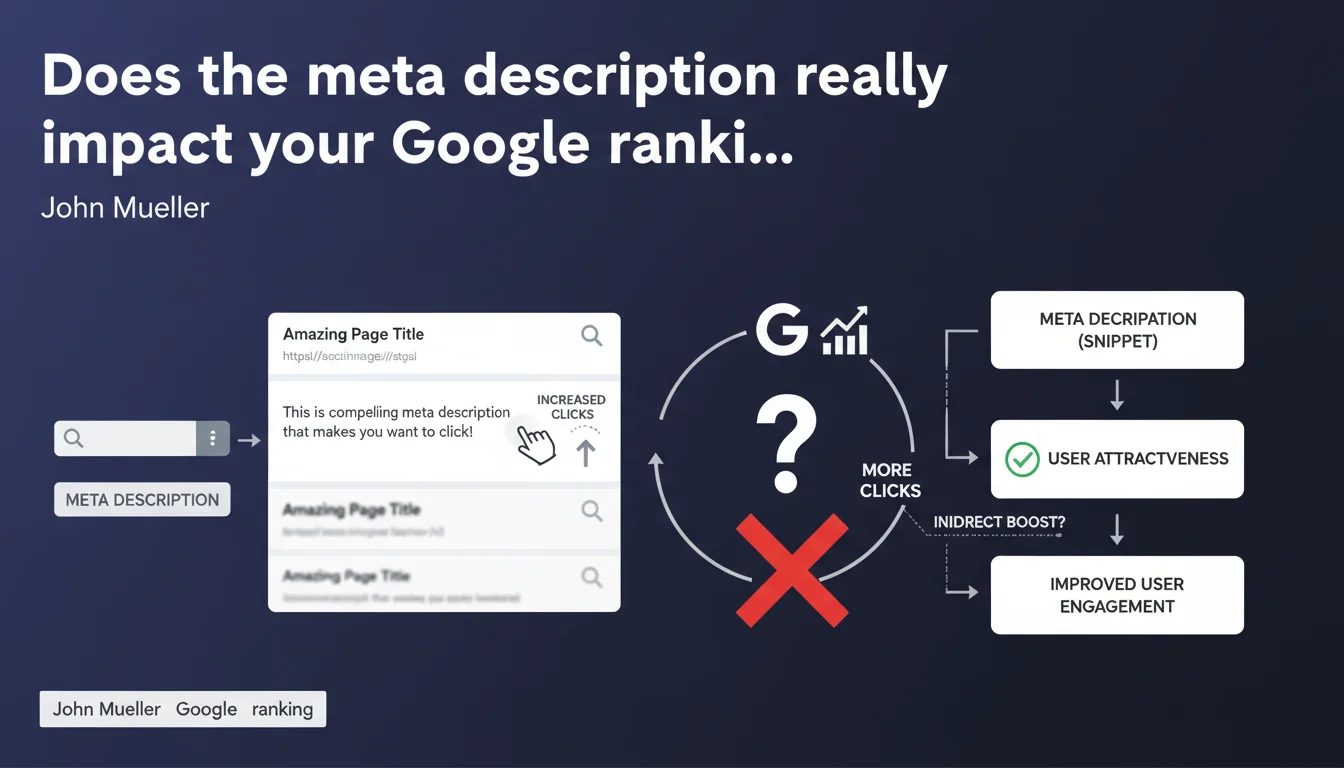
Google confirms that the meta description plays no role in rankings. It only serves to generate the snippet displayed in search results. However, a well-written snippet can boost your click-through rate, indirectly influencing visibility.
What you need to understand
Why does Google ignore the meta description for rankings?
The meta description has never been a direct ranking factor. Google has confirmed this repeatedly, and John Mueller makes it crystal clear here. This HTML tag is used exclusively to provide descriptive text that the search engine can display below the title in the SERPs.
Unlike title tags or h1-h6 content, the meta description sends no signals of thematic relevance to ranking algorithms. Google prioritizes visible page content, link signals, user experience — the meta description remains on the sidelines of this equation.
So what is its real purpose?
The meta description acts as a sales pitch in search results. It must convince the user to click on your link rather than your competitor's. It's a conversion tool, not a positioning lever.
An attractive snippet can increase your click-through rate (CTR), which sends positive signals to Google about your page's relevance for a given query. Indirectly, this can influence your visibility — but the mechanism is indirect and tied to user behavior, not to the content of the tag itself.
Does Google always use the meta description you provide?
No. Google regularly rewrites snippets by pulling from your page content. If your meta description doesn't match the user's search query or if Google determines that an excerpt from your body text is more relevant, it will replace it.
You can write the most polished meta description in the world — if Google decides that a passage from your article better answers the search intent, that passage will be displayed instead. You only have partial control over what ultimately appears in the SERPs.
- The meta description is not a ranking factor — Google ignores it for classification.
- It only serves to generate the snippet in search results.
- A good snippet can increase your CTR, indirectly influencing visibility.
- Google can rewrite the snippet based on the query and page content.
- Control over final display remains partial.
SEO Expert opinion
Is this statement consistent with real-world observations?
Absolutely. Correlation tests conducted over the years show a lack of connection between the presence or quality of a meta description and positioning in the SERPs. Inserting keywords into this tag won't move your rankings.
On the other hand, we observe a measurable impact on CTR when the meta description is well-written, relevant, and compelling. This click gain can, in certain contexts, strengthen visibility — but it's a side effect, not a direct ranking mechanism.
Should you still write meta descriptions?
Yes, despite everything. Even though Google often rewrites them, providing an optimized meta description remains a best practice. You keep a chance to control the message displayed, especially on transactional or strategic pages where every click counts.
Let's be honest — if you let Google improvise, it will sometimes pull poorly formatted or out-of-context excerpts. You might as well give it a solid base. But don't expect miracles: a perfect meta description will never compensate for weak content or insufficient link signals.
What are the limitations of this approach?
Google doesn't specify the extent to which CTR influences rankings. We know that user behavior matters, but the mechanisms remain opaque. [To verify]: the real impact of high CTR on positioning is not officially documented.
Moreover, if your page ranks poorly, even the best snippet in the world won't generate traffic. The meta description optimizes what already exists — it doesn't create visibility from scratch. It's a tool for converting SERP traffic, not generating traffic.
Practical impact and recommendations
What should you actually do with meta descriptions?
Write unique and compelling meta descriptions for your strategic pages: product sheets, pillar pages, landing pages. Focus on value proposition and search intent. Use a tone that resonates with your audience.
For large sites (thousands of pages), automate meta description generation using consistent templates. A generic but relevant meta description is better than none at all or a sloppy copy-paste job.
What mistakes should you absolutely avoid?
Don't stuff your meta description with keywords as if it were still 2005. Google doesn't factor it into rankings, and an unreadable snippet will drive users away. Aim for clarity and appeal, not keyword density.
Avoid duplicate meta descriptions across multiple pages. If Google detects duplication, it may systematically rewrite your snippets — you lose all control. Each page deserves its own description, or none if you don't have the resources to do it right.
How do you measure the effectiveness of your meta descriptions?
Analyze CTR in Search Console. Compare performance between pages with optimized meta descriptions versus those without or with generic descriptions. If CTR increases without a position boost, that means your snippet is working.
Test different approaches: questions, benefits, numbers, urgency. Monitor bounce rates — a misleading snippet can generate clicks but also immediate exits if your page doesn't deliver on the promise.
- Write unique meta descriptions for each strategic page
- Target 150-160 characters to avoid truncation in the SERPs
- Focus on value proposition, not keywords
- Avoid duplication across pages
- Automate with templates for large-scale sites
- Measure CTR in Search Console to evaluate impact
- Don't expect any direct ranking gains — it's a SERP conversion tool
❓ Frequently Asked Questions
Faut-il mettre des mots-clés dans la meta description ?
Quelle est la longueur idéale d'une meta description ?
Google affiche-t-il toujours la meta description que j'ai rédigée ?
Dois-je créer une meta description pour toutes les pages ?
Un bon CTR peut-il influencer le ranking ?
🎥 From the same video 15
Other SEO insights extracted from this same Google Search Central video · published on 29/04/2022
🎥 Watch the full video on YouTube →
💬 Comments (0)
Be the first to comment.