
Official statement
Other statements from this video 15 ▾
- □ Hreflang booste-t-il vraiment le ranking dans un pays ciblé ?
- □ Faut-il vraiment réduire le nombre de pages pour optimiser son SEO international ?
- □ Comment Google détermine-t-il vraiment la langue d'une page multilingue ?
- □ Pourquoi Google ignore-t-il vos titres de page si la langue ne correspond pas au contenu ?
- □ Google utilise-t-il vraiment l'autorité de domaine pour classer les sites ?
- □ Pourquoi Googlebot refuse-t-il de cliquer sur vos boutons ?
- □ Les interstitiels JavaScript sont-ils vraiment sans risque pour le SEO ?
- □ Un bug technique pendant une Core Update peut-il vraiment faire chuter votre site ?
- □ Les problèmes techniques peuvent-ils vraiment déclencher une chute lors d'un Core Update ?
- □ Les traductions automatiques de mauvaise qualité peuvent-elles vraiment saboter votre SEO international ?
- □ Faut-il vraiment utiliser l'API d'indexation pour tous vos contenus ?
- □ Googlebot peut-il accéder à votre fichier .htaccess ?
- □ Google favorise-t-il réellement ses propres plateformes dans les résultats de recherche ?
- □ La meta description influence-t-elle vraiment le classement dans Google ?
- □ Faut-il vraiment choisir ses données structurées en fonction des résultats enrichis visés ?
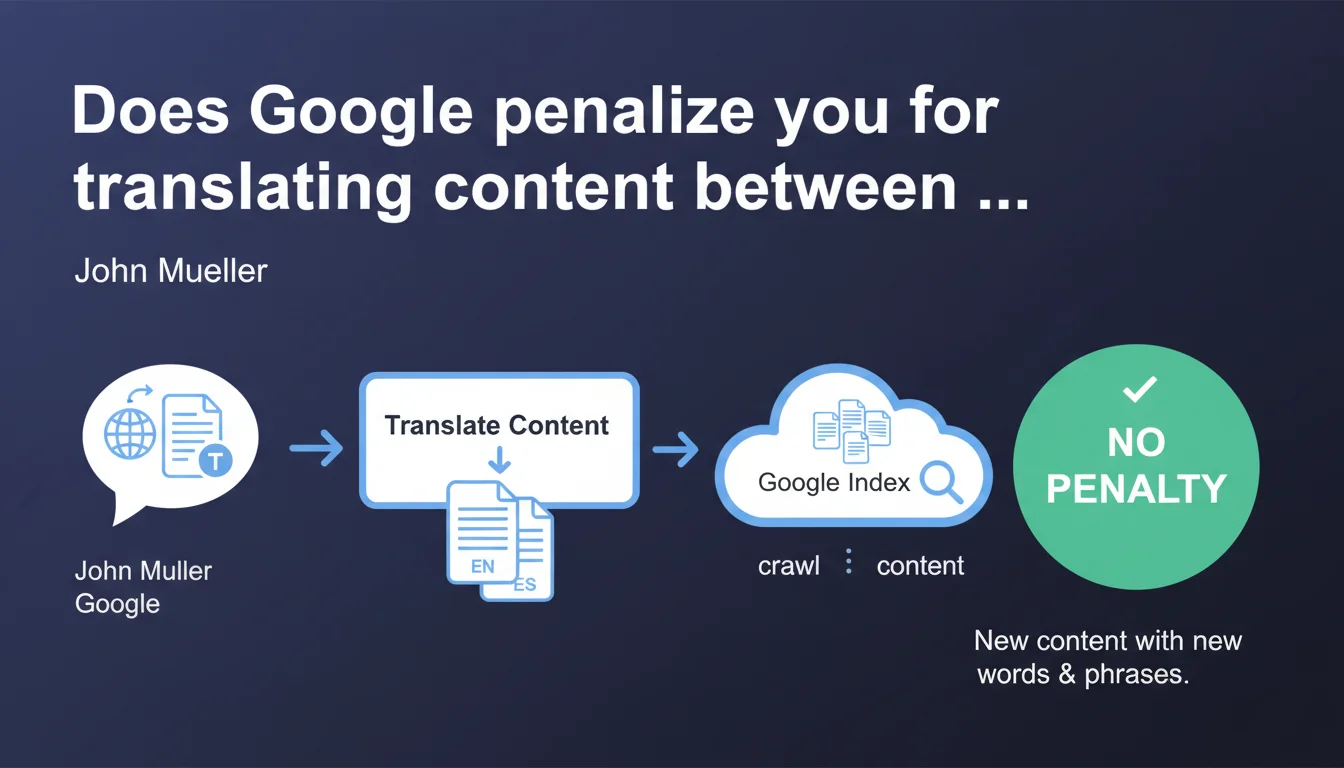
Google does not penalize content translation from one language to another. Each language version is considered unique content with its own words and phrases, crawlable and indexable normally. Multilingual websites can therefore translate their pages without fear of duplicate content penalties.
What you need to understand
Why is this statement so important for multilingual websites?
International sites often hesitate to translate their content for fear of being penalized for duplicate content. This concern stems from a misunderstanding: Google does not consider two identical pages in different languages as duplicate content.
Mueller clarifies here that translation technically creates new content. Words, phrases, and linguistic structures differ fundamentally from one language to another, even if the meaning remains identical.
How does Google differentiate between language versions?
The search engine analyzes each page in its respective language. A text in French and its German translation are indexed separately, with their own semantic signals and their own positioning in local search results.
The hreflang tags allow you to explicitly signal to Google that these are alternative versions of the same content. This prevents any confusion and optimizes the display of the correct version based on the user's language.
What are the conditions for this to work correctly?
The translation must be of professional quality. An unrevised machine translation, full of errors or incomprehensible, will add no value and could even harm user experience.
- Each language version is crawled and indexed independently
- Translation is not considered duplicate content
- Hreflang tags remain essential to signal alternative versions
- Translation quality directly impacts user experience and SEO performance
- Each version can rank differently depending on its local market
SEO Expert opinion
Is this statement consistent with real-world observations?
Absolutely. Well-configured multilingual sites experience no penalty related to translation. In fact, we often observe the opposite: translated versions outperform original content that is poorly optimized for their local market.
The nuance missing here: Mueller does not specify the importance of localization versus simple translation. A word-for-word translation may be technically correct but completely unsuitable for local search queries and search intent.
What pitfalls await multilingual sites despite this statement?
The first pitfall: using unverified automated translations. Google can index these pages, certainly, but their mediocre quality will negatively impact ranking and engagement metrics.
Second mistake: neglecting technical implementation. Poorly structured URLs, incorrect hreflang tags, or misconfigured geolocation redirects create more problems than the translation itself. [To verify]: Google remains vague about how it handles inconsistencies between hreflang signals and other language indicators.
In what cases might this rule not be sufficient?
Translating thin or low-quality content remains a poor strategy. If the original page adds no value, its translation won't either. Google evaluates relevance and quality in each language independently.
Local markets have their own requirements. A page that performs in US English won't automatically succeed in French if it ignores cultural specifics, date formats, currencies, or local search intent. Translation is just one brick — complete localization is the real challenge.
Practical impact and recommendations
What should you do concretely to optimize your multilingual content?
Start by auditing your multilingual architecture. Verify that each language version has its own clear URL (subdomains, subdirectories, or ccTLD depending on your strategy).
Implement hreflang tags correctly on all translated pages. Use Google Search Console to verify that no errors are reported. These tags are your assurance that Google understands the relationship between your versions.
What mistakes should you avoid at all costs?
Never settle for raw automated translations. Google Translate or DeepL are starting tools, not final solutions. Review by a native speaker is essential.
Avoid mechanically duplicating your content structure without adapting to local searches. Perform keyword research specific to each language — queries vary considerably from one market to another.
- Audit your multilingual URL structure (subdirectories, subdomains, or ccTLD)
- Implement and test hreflang tags on all translated pages
- Prioritize professional translations or at least review by native speakers
- Conduct distinct keyword research for each language market
- Localize cultural elements (currencies, formats, examples, references)
- Check Search Console for the absence of hreflang errors
- Monitor the performance of each language version separately
- Adapt your meta-descriptions and titles to local queries, not just translations
How do you verify that your multilingual configuration is optimal?
Use URL inspection in Search Console for each language version. Verify that Google correctly detects the language and associated hreflang tags.
Analyze performance by country and language in Search Console. If a translated version generates no organic traffic, it's either a technical issue or content unsuitable for the local market.
❓ Frequently Asked Questions
Puis-je utiliser Google Translate directement pour traduire mes pages ?
Dois-je créer du contenu unique pour chaque langue ou la traduction suffit-elle ?
Les balises hreflang sont-elles obligatoires pour éviter une pénalité ?
Faut-il traduire absolument toutes les pages de mon site ?
Mon contenu traduit ne rank pas, est-ce normal ?
🎥 From the same video 15
Other SEO insights extracted from this same Google Search Central video · published on 29/04/2022
🎥 Watch the full video on YouTube →
💬 Comments (0)
Be the first to comment.