
Official statement
Other statements from this video 14 ▾
- □ Does a 403 error on mobile really block your entire site from being indexed by Google?
- □ Do 404 errors and 301 redirects really hurt your SEO rankings?
- □ Does the canonical tag really prevent your pages from being indexed?
- □ Why does Google treat hreflang and canonical tags as two completely separate mechanisms?
- □ Does the disavow tool really delete toxic backlinks from Google's index?
- □ How can you create unique content for identical products without falling into duplicate content traps?
- □ Should you really verify each subdomain separately in Search Console?
- □ Do you really need to worry about a high volume of 404 errors on your site?
- □ Should you really mark every affiliate link with rel=nofollow or rel=sponsored?
- □ Do Google's quality raters really affect your site's search rankings?
- □ How long does Google actually remember old URLs after a site migration?
- □ Is mobile-first indexing really the standard for every website on the web?
- □ Is the .ai domain really being treated as a gTLD by Google?
- □ Does cutting your indexed pages really boost SEO, or is it just a myth?
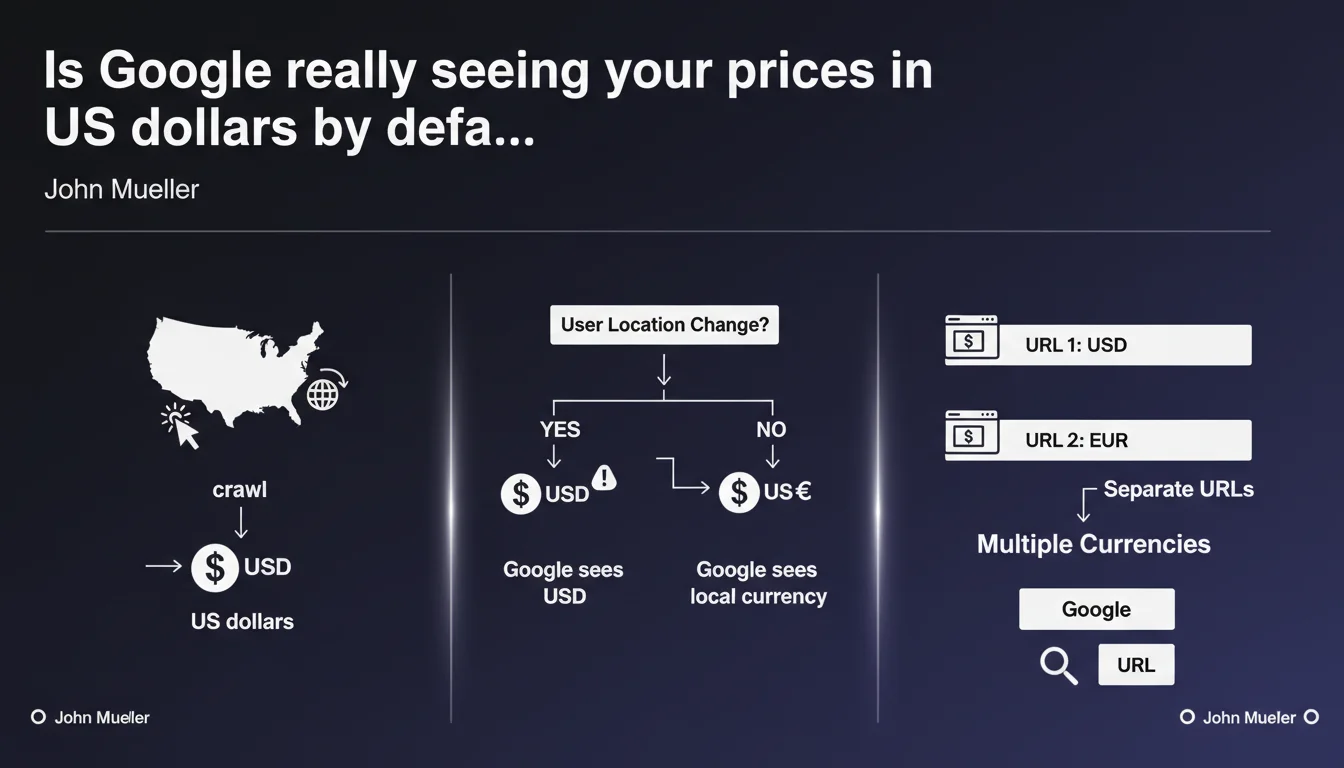
Google crawls primarily from the United States, which means your e-commerce site will display prices in US dollars by default in search results if you geolocalize your currency. To have Google index and display multiple currencies correctly, you need to set up separate URLs for each currency version — automatic detection based on crawler IP won't work.
What you need to understand
Where does Google crawl your pages from?
The vast majority of Google's crawling happens from US-based datacenters. In concrete terms, when Googlebot visits your site, it does so with an IP address located in the United States in the overwhelming majority of cases.
This technical reality has direct consequences for what Google sees and indexes. If your site adapts its content based on user geolocation — currency, language, product availability — Google will see the American version by default.
What does this change for a multi-currency e-commerce site?
If your site automatically detects visitor location to display prices in euros, pounds sterling, or Swiss francs, Google will primarily see dollars. It's its American IP that triggers this adaptation.
The result? In search results, product rich snippets, price snippets — everything will display the American currency. For European users searching for your products, it's inconsistent and counterproductive.
What is Google's recommended solution?
Mueller is clear: you need separate URLs per currency. No dynamic content that adapts to visitor IP. Each currency version must have its own stable address that Google can crawl and index independently.
It's the same principle as language versions with hreflang — except here we're talking about currency segmentation rather than language segmentation.
- Google crawls from the USA in the majority of cases
- Sites that adapt currency based on IP will show US dollars to Google
- To display multiple currencies in SERPs, you need distinct URLs
- Automatic geolocation doesn't work for multi-currency indexing
- This constraint also applies to product rich snippets
SEO Expert opinion
Is this statement consistent with what we observe in practice?
Absolutely. SEOs managing international e-commerce sites know this well: relying on IP detection to serve localized content to Google is a classic mistake. We find this same logic for language content, geotargeted promotions, product availability restrictions.
What Mueller doesn't specify — and it's unfortunate — is the frequency at which Google crawls from other countries. He says "predominantly" from the USA, but what's the exact proportion? 70%? 95%? [To verify] This nuance matters for sizing the risk.
What nuance should be applied to this rule?
Google may sometimes crawl from other locations, particularly to verify consistency across international versions or test site behavior. But betting on that for your currency indexing is gambling — not solid SEO strategy.
Another point: Mueller talks about separate URLs, but doesn't detail the optimal technical mechanism. Subdomains? Subdirectories? URL parameters? The answer depends on your overall architecture, but subdirectories generally remain the cleanest solution for crawling and link equity.
In which cases does this constraint really cause problems?
For sites that built their entire architecture on dynamic personalization. Moving to fixed URLs per currency often represents significant technical rework — session management, cookies, redirects, canonicals.
E-commerce platforms like Shopify or WooCommerce don't always facilitate this approach by default. You need specific plugins or custom development to cleanly separate currency versions without unnecessarily duplicating content.
Practical impact and recommendations
What do you need to do concretely to index multiple currencies?
First, abandon automatic IP-based detection for your product pages meant for natural search. Create stable, distinct URLs for each currency you want to appear in Google results.
Next, implement clear navigation that allows users — and Googlebot — to switch between currency versions. A permanent currency selector in the header, not a script that guesses location.
- Create separate URLs for each currency (e.g., /fr/eur/product and /fr/chf/product)
- Implement hreflang tags if currencies combine with different languages
- Add schema.org Product markup with the "priceCurrency" property correctly filled in for each version
- Verify in Search Console that the correct URLs are indexed for each target market
- Avoid automatic IP-based redirects that would prevent Google from crawling all versions
- Use self-referencing canonicals to prevent Google from treating versions as duplicate content
- Test crawling with a VPN or tools like Screaming Frog from different locations
What technical errors should you avoid?
The worst mistake: setting up 302 or 303 redirects that automatically send Googlebot to the USD version because it arrives with a US IP. You then cancel out any benefit of having separate URLs.
Another common trap: using client-side JavaScript to modify displayed prices. Google can execute JS, but with its US IP, it will still see the USD version if your script is based on geolocation.
How do you verify your configuration is working?
Use the URL inspection tool in Search Console for each currency version. Verify that Google is crawling and indexing the right pages with the right prices in the rendered HTML.
Also test with geotargeted searches in Google. Use a VPN or search settings to simulate a query from Switzerland, France, Canada — and verify that rich snippets display the expected currency.
❓ Frequently Asked Questions
Google crawle-t-il parfois depuis d'autres pays que les États-Unis ?
Peut-on utiliser des paramètres d'URL pour gérer les devises au lieu de sous-répertoires ?
Faut-il déclarer les versions par devise dans le sitemap XML ?
Les balises hreflang sont-elles obligatoires pour les versions par devise ?
Comment éviter le duplicate content entre versions monétaires du même produit ?
🎥 From the same video 14
Other SEO insights extracted from this same Google Search Central video · published on 11/07/2023
🎥 Watch the full video on YouTube →
💬 Comments (0)
Be the first to comment.