
Official statement
Other statements from this video 12 ▾
- □ Does having multiple URLs for the same content really trigger a Google penalty?
- □ Why does Google refuse to reveal the complete formula behind its ranking algorithm?
- □ Should you embrace experimentation to unlock your SEO potential?
- □ Should SEOs be comfortable admitting when they don't have all the answers?
- □ Does eliminating redirect chains really protect your crawl budget from wasting resources?
- □ Is the impact/effort matrix really the key to prioritizing your SEO tasks effectively?
- □ Should SEOs dictate technical solutions to developers, or simply expose the SEO problems they've identified?
- □ Does choosing between 301 and 302 redirects really impact your Google rankings?
- □ Is developing content that remains invisible to search engines really worth your time and effort?
- □ Does Google really push algorithm updates every single minute?
- □ Should you really integrate SEO from the development phase to avoid costly fixes later?
- □ Can SEO pages without real user value still rank in Google?
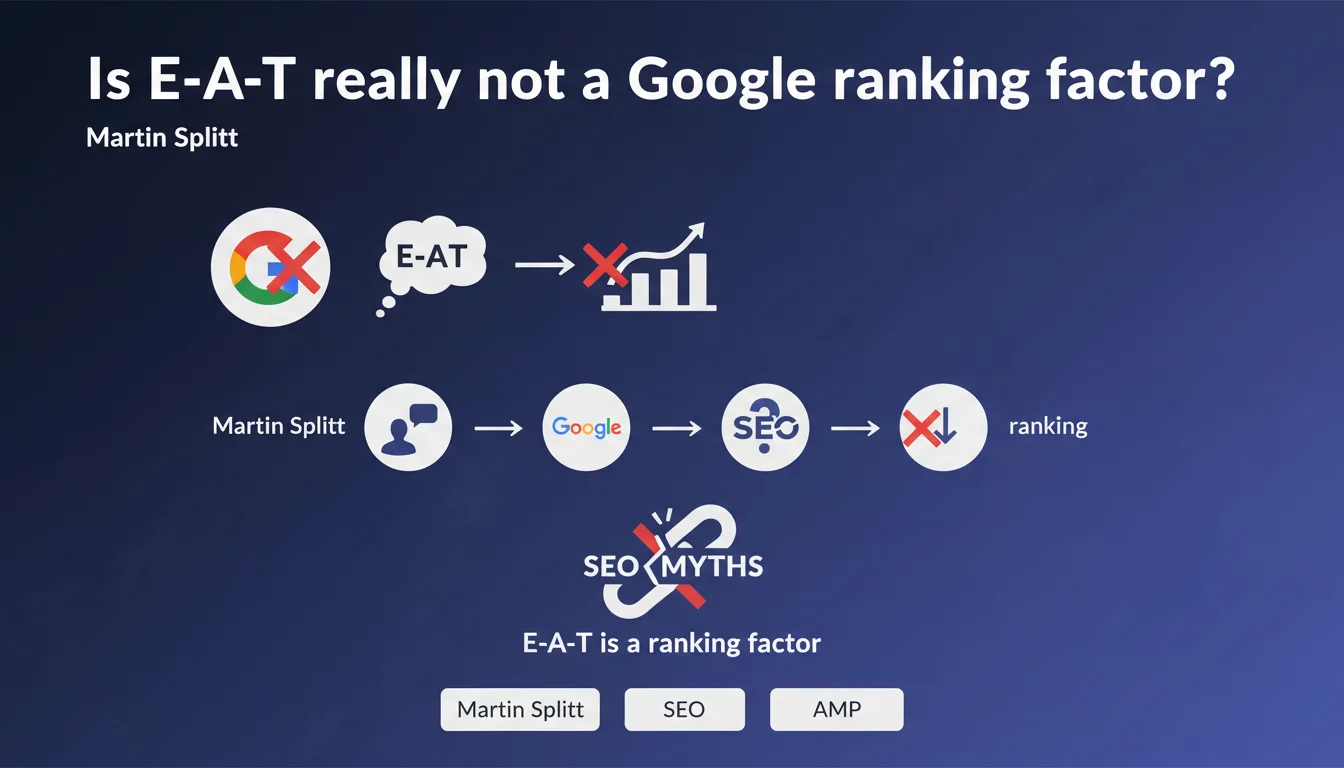
Martin Splitt definitively dismisses the idea that E-A-T would be a direct ranking factor. He categorizes this belief among the persistent SEO myths that still clutter professional discussions. Concretely, this means Google doesn't have an "E-A-T algorithm" that assigns a score to your content — but it doesn't mean expertise, authority and trustworthiness have no impact.
What you need to understand
The confusion around E-A-T has dragged on for years in the SEO community. Many practitioners still talk about optimizing their E-A-T as if it were a measurable technical signal for Google.
Splitt's statement comes to settle the matter: it's not a ranking factor in the strict sense. No E-A-T metric in the algorithm.
What's the difference between a ranking factor and an evaluation concept?
A ranking factor is a technical signal that Google measures directly — page load speed, backlinks, HTTPS, etc. E-A-T, on the other hand, is an evaluation concept used in the Search Quality Rater Guidelines to guide human raters.
Quality Raters don't modify rankings. They assess the relevance of results to improve the overall algorithm. E-A-T is therefore an analytical lens, not a direct lever.
If E-A-T isn't a factor, why do we talk about it so much?
Because the underlying signals that reflect expertise, authority and trustworthiness are indeed ranking factors. Author prominence, backlink quality, content freshness, brand mentions — all of that counts.
Google doesn't measure "E-A-T", but it measures the components that translate it. It's an aggregate, not a single signal.
- E-A-T is not a technical ranking factor measurable by an algorithm
- It's a conceptual framework for Quality Raters, not for Googlebot
- The signals that reflect expertise, authority and trustworthiness remain essential to ranking
- Talking about "optimizing your E-A-T" is technically incorrect, even if the intention is good
SEO Expert opinion
Does this statement change anything about our practices?
No. And that's precisely the trap.
Splitt clarifies a terminology, not a strategy. Saying "E-A-T is not a ranking factor" doesn't make E-A-T any less important — it simply corrects a false formulation. Practitioners who spent years strengthening expertise signals shouldn't change their approach.
Why does Google maintain this confusion?
Because Google has every interest in creators aiming for intrinsic content quality rather than technical optimization. E-A-T is a simple conceptual framework: "Create good content, by competent people, on a trustworthy site."
The problem is that many SEO professionals have transformed this framework into a tactical checklist — author biographies, displayed certifications, links to authoritative sources. Not wrong, but reductive. [To verify]: Google has never confirmed that these isolated elements have direct impact.
In what cases does this nuance change nothing on the ground?
For YMYL sites (health, finance, legal), it doesn't matter whether E-A-T is a "factor" or a "concept". Google scrutinizes these niches with maximum rigor, and authority signals — expert mentions, authoritative backlinks, factual accuracy — are examined closely.
If your health site doesn't display identifiable doctors, you'll struggle to rank. Factor or not, the result is the same.
Practical impact and recommendations
What should you concretely do after this clarification?
Stop talking about "optimizing E-A-T" as if it were a metric. Focus on the tangible signals that translate expertise and authority.
This means: identifiable authors with their real qualifications, backlinks from recognized sources in your field, regularly updated content, mentions in reference media. In short, everything that sends credibility signals — not a cosmetic checklist.
What mistakes should you avoid now that we know this?
Don't fall into the opposite trap: ignoring E-A-T on the pretext that "it's not a factor". Google may not measure E-A-T directly, but it measures user satisfaction, and content without expertise won't satisfy anyone.
Another common mistake: believing that a few superficial adjustments are enough. Adding an author bio doesn't replace expert content. If the text is mediocre, a PhD signature won't save it.
- Clearly identify authors and their real qualifications (not empty name-dropping)
- Get backlinks from sites recognized in your sector
- Regularly update content to maintain its reliability
- Display proof of legitimacy (certifications, partnerships, media mentions)
- Focus on user satisfaction rather than a fantasized E-A-T metric
- For YMYL sites, redouble your requirements for accuracy and source traceability
E-A-T is not a technical lever to activate, it's a qualitative horizon to aim for. The signals that translate it — authority, trustworthiness, expertise — remain pillars of sustainable SEO.
These optimizations require a comprehensive vision and fine expertise in advanced SEO levers. If structuring a coherent authority strategy seems complex to you, support from a specialized SEO agency can help you establish the right foundations without wasting time on hasty experiments.
❓ Frequently Asked Questions
E-A-T n'étant pas un facteur de classement, faut-il arrêter de s'en préoccuper ?
Pourquoi Google utilise-t-il le terme E-A-T s'il ne s'agit pas d'un facteur de classement ?
Comment Google évalue-t-il l'expertise d'un auteur sans métrique E-A-T ?
Les sites YMYL sont-ils traités différemment concernant E-A-T ?
Ajouter une bio d'auteur améliore-t-il le classement ?
🎥 From the same video 12
Other SEO insights extracted from this same Google Search Central video · published on 26/01/2022
🎥 Watch the full video on YouTube →
💬 Comments (0)
Be the first to comment.