
Official statement
Other statements from this video 12 ▾
- □ E-A-T n'est-il vraiment pas un facteur de classement Google ?
- □ Avoir plusieurs URLs pour un même contenu entraîne-t-il vraiment une pénalité Google ?
- □ Pourquoi Google refuse-t-il de dévoiler la recette complète de son algorithme ?
- □ Faut-il avouer qu'on ne sait pas tout en SEO ?
- □ Faut-il vraiment éliminer toutes les chaînes de redirections pour préserver son crawl budget ?
- □ La matrice impact/effort est-elle vraiment la clé pour prioriser vos tâches SEO ?
- □ Faut-il imposer des solutions techniques aux développeurs ou simplement exposer les problèmes SEO ?
- □ Faut-il vraiment distinguer les redirections 301 et 302 pour le SEO ?
- □ Pourquoi développer du contenu invisible dans les moteurs de recherche revient-il à travailler pour rien ?
- □ Google déploie-t-il vraiment des mises à jour algorithme chaque minute ?
- □ Faut-il vraiment intégrer le SEO dès la phase de développement pour éviter les corrections coûteuses ?
- □ Les pages SEO sans valeur utilisateur peuvent-elles encore se classer dans Google ?
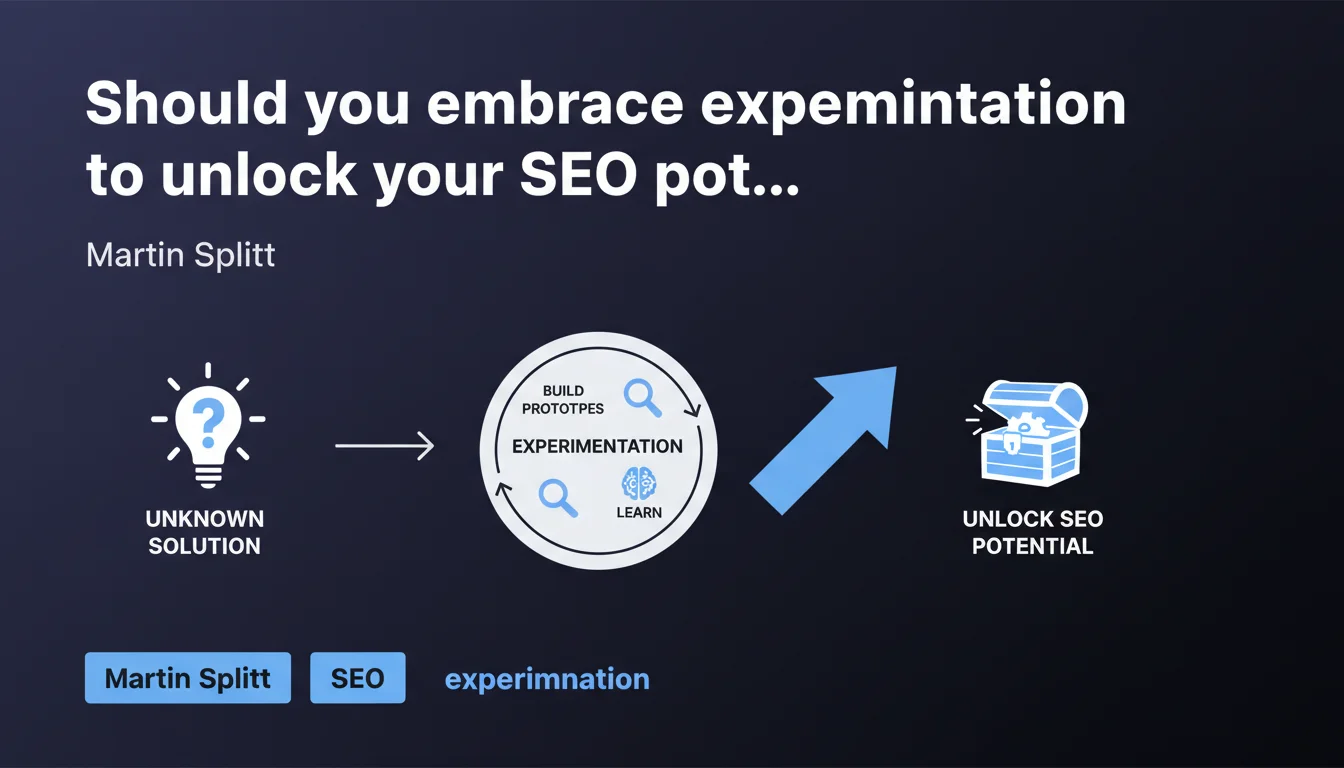
Martin Splitt officially validates the "test and learn" approach in SEO, comparing it to software development methods. Google is therefore encouraging professionals to experiment when the optimal solution isn't obvious, rather than waiting for definitive guidelines.
What you need to understand
Why is Google officially recommending experimentation in SEO?
Google acknowledges that SEO situations are too varied to be covered by universal rules. Martin Splitt draws an explicit parallel with software development: when engineers don't know which technical solution will work best, they build prototypes and test.
This statement legitimizes a practice that senior SEOs have been applying for years, often navigating a gray area. Google implicitly recognizes that its own algorithm contains zones of uncertainty — and that experimenting is not only acceptable but recommended.
What does this concretely change for a professional?
This official validation shifts the balance of power within organizations. An SEO professional can now justify A/B testing budgets or progressive deployment rollouts by citing Google directly. No more need to hide behind vague formulations.
Let's be honest: this doesn't revolutionize ground-level practice. Agencies are already experimenting at scale. But it changes perception on the client and decision-maker side, who often associate "testing" with "improvisation".
What are the limitations of this approach?
Experimentation requires technical and analytical resources that small sites don't always have. Testing a URL structure on 3 pages has no statistical value. You need volume, time, robust tracking tools.
And that's where it gets tricky. Google encourages testing without providing an official test infrastructure — unlike some platforms that offer sandbox environments. The practitioner must therefore improvise protocols using Search Console, Analytics, and lots of rigor.
- Google officially validates the "test and learn" approach in SEO
- Experimentation is compared to software engineering methods
- This statement legitimizes dedicated SEO testing budgets
- The approach requires technical resources and data volume
- No official Google tool to facilitate these experiments
SEO Expert opinion
Is this statement consistent with practices observed in the field?
Absolutely. SEOs who achieve the best results are those who test continuously: Title tag variations, internal linking structures, content formats, information architecture depth. They don't just follow the guidelines — they challenge them.
However, there's a gap between what Google recommends and what Google facilitates. Search Console offers no native A/B testing functionality. No control groups, no statistical significance metrics. [To verify]: how does Google itself measure the effectiveness of this recommendation if no tool allows applying it rigorously?
What nuances should be added to this recommendation?
Testing for the sake of testing achieves nothing. A valid SEO test requires a strict protocol: clear hypothesis, control group, sufficient duration (minimum 4-6 weeks to smooth fluctuations), variable isolation. Without this, you're optimizing noise.
Another rarely mentioned nuance: some tests can temporarily degrade performance. Massively modifying a URL structure creates a fluctuation period — even with perfect 301 redirects. You must accept this risk, which requires clear client mandate.
In what cases does this approach reach its limits?
On sites with low traffic volume, experimentation has no statistical meaning. Testing two Title variations on 50 monthly pages is pure noise. Results will be drowned in natural traffic variations.
Similarly, certain sectors — healthcare, finance, legal — are so sensitive to E-E-A-T criteria that experimenting with content structure can trigger manual penalties. In these contexts, "test and learn" must be extremely cautious, or even abandoned in favor of more conservative approaches.
Practical impact and recommendations
What needs to be put in place concretely to test effectively?
First, a documented testing framework. Each experiment must have a hypothesis, success metrics, defined duration, control group. Without documentation, it's impossible to capitalize on learnings — you'll repeat the same mistakes.
Next, robust tracking tools. Google Analytics 4 alone isn't enough. You need to cross-reference with Search Console, a crawler like Screaming Frog or Oncrawl, and ideally a ranking tool if you're testing content variations. Tool budgets quickly become substantial.
What mistakes should you avoid in this experimental approach?
Never test multiple variables simultaneously. If you modify heading structure, internal linking, and content length all at once, it's impossible to isolate what works. One test = one variable. It's constraining, but it's the only scientifically valid approach.
Another classic mistake: stopping a test too early. Google needs time to recrawl, re-index, re-evaluate. Stopping after 10 days because "nothing's moving" is like drawing conclusions from a non-representative sample. Patience and rigor.
How do you structure this approach at an organizational scale?
You need a testing calendar planned over several months, with experimentation windows that don't overlap. A shared spreadsheet where each test is tracked: hypothesis, deployment date, duration, results, final decision.
Concretely, this methodology requires cross-functional skills — SEO, data analysis, development — and constant coordination between teams. Many organizations underestimate this complexity. In this context, partnering with a specialized SEO agency that already masters these protocols can significantly accelerate your learning curve and avoid costly mistakes from a self-taught approach.
- Document each test with hypothesis, metrics, duration, and control group
- Cross-reference multiple data sources (GSC, GA4, crawler, rankings)
- Test only one variable at a time to isolate effects
- Respect a minimum duration of 4 to 6 weeks per test
- Build a testing calendar to prevent overlaps
- Train teams in rigorous experimental methodology
- Budget for tools and resources needed for analysis
❓ Frequently Asked Questions
Combien de temps faut-il laisser un test SEO avant de tirer des conclusions ?
Peut-on tester plusieurs optimisations en même temps sur différentes sections du site ?
Quels outils Google fournit-il pour faciliter ces expérimentations ?
Cette approche est-elle applicable aux petits sites avec peu de trafic ?
Faut-il informer Google qu'on mène des tests sur son site ?
🎥 From the same video 12
Other SEO insights extracted from this same Google Search Central video · published on 26/01/2022
🎥 Watch the full video on YouTube →
💬 Comments (0)
Be the first to comment.