
Official statement
Other statements from this video 12 ▾
- □ Is E-A-T really not a Google ranking factor?
- □ Does having multiple URLs for the same content really trigger a Google penalty?
- □ Why does Google refuse to reveal the complete formula behind its ranking algorithm?
- □ Should you embrace experimentation to unlock your SEO potential?
- □ Should SEOs be comfortable admitting when they don't have all the answers?
- □ Is the impact/effort matrix really the key to prioritizing your SEO tasks effectively?
- □ Should SEOs dictate technical solutions to developers, or simply expose the SEO problems they've identified?
- □ Does choosing between 301 and 302 redirects really impact your Google rankings?
- □ Is developing content that remains invisible to search engines really worth your time and effort?
- □ Does Google really push algorithm updates every single minute?
- □ Should you really integrate SEO from the development phase to avoid costly fixes later?
- □ Can SEO pages without real user value still rank in Google?
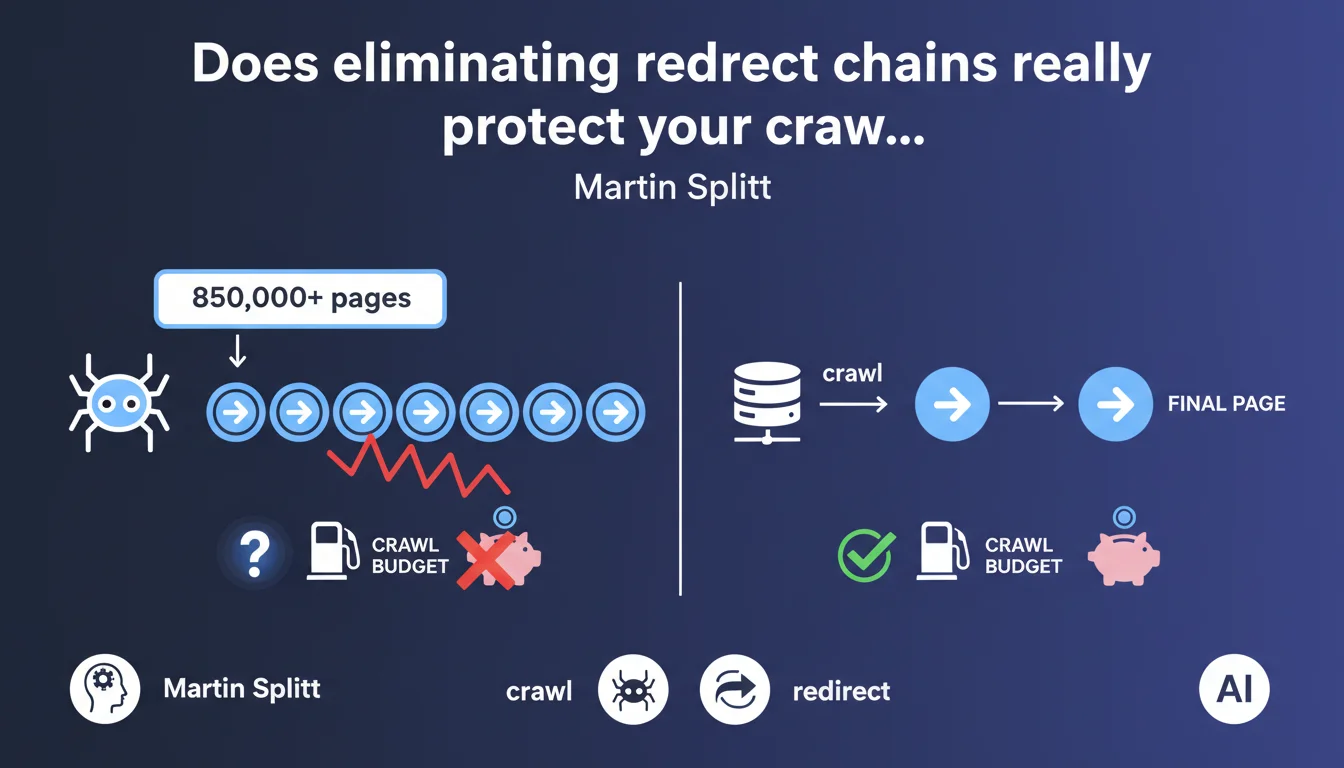
Google officially confirms that multiple redirect chains are problematic. The cited example — 850,000 pages with cascading redirects — illustrates a concrete case where these configurations negatively impact technical performance. Bottom line: clean up your redirects and stop stacking 301s on top of 301s.
What you need to understand
Why does Google keep hammering home this technical point?
Redirect chains (or multiple redirects) unnecessarily complicate Googlebot's work. Page A redirects to B, which redirects to C, which finally points to D. Each hop consumes crawl time, slows down indexing, and potentially dilutes the PageRank being passed along.
The example Martin Splitt gave isn't theoretical — 850,000 pages affected is significant. We're talking about a case where technical architecture degraded gradually, likely from successive migrations or poorly planned redesigns.
What's the difference between a single redirect and a chain?
A simple redirect: URL A → URL B (final). One step, clean, efficient. A redirect chain: URL A → URL B → URL C → URL D. Each additional link slows down the process and increases the risk of errors.
Google can technically follow multiple hops, but that doesn't mean you should abuse it. Beyond 3-4 redirects, the risk that Googlebot abandons or takes time to reach the final destination becomes real.
Do multiple redirects really affect PageRank?
Officially, Google claims that a 301 redirect passes along almost all PageRank. But here's the thing — a chain of multiple 301s? That remains murky. Logic suggests that chaining 4-5 redirects isn't neutral, even if Google never publicly quantifies this loss.
Beyond PageRank, the real problem is crawl budget and user experience. A page that takes 3 seconds to resolve a redirect chain before displaying content is wasted time for both server and user.
- Avoid redirect chains — always aim for a direct redirect to the final URL
- Audit regularly — after every migration or redesign, check that no chains have been created
- Prioritize fixes — start with high-traffic pages or those linked from strategic pages
- Automate detection — use tools like Screaming Frog or Oncrawl to spot these configurations automatically
SEO Expert opinion
Is this statement consistent with what we observe in the field?
Absolutely. Sites that clean up their redirect chains often see improvements in crawl speed and, in some cases, a boost in organic traffic a few weeks later. Not always dramatic, but measurable.
The problem is that many sites accumulate layers of successive migrations without ever doing cleanup. Result: redirects pointing to other redirects, sometimes across 5-6 levels. And nobody realizes it until a technical audit reveals the extent of the damage.
What tolerance does Google really give to short chains?
Google generally follows up to 5 redirect hops, but that's not an invitation to take advantage of it. Going beyond 2-3 redirects becomes problematic in terms of performance and maintenance. Let's be honest — if your architecture systematically requires 4-5 redirects to reach the final content, you have a deeper structural problem.
[To verify] Google never gives precise figures on PageRank loss in a chain. We know an isolated 301 passes most of it along, but 4 or 5 stacked? No reliable public data. Caution dictates avoiding this scenario.
In what cases can you temporarily tolerate a chain?
During a complex migration, it sometimes happens that you need to temporarily create chains to manage the technical transition. The key is documenting these configurations and correcting them quickly — ideally within 2-3 weeks.
Another case: some CMS or CDN platforms sometimes automatically create intermediate redirects (www/non-www normalization + HTTPS + trailing slash). If these layers are technically unavoidable, at least ensure they remain short and predictable.
Practical impact and recommendations
What should you do concretely to fix these chains?
First step: audit your site with a professional crawler (Screaming Frog, Oncrawl, Botify, etc.). Configure it to follow redirects and identify all existing chains. Export a complete report with the number of hops per URL.
Next, prioritize the fixes. Start with pages that receive organic traffic or quality backlinks. A redirect chain on an orphaned page without inbound links can wait — a chain on your flagship product page, not so much.
What mistakes should you avoid when cleaning up?
Don't break anything. When you modify a redirect to short-circuit the chain, verify that the final URL is indeed the intended one. A frequent error: pointing directly to a URL that itself still redirects somewhere else, or worse, to a 404.
Test each fix in a staging environment before deploying to production. And keep a record of the old configurations — if something breaks, you need to be able to roll back quickly.
How do you monitor so the problem doesn't happen again?
Set up an automatic alert in your crawl tool. Configure it to notify you as soon as a new redirect chain is detected. Ideally, integrate this check into your deployment process.
After every migration, redesign, or major architecture change, run a full crawl and specifically check redirects. This is a reflex to develop — it's better to prevent than to fix 850,000 pages after the fact.
- Crawl your site to identify all existing redirect chains
- Prioritize fixes by SEO impact (traffic, backlinks, strategic pages)
- Modify redirects to point directly to the final URL
- Test each modification before deploying to production
- Verify that internal redirects (links in content) also point directly to final URLs
- Configure automatic alerts to detect new chains
- Document each modification to facilitate tracking and rollback if necessary
❓ Frequently Asked Questions
Combien de redirections Google peut-il suivre avant d'abandonner ?
Une chaîne de redirections peut-elle empêcher l'indexation d'une page ?
Doit-on aussi corriger les redirections dans les liens internes ?
Les chaînes de redirections impactent-elles la vitesse de chargement perçue par l'utilisateur ?
Peut-on détecter automatiquement les chaînes de redirections après chaque déploiement ?
🎥 From the same video 12
Other SEO insights extracted from this same Google Search Central video · published on 26/01/2022
🎥 Watch the full video on YouTube →
💬 Comments (0)
Be the first to comment.