
Official statement
Other statements from this video 12 ▾
- □ Is E-A-T really not a Google ranking factor?
- □ Does having multiple URLs for the same content really trigger a Google penalty?
- □ Why does Google refuse to reveal the complete formula behind its ranking algorithm?
- □ Should you embrace experimentation to unlock your SEO potential?
- □ Should SEOs be comfortable admitting when they don't have all the answers?
- □ Does eliminating redirect chains really protect your crawl budget from wasting resources?
- □ Is the impact/effort matrix really the key to prioritizing your SEO tasks effectively?
- □ Should SEOs dictate technical solutions to developers, or simply expose the SEO problems they've identified?
- □ Is developing content that remains invisible to search engines really worth your time and effort?
- □ Does Google really push algorithm updates every single minute?
- □ Should you really integrate SEO from the development phase to avoid costly fixes later?
- □ Can SEO pages without real user value still rank in Google?
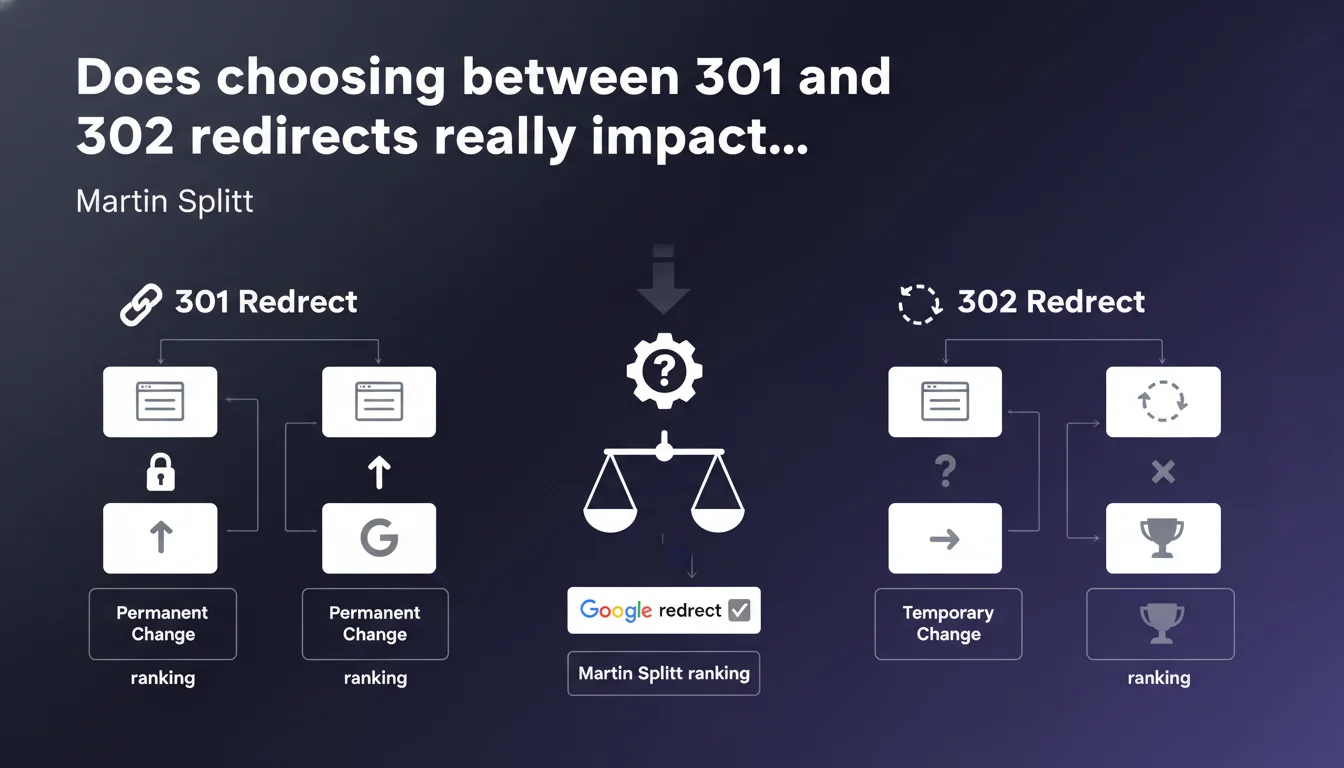
Martin Splitt confirms that the choice between a 301 (permanent) and 302 (temporary) redirect is significant for Google. The type of redirect selected must match the actual intention: if the move is definitive, a 301 is required; if it's provisional, a 302 is appropriate. Incorrect implementation can impact signal transfer and how Google processes URLs.
What you need to understand
Why does Google insist on this distinction?
301 and 302 redirects send different signals to Google. A permanent 301 indicates that the source URL will never return — the search engine then consolidates signals (PageRank, anchor text, history) toward the destination.
A temporary 302 suggests that the original URL will resume service. Google therefore keeps the source URL in its index longer and transfers signals more cautiously, or not at all depending on the context.
What are the consequences if you use the wrong code?
Using a 302 for a permanent move slows down — sometimes considerably — the transfer of authority. The old page may remain indexed for weeks, diluting the visibility of the new one.
Conversely, a 301 for a temporary redirect (seasonal campaign, A/B test) removes the source URL from the index. When you want to reactivate it, Google must recrawl and reevaluate everything — loss of time and rankings.
What specifically changes in how Google processes the redirect?
With a 301, Googlebot understands that it must permanently update its data: the destination URL inherits the backlinks, age, and relevance signals. Crawling of the old URL decreases quickly.
With a 302, the bot continues to regularly check the source URL to see if it has come back online. Signals don't automatically migrate, especially if the redirect is short-lived.
- Permanent 301: complete signal transfer, rapid deindexing of the old URL
- Temporary 302: source URL remains in the index, partial or delayed signal transfer
- The HTTP code choice must reflect the actual intention of the redirect
- A typology error slows down SEO or causes loss of authority
SEO Expert opinion
Does this statement really change established practices?
No — and that's precisely what's interesting. For years, experienced SEOs have distinguished between 301 and 302. This reminder from Martin Splitt confirms that Google has not unified redirect handling as some hoped.
We regularly observe sites using 302s by default (misconfigured server settings, poorly configured CMS). These sites lose link juice without understanding why. The message is clear: intention still matters.
When does this rule become unclear?
Google doesn't specify how long a 302 can last before it treats it as a 301 in practice. Observations show that after several months, even a 302 eventually transfers signals — but without guarantee or timeline.
[To be verified] The exact behavior for long-term 302 redirects remains opaque. Some sites observe partial transfer after 6 months, others never. Google doesn't document this threshold.
What nuance to add for complex migrations?
On massive migrations (thousands of URLs), a wrong code choice comes with a price. An accidental 302 on 10,000 pages delays consolidation for months. Post-migration audits must verify actual HTTP codes, not just the theoretical redirect plan.
Let's be honest: many developers don't make the distinction or configure a 302 by default "just in case." It's a classic that costs visibility.
Practical impact and recommendations
How do you verify which type of redirect to use?
Ask yourself the long-term intention question. If you're permanently removing a product, merging two categories, or changing your URL structure, it's a 301. Period.
If you're redirecting temporarily for maintenance, A/B testing, seasonal campaigns, or geolocation variants intended to return to the original, it's a 302. And if the "temporary" lasts more than 3 months, reconsider: it might actually be permanent.
What errors should you avoid during implementation?
Don't rely solely on what your CMS or plugin displays. Test actual HTTP headers with curl, Screaming Frog, or Chrome DevTools. Surprises are frequent: a field marked "permanent" but a 302 in the headers.
Avoid redirect chains (A → B → C) that mix 301s and 302s. Google can get confused, dilute the transfer, or abandon midway. One redirect = one hop maximum, ideally.
What should you actually do to audit your site?
- Crawl your entire site with Screaming Frog, Sitebulb, or Oncrawl to list all redirects
- Filter 302 redirects and verify their legitimacy one by one
- Immediately correct accidental 302s on content that has been permanently moved
- Document intentional 302s (campaigns, tests) with a review date to prevent them from becoming permanent through oversight
- Test redirects under real conditions (different user agents, geolocation) to detect unexpected server behavior
- Set up monitoring alerts to detect new unplanned 302s
❓ Frequently Asked Questions
Une 302 transfère-t-elle du PageRank comme une 301 ?
Combien de temps peut durer une 302 avant que Google ne la traite comme une 301 ?
Mon CMS utilise des 302 par défaut, est-ce un problème ?
Peut-on passer d'une 302 à une 301 sans perdre de SEO ?
Les redirections 307 et 308 sont-elles traitées différemment par Google ?
🎥 From the same video 12
Other SEO insights extracted from this same Google Search Central video · published on 26/01/2022
🎥 Watch the full video on YouTube →
💬 Comments (0)
Be the first to comment.