
Official statement
Other statements from this video 12 ▾
- □ E-A-T n'est-il vraiment pas un facteur de classement Google ?
- □ Avoir plusieurs URLs pour un même contenu entraîne-t-il vraiment une pénalité Google ?
- □ Pourquoi Google refuse-t-il de dévoiler la recette complète de son algorithme ?
- □ Faut-il adopter une démarche expérimentale pour optimiser son référencement naturel ?
- □ Faut-il avouer qu'on ne sait pas tout en SEO ?
- □ Faut-il vraiment éliminer toutes les chaînes de redirections pour préserver son crawl budget ?
- □ La matrice impact/effort est-elle vraiment la clé pour prioriser vos tâches SEO ?
- □ Faut-il imposer des solutions techniques aux développeurs ou simplement exposer les problèmes SEO ?
- □ Faut-il vraiment distinguer les redirections 301 et 302 pour le SEO ?
- □ Google déploie-t-il vraiment des mises à jour algorithme chaque minute ?
- □ Faut-il vraiment intégrer le SEO dès la phase de développement pour éviter les corrections coûteuses ?
- □ Les pages SEO sans valeur utilisateur peuvent-elles encore se classer dans Google ?
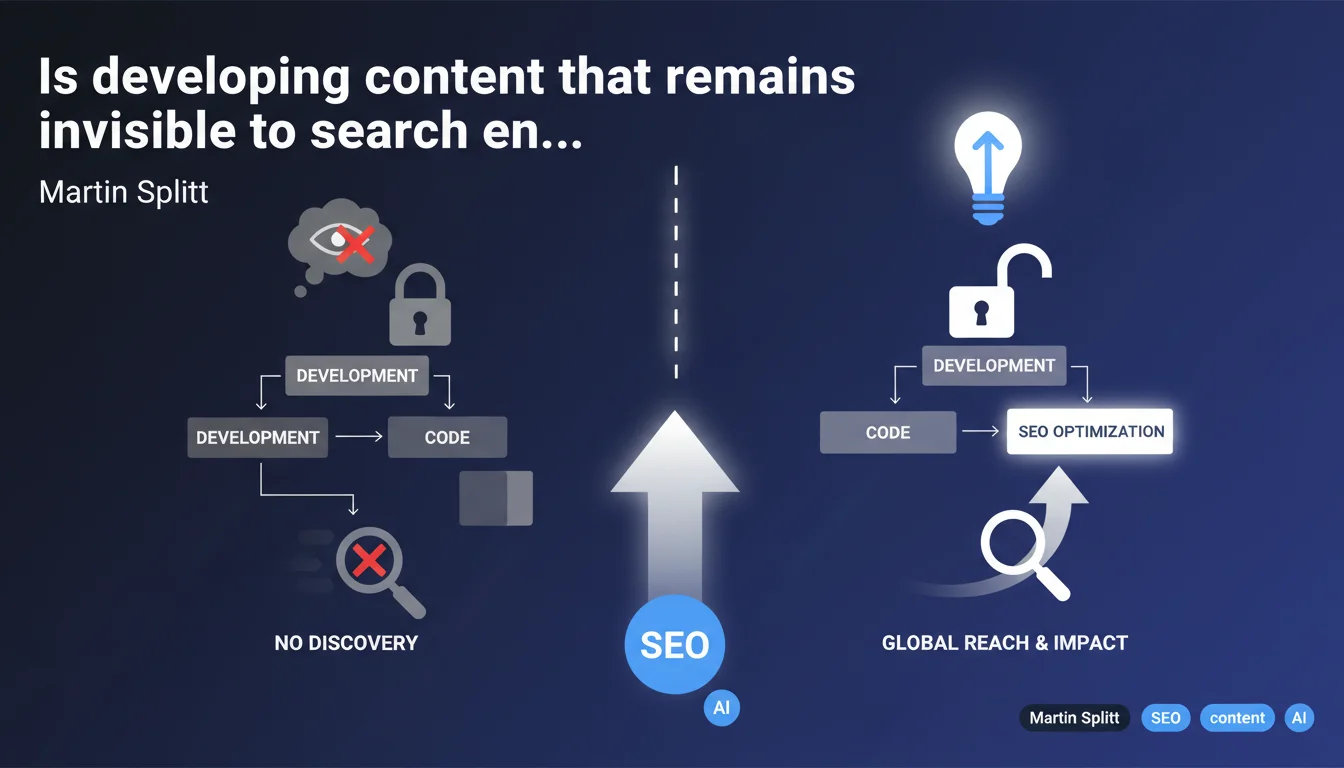
Martin Splitt reminds us of an often-overlooked reality: if no one discovers your content through search engines, your development efforts are largely wasted. SEO is not a cosmetic option—it's the visibility lever that determines whether your work reaches its audience or remains invisible.
What you need to understand
What is the logic behind Google's claim?
The argument by Martin Splitt rests on a simple reality: the majority of users discover content through search engines. If your software, documentation, or platform never appears in search results, you're cutting off access to a massive source of traffic.
For developers—and product teams in general—this statement aims to reposition SEO as a strategic discipline, not as a "marketing" topic. A technically sound product that remains invisible in Google has limited growth potential, regardless of how innovative it is.
How does this perspective differ from the traditional view of SEO?
Traditionally, SEO is seen as the domain of writers or marketers. Splitt flips the logic: he's speaking directly to developers and telling them that their code, architecture, and technical choices directly impact visibility.
It's a way to destigmatize SEO in tech environments where it's sometimes perceived as a secondary constraint. Google is trying to reposition SEO here as a multiplier of impact for work already completed.
What are the concrete implications for product teams?
If you're developing a web application, a SaaS, or even technical documentation, ignoring SEO amounts to hoping your audience will find you by magic—through word-of-mouth, ads, or social media. Except those channels are often costly or volatile.
Natural referencing, while time-consuming at first, generates recurring and qualified traffic at no marginal cost in the long term. That's what Splitt is implying: the ROI of SEO is structurally superior if the goal is to maximize a product's reach over time.
- SEO transforms a developed product into a discoverable one
- Without organic visibility, acquisition depends solely on paid or volatile channels
- Developers must integrate SEO from the design phase, not as a patch job afterward
- A good invisible product serves no one—neither the user nor the business
SEO Expert opinion
Is this statement consistent with what we observe in practice?
Yes, and it's even a recurring refrain from Google. The message "SEO is a necessity, not an option" is nothing new. But it's politically savvy: by targeting developers, Google broadens its base of evangelists. The more developers understand the importance of SEO, the less SEO teams have to fight for technical resources.
On substance, it's hard to dispute. A website that ranks for no relevant queries is doomed to depend on external channels to exist. The problem is that this truth is often instrumentalized to justify mediocre SEO strategies or disproportionate budgets.
What nuances should we add to this narrative?
First, not all content must be discoverable through search. Some applications are intended for existing users, some documentation is internal-only, some software targets such a specialized niche that word-of-mouth suffices. [To verify] whether Google views these as exceptions or if Splitt is really talking about all web content.
Second, the phrase "no one finds" is binary, while reality is a spectrum. Between an invisible site and a dominant one, there are hundreds of gradations. A product can generate modest yet highly qualified organic traffic, which may be sufficient depending on the business model. Splitt doesn't say "you must rank first for every keyword," but his message can be misinterpreted.
In what cases does this rule not apply?
If your product relies on a closed distribution model—a mobile app with no indexable web version, B2B platform sold exclusively through sales, ultra-confidential service—SEO can be secondary or even irrelevant. The same applies to products where acquisition happens through direct referral (medical software, specialized industrial tools).
There are also environments where Google isn't the dominant channel: some Asian markets favor other search engines, some niches operate on Reddit or Discord. In those contexts, optimizing for Google amounts to working for nothing—but not for the reasons Splitt mentions.
Practical impact and recommendations
What concrete steps should you take to avoid invisibility?
First step: audit the discoverability of your strategic pages. Use tools like Screaming Frog or OnCrawl to verify that your URLs are crawlable, indexable, and responding properly to bots. If Google can't access your content, nothing else matters.
Next, integrate SEO from the design phase of your product. This means: clean URL structure, semantic HTML tags, managed load times, server-side rendering or pre-rendering for JS frameworks. These decisions made upfront avoid months of refactoring later.
What errors should you avoid to not sabotage your visibility?
Don't accidentally block indexation—check your robots.txt files and meta robots tags. It's silly, but it still happens regularly, especially on migrated sites or staging environments that went live without an audit.
Also avoid neglecting relevance signals: vague titles, duplicate content, lack of internal linking. Google needs to understand what your product does and who it's for. If your pages look like empty shells or incomprehensible jargon, they won't rank for anything.
How do you measure the real impact of SEO on discoverability?
Track indexation coverage in Search Console: how many pages are discovered, indexed, excluded. Cross-reference with your Analytics data to see what share of traffic comes from organic search. If that number is close to zero, you have a problem.
Also measure the organic click-through rate on your priority pages. Good ranking without clicks signals a title/meta description problem. Poor ranking signals a relevance or competition problem. Adjust accordingly.
- Audit the crawlability and indexability of all strategic pages
- Integrate SEO from the product design phase, not afterward
- Check robots.txt files and meta robots tags to avoid accidental blocks
- Optimize relevance signals: titles, descriptions, content structure
- Track indexation coverage and organic traffic in Search Console and Analytics
- Measure organic click-through rates to detect ranking or presentation issues
❓ Frequently Asked Questions
Le SEO est-il vraiment indispensable pour tous les types de sites ?
Peut-on compenser l'absence de SEO par de la publicité payante ?
Quels sont les premiers leviers SEO à activer pour un produit invisible ?
Comment savoir si mon site est vraiment invisible dans Google ?
Le SEO doit-il être piloté par les développeurs ou les marketeurs ?
🎥 From the same video 12
Other SEO insights extracted from this same Google Search Central video · published on 26/01/2022
🎥 Watch the full video on YouTube →
💬 Comments (0)
Be the first to comment.