
Official statement
Other statements from this video 12 ▾
- □ E-A-T n'est-il vraiment pas un facteur de classement Google ?
- □ Avoir plusieurs URLs pour un même contenu entraîne-t-il vraiment une pénalité Google ?
- □ Pourquoi Google refuse-t-il de dévoiler la recette complète de son algorithme ?
- □ Faut-il adopter une démarche expérimentale pour optimiser son référencement naturel ?
- □ Faut-il avouer qu'on ne sait pas tout en SEO ?
- □ Faut-il vraiment éliminer toutes les chaînes de redirections pour préserver son crawl budget ?
- □ La matrice impact/effort est-elle vraiment la clé pour prioriser vos tâches SEO ?
- □ Faut-il imposer des solutions techniques aux développeurs ou simplement exposer les problèmes SEO ?
- □ Faut-il vraiment distinguer les redirections 301 et 302 pour le SEO ?
- □ Pourquoi développer du contenu invisible dans les moteurs de recherche revient-il à travailler pour rien ?
- □ Google déploie-t-il vraiment des mises à jour algorithme chaque minute ?
- □ Faut-il vraiment intégrer le SEO dès la phase de développement pour éviter les corrections coûteuses ?
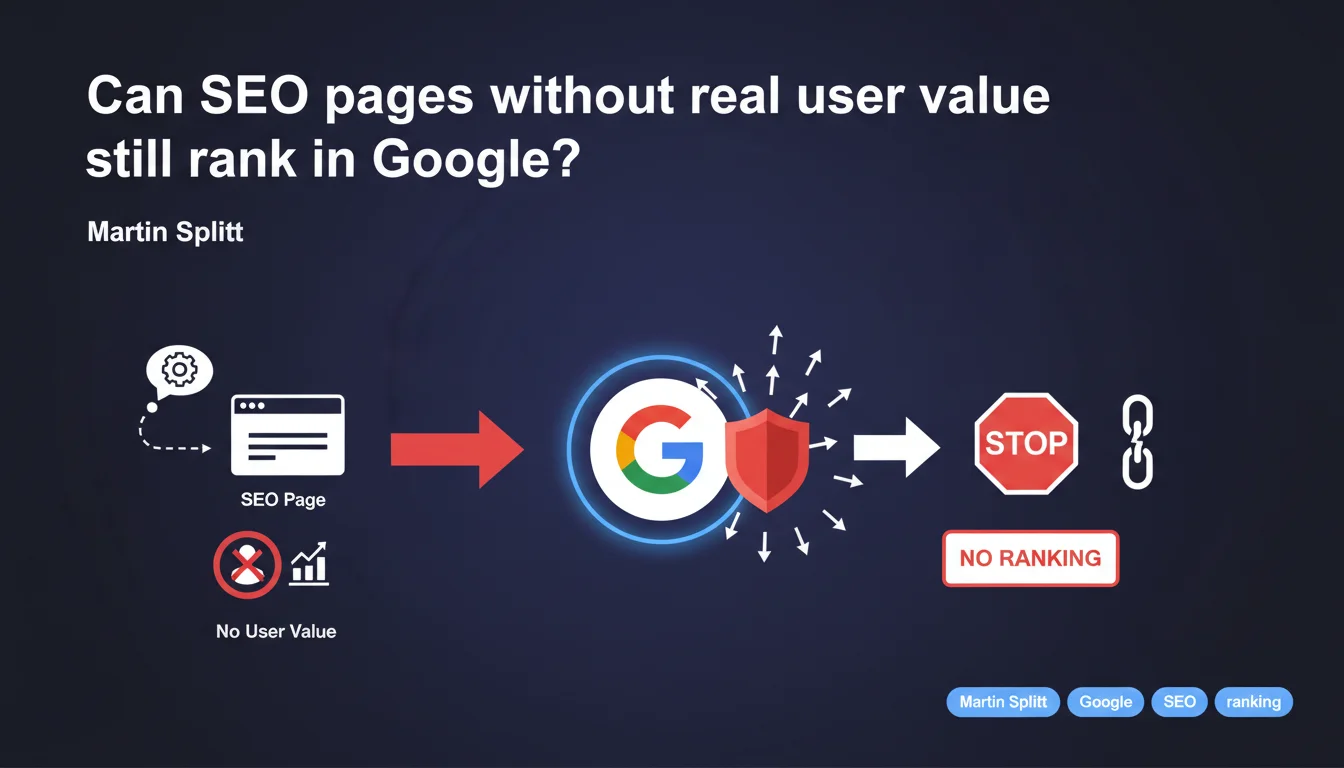
Google claims to detect and penalize pages created solely to manipulate rankings without delivering genuine value to users. Martin Splitt and Jenn Mathews are emphatic: an SEO page must serve a concrete user need, otherwise it won't rank sustainably.
What you need to understand
What does Google really mean by "pages created for SEO"?
Google targets content generated solely to drive organic traffic, without answering a legitimate user intent. These are pages that are artificially optimized, stuffed with keywords but devoid of substance, or massive content created through scraping or unedited AI without human curation.
The algorithm seeks to distinguish genuine added value from the illusion of usefulness. If your page exists only to capture clicks without serving a useful answer, Google says it can detect that.
How does Google identify these manipulative pages?
Splitt remains vague about the precise mechanisms — intentionally so. We know Google combines behavioral signals (pogo-sticking, session duration, nuanced bounce rate), semantic analysis (content coherence with the query), and pattern detection (sites with thousands of similar pages).
Core Updates regularly target this low-value content. The Helpful Content Update was explicitly designed to demote pages "created first for search engines."
What concretely defines "user value"?
Google never gives an absolute criterion. In practice, this covers: precisely answering search intent, providing reliable and complete information, offering a smooth reading experience, being up-to-date, citing sources when relevant.
A page has value if the user leaves satisfied without needing to return to the SERPs to search elsewhere. It's intent satisfaction that matters — not keyword stuffing.
- Google penalizes pages created solely to rank without real utility
- Behavioral signals and semantic analysis are deployed to detect content spam
- "User value" is measured by satisfaction of search intent, not by text volume or keyword density
- Helpful Content Update and Core Updates explicitly target this low-value content
SEO Expert opinion
Is this statement consistent with what we observe in practice?
Yes and no. Recent Core Updates have indeed decimated entire "content farm" sites and generic comparison pages. We've seen domains lose 70% of their traffic overnight because they were stacking product pages or FAQs without real expertise.
But — and this is where it gets sticky — many low-value sites continue to rank perfectly. Public data aggregators, automatically-generated directories, "city + keyword" pages by the thousands: they still hold top positions in certain niches. [Needs verification] whether Google "detects" these pages systematically, or whether its definition of "user value" remains quite elastic.
What nuances should we add to Google's claim?
First nuance: a page can have value without being original. A price comparison site aggregates existing data — that's useful. A "plumber Paris 15th" page done well answers a specific local intent, even if it resembles 10,000 others.
Second nuance: Google sometimes conflates "pages created for SEO" with "pages optimized for SEO." Any well-executed page incorporates title tags, Hn structure, internal linking — that's still SEO. Intent matters more than method. If your content truly serves users, technical optimization is legitimate.
In what cases does this rule not really apply?
Established authority sites benefit from a halo effect: even their mediocre pages rank better than excellent content on small sites. Amazon, Wikipedia, Reddit — they have millions of "average" pages that rank perfectly.
Highly-targeted transactional pages (e-commerce product sheets, local service pages) can be minimal and still rank if commercial intent is clear. Google tolerates less "editorial value" when intent is purely transactional.
Practical impact and recommendations
What should you concretely do to avoid the "low-value" penalty?
Audit your orphaned pages or those with nearly zero traffic. If they add nothing, delete them or radically improve them. Google prefers 50 excellent pages to 500 mediocre ones.
For each page, ask yourself: "If I land here from Google, do I find my answer in 10 seconds?" If not, rework it. Add context, examples, hard data, visuals. Make the content scannable and actionable.
Avoid rigid templates that generate nearly-identical content across hundreds of pages. If you do local or e-commerce, personalize each page with unique elements — local testimonials, specific photos, FAQ tailored to the city or product.
What mistakes should you absolutely avoid?
Don't create pages "just to rank for a keyword" if you have nothing substantive to say. Better to add a section to an existing page than launch a hollow standalone page.
Avoid unedited AI content that loops without adding insight. Google detects repetitive patterns, generic phrasing, absence of editorial voice. If you use AI, enrich it with your expertise, your data, your angle.
Don't multiply near-identical variants ("plumber Paris 15," "plumber 75015," "plumbing Paris 15th") — consolidate on a single well-ranking page with semantic variations built in.
How can you verify your site meets this user value requirement?
Check your Search Console metrics: pages with impressions but low CTR (uninspiring title/meta description), pages with traffic but session duration under 30 seconds (disappointing content).
Use a tool like Screaming Frog or Oncrawl to identify pages with duplicate or very similar content. Prioritize those with traffic: if they don't convert or hold attention, they lack value.
Test your key pages with real users or through UX tools (Hotjar, Microsoft Clarity). If people scroll without reading, or click back immediately, you have a relevance problem.
- Audit and delete or rebuild pages with zero or near-zero traffic and no clear intent
- Ensure each page answers its primary search intent within 10 seconds
- Personalize bulk-generated content (local, e-commerce) with unique elements
- Ban generic unedited AI content — always enrich with expertise and proprietary data
- Consolidate near-identical page variants onto a single well-optimized URL
- Analyze CTR, session duration, and bounce rate to identify low-value pages
- Detect and address duplicate or overly-similar content across your site
❓ Frequently Asked Questions
Google peut-il vraiment détecter si une page est créée « uniquement pour le SEO » ?
Une page optimisée SEO est-elle automatiquement suspecte aux yeux de Google ?
Faut-il supprimer toutes les pages à faible trafic ?
Les pages e-commerce ou locales minimalistes risquent-elles d'être pénalisées ?
Comment prouver à Google qu'une page apporte de la valeur ?
🎥 From the same video 12
Other SEO insights extracted from this same Google Search Central video · published on 26/01/2022
🎥 Watch the full video on YouTube →
💬 Comments (0)
Be the first to comment.