
Official statement
Other statements from this video 12 ▾
- □ E-A-T n'est-il vraiment pas un facteur de classement Google ?
- □ Avoir plusieurs URLs pour un même contenu entraîne-t-il vraiment une pénalité Google ?
- □ Pourquoi Google refuse-t-il de dévoiler la recette complète de son algorithme ?
- □ Faut-il adopter une démarche expérimentale pour optimiser son référencement naturel ?
- □ Faut-il avouer qu'on ne sait pas tout en SEO ?
- □ Faut-il vraiment éliminer toutes les chaînes de redirections pour préserver son crawl budget ?
- □ La matrice impact/effort est-elle vraiment la clé pour prioriser vos tâches SEO ?
- □ Faut-il imposer des solutions techniques aux développeurs ou simplement exposer les problèmes SEO ?
- □ Faut-il vraiment distinguer les redirections 301 et 302 pour le SEO ?
- □ Pourquoi développer du contenu invisible dans les moteurs de recherche revient-il à travailler pour rien ?
- □ Google déploie-t-il vraiment des mises à jour algorithme chaque minute ?
- □ Les pages SEO sans valeur utilisateur peuvent-elles encore se classer dans Google ?
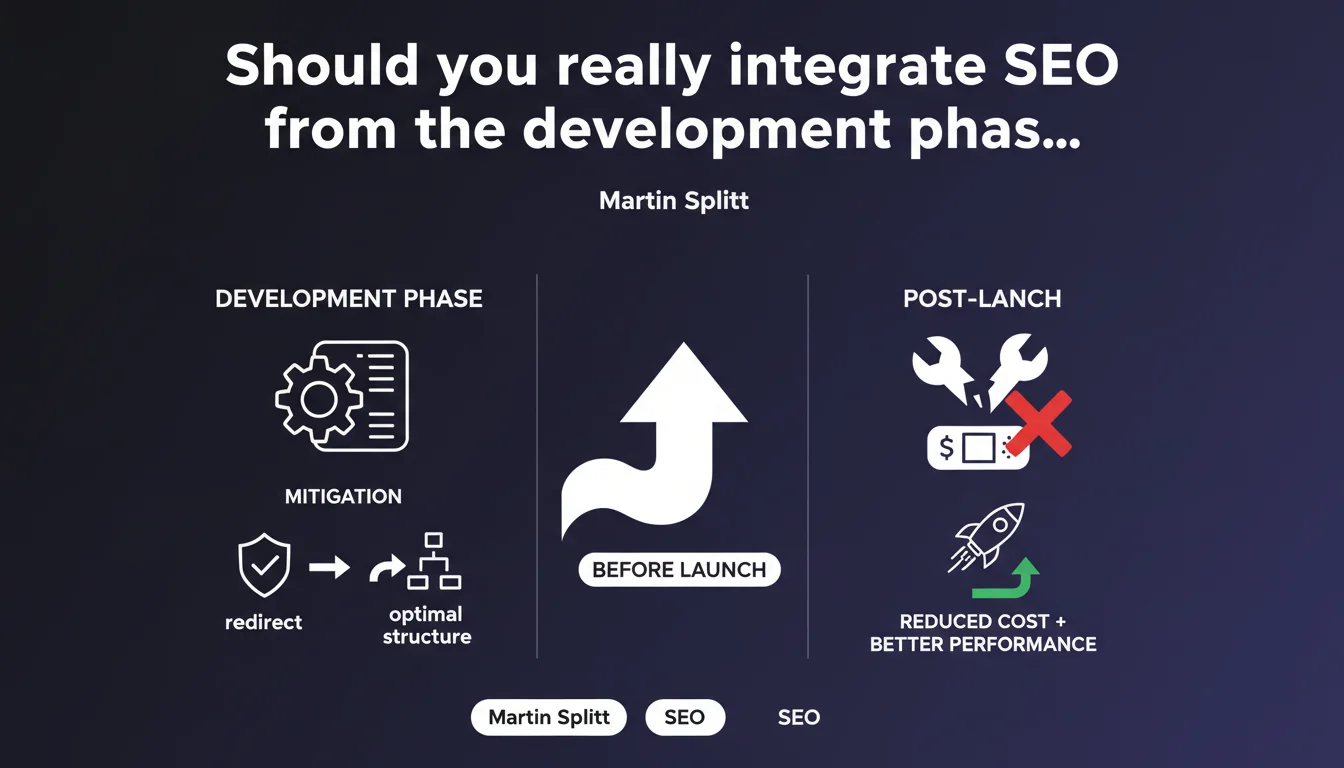
Martin Splitt recommends integrating best SEO practices (redirects, structure) from the development phase rather than correcting after launch. This "mitigation" approach drastically reduces post-launch interventions and traffic losses caused by technical errors.
What you need to understand
Why does Google insist on early SEO integration?
The position of Martin Splitt is simple: anticipating is better than repairing. When a redesign or new site launches with structural errors, broken redirects, or faulty architecture, necessary corrections require time — and during that time, the site loses traffic.
The "mitigation" approach consists of integrating SEO constraints from the first mockups and technical specifications. Concretely? Developers configure 301 redirects, respect URL structure, manage crawl budget, avoid duplicate content — all of this before the first commit.
What is considered "best SEO practices" in this context?
Splitt doesn't detail exhaustively, but we can extrapolate on what he means by that: correct redirects (permanent 301s, no chains), coherent URL structure, canonical tags properly placed, clean mobile/desktop version management, up-to-date XML sitemap.
But also — and this is often forgotten — an information architecture designed for crawling, internal linking that distributes PageRank, optimized load times from the codebase itself.
Does this approach really make a difference in practice?
On paper, yes. In reality, it depends on the maturity of the organization. Teams that integrate SEO from the brief phase effectively avoid post-launch disasters: traffic drops of 30-50%, partial deindexation, massive cannibalization.
But for this to work, SEO must be a stakeholder in technical decisions, not just consulted in final validation.
- Integrating SEO from design reduces post-launch corrections
- "Best practices" include redirects, URL structure, canonicals, crawlable architecture
- Effectiveness depends on the decision-making power given to SEO in development sprints
- Technical errors post-launch cost in traffic and correction time
SEO Expert opinion
Is this statement consistent with practices observed in the field?
Absolutely. Catastrophic redesigns — those that cause a 40% traffic drop overnight — almost always have the same profile: SEO was consulted too late. When architecture is already locked in, templates are coded, URLs are decided, only band-aids remain.
Companies that fare best effectively integrate SEO from the wireframes. They document redirect rules before migration, test in pre-production, verify crawl budget. Result? No traffic gap post-launch.
What nuances should be added to this advice?
Attention: "integrating from the development phase" doesn't mean blocking product teams with rigid SEO requirements that slow down the roadmap. You need to find the right balance between technical pragmatism and SEO requirements.
Some optimizations can wait — for example, refining internal linking or fine-tuning H tag structure. Others are non-negotiable: redirects, canonical tag management, crawl configuration. Let's be honest: not everything has the same impact.
[To verify] — Splitt provides no figures on the actual cost of post-launch corrections. From experience we know that some errors bounce back quickly (missing redirects), others much more slowly (poorly designed architecture requiring complete redesign).
In what cases is this approach insufficient?
Even with SEO integrated from the start, some issues escape technical control: weak content, lack of backlinks, overwhelming competition. Perfect structure doesn't compensate for a non-existent editorial strategy.
And then there are business constraints — sometimes an ugly URL is imposed by marketing, a 302 redirect is required for legal reasons, infinite pagination is wanted by UX. SEO can mitigate, not control everything.
Practical impact and recommendations
What should you do concretely to integrate SEO from development?
First step: document SEO requirements before the first line of code. This includes a comprehensive redirect plan, URL rules, canonical directives, performance constraints. This document becomes a technical spec just like UX mockups.
Next, integrate SEO into sprints. Not in final validation — upstream. The SEO person attends design meetings, comments on user stories, validates proposed architectures. This avoids costly back-and-forths.
Finally, test in pre-production. Crawl the staging environment, verify redirects, analyze response times, detect 404 errors. All of this before production deployment.
What errors must be avoided at all costs?
Don't wait until launch to map redirects. This is the classic mistake: you tell yourself you'll do it "later", and the site goes into production with hundreds of 404s. Search engines take weeks to recrawl, traffic plummets.
Another trap: underestimating technical dependencies. A well-designed URL for SEO can conflict with the CMS routing system. If SEO isn't in the loop from the start, you discover the problem too late.
How can you verify that your process complies with this approach?
Ask yourself: when does SEO get involved in your projects? If it's after the design phase, that's too late. SEO must be present from the scoping workshops, not invited in final validation.
Another indicator: the number of post-launch back-and-forths. If every redesign requires three months of SEO corrections, then upstream integration didn't happen.
- Document SEO requirements before development (redirects, URLs, canonicals)
- Integrate SEO into design sprints, not in final validation
- Test in pre-production: crawl staging, verify redirects, detect 404s
- Never launch without a comprehensive and tested redirect plan
- Verify that SEO participates in scoping workshops from the start of the project
- Measure the number of post-launch corrections as an indicator of process maturity
❓ Frequently Asked Questions
Faut-il vraiment impliquer le SEO dès les wireframes, ou peut-on attendre la phase de développement ?
Quelles sont les erreurs SEO qui coûtent le plus cher si elles sont découvertes après le lancement ?
Est-ce que cette approche fonctionne aussi pour les petits sites, ou c'est réservé aux grosses structures ?
Comment convaincre une équipe produit de ralentir pour intégrer le SEO dès la conception ?
Peut-on automatiser une partie de ces bonnes pratiques SEO ?
🎥 From the same video 12
Other SEO insights extracted from this same Google Search Central video · published on 26/01/2022
🎥 Watch the full video on YouTube →
💬 Comments (0)
Be the first to comment.