
Official statement
What you need to understand
What Exactly Is an HTTP 103 Early Hints Response?
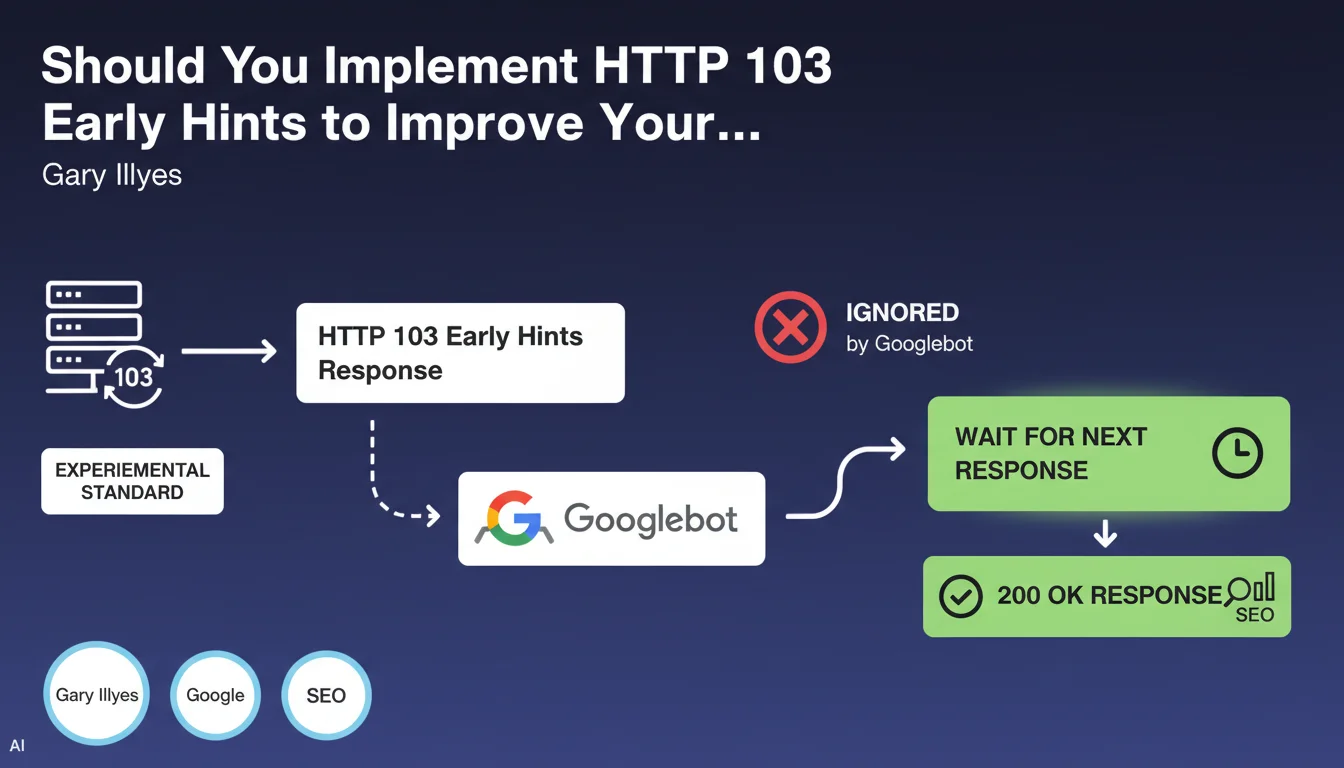
The HTTP 103 Early Hints status code is an experimental response that allows the server to send preliminary hints to the browser before the final response. Specifically, it tells the browser which resources (CSS, JavaScript, fonts) it can start preloading while the server prepares the complete response.
This feature aims to improve perceived loading performance for users by optimizing rendering time. The browser gains precious milliseconds by anticipating the download of critical resources.
What Is Google's Official Stance on Early Hints?
Gary Illyes clearly stated that Googlebot completely ignores 103 responses. The bot simply waits for the definitive response (typically a 200 OK status code) without taking preload instructions into account.
This approach is explained by the still experimental nature of the standard and by the specific way Google's crawl functions. Unlike browsers that optimize real-time user experience, Googlebot focuses on analyzing the final content.
What Are the Implications for Organic Search Rankings?
Implementing Early Hints has no direct impact on SEO. Neither positive nor negative. Googlebot handles them "gracefully" by simply ignoring them, without any penalty.
However, the Core Web Vitals improvements they can provide remain an indirect SEO factor. A faster site improves user experience, which positively influences rankings through engagement signals.
- Googlebot completely ignores HTTP 103 responses during crawling
- No direct SEO penalty or bonus related to their use
- Possible indirect SEO impact through improved user performance
- The standard remains experimental and its adoption limited
SEO Expert opinion
Is This Statement Consistent with Practices Observed in the Field?
Absolutely. Google's position is perfectly consistent with its historical approach to emerging web standards. The company generally adopts a cautious stance toward experimental technologies, preferring to wait for their stabilization.
In my technical audits, I've found that sites using Early Hints indeed gain no measurable crawl advantage. Crawl budget, indexing frequency, and exploration depth remain identical. However, user-side performance gains are real and measurable on Core Web Vitals.
What Important Nuances Should Be Added to This Analysis?
The distinction between technical SEO and user performance is crucial here. While Early Hints don't directly influence crawling and indexing, they can improve LCP (Largest Contentful Paint) by 100 to 300ms depending on configuration.
Now, Core Web Vitals are an official ranking factor since 2021. A site that gains significantly in speed through Early Hints can therefore benefit from a slight competitive advantage, especially in sectors where margins are narrow.
In Which Cases Does This Technology Still Deserve Consideration?
Early Hints present real value for high-traffic sites where every millisecond counts for user experience and conversion rate. E-commerce, media, and web applications are the primary potential beneficiaries.
From an SEO perspective, prioritize this optimization if you've already addressed priority technical fundamentals: clean HTML structure, optimal server response time, compression, caching, minification. Early Hints constitute an advanced optimization, not a basic prerequisite.
Practical impact and recommendations
What Should You Concretely Do on Your Site?
If your site doesn't have critical performance issues, implementing Early Hints is not an SEO priority. Focus first on high-impact optimizations: server speed, image optimization, reducing blocking JavaScript.
If you're exploring this technology for user performance gains, first ensure your infrastructure supports it. Test implementation in a staging environment before any production deployment.
What Mistakes Should You Avoid During Implementation?
The main mistake would be considering Early Hints as a direct SEO factor and dedicating resources to it at the expense of more impactful optimizations. Always prioritize actions with proven SEO ROI.
Don't attempt to implement this feature without solid technical expertise. Incorrect configuration can introduce hard-to-diagnose bugs, particularly cache issues or preloading of wrong resources.
Also avoid preloading too many resources via Early Hints. The goal is to accelerate initial rendering, not to saturate bandwidth with unnecessary downloads.
How Can You Verify and Measure Real Impact?
Use browser developer tools (Network tab) to verify that 103 responses are actually sent and resources are effectively preloaded. Chrome DevTools clearly displays these headers.
Measure the impact on your real Core Web Vitals via Search Console and Google Analytics. Compare before/after data over a significant period (at least 4 weeks) for statistically valid results.
- Prioritize fundamental SEO optimizations before advanced techniques
- Verify infrastructure compatibility (server, CDN) before any implementation
- Test exhaustively in staging environment
- Preload only resources critical for initial rendering
- Measure real impact on user Core Web Vitals
- Don't expect direct impact on crawling or indexing
- Document configuration to facilitate future maintenance
In summary: HTTP 103 Early Hints responses have no direct SEO impact since Googlebot completely ignores them. Their value lies exclusively in improving user performance and potentially Core Web Vitals.
This optimization is advanced-level and should only be considered after solidifying all technical fundamentals. The web performance and technical SEO ecosystem is becoming increasingly complex, with subtle interdependencies between speed, crawling, indexing, and user experience.
Faced with this growing complexity, engaging a specialized SEO agency can prove wise to obtain personalized guidance. An in-depth technical audit will identify truly priority optimizations for your specific situation and implement best practices in the right order, thus maximizing your return on investment.
💬 Comments (0)
Be the first to comment.