
Official statement
Other statements from this video 14 ▾
- □ Does Google really ignore links coming from penalized sites?
- □ Should you really abandon directories and social bookmarking for your SEO strategy once and for all?
- □ Does Google really ignore spam links automatically without any action needed?
- □ Should you really use Google's link disavow tool, or is it just wasting your time?
- □ Does your choice of CMS and programming language really impact your SEO?
- □ Do keywords in URLs really matter for SEO rankings?
- □ Does image URL depth really prevent Googlebot from crawling your images?
- □ Are your Search Console metrics really showing what's actually happening to your site in Google search results?
- □ Should you abandon dynamic rendering for SEO?
- □ Does Google really render EVERY successfully crawled page with JavaScript?
- □ Does invalid schema markup really hurt your search rankings?
- □ Should you really worry about the difference between 301 and 302 redirects anymore?
- □ Does extended boilerplate content really hurt your SEO rankings?
- □ Can a domain migration really happen without losing your SEO rankings?
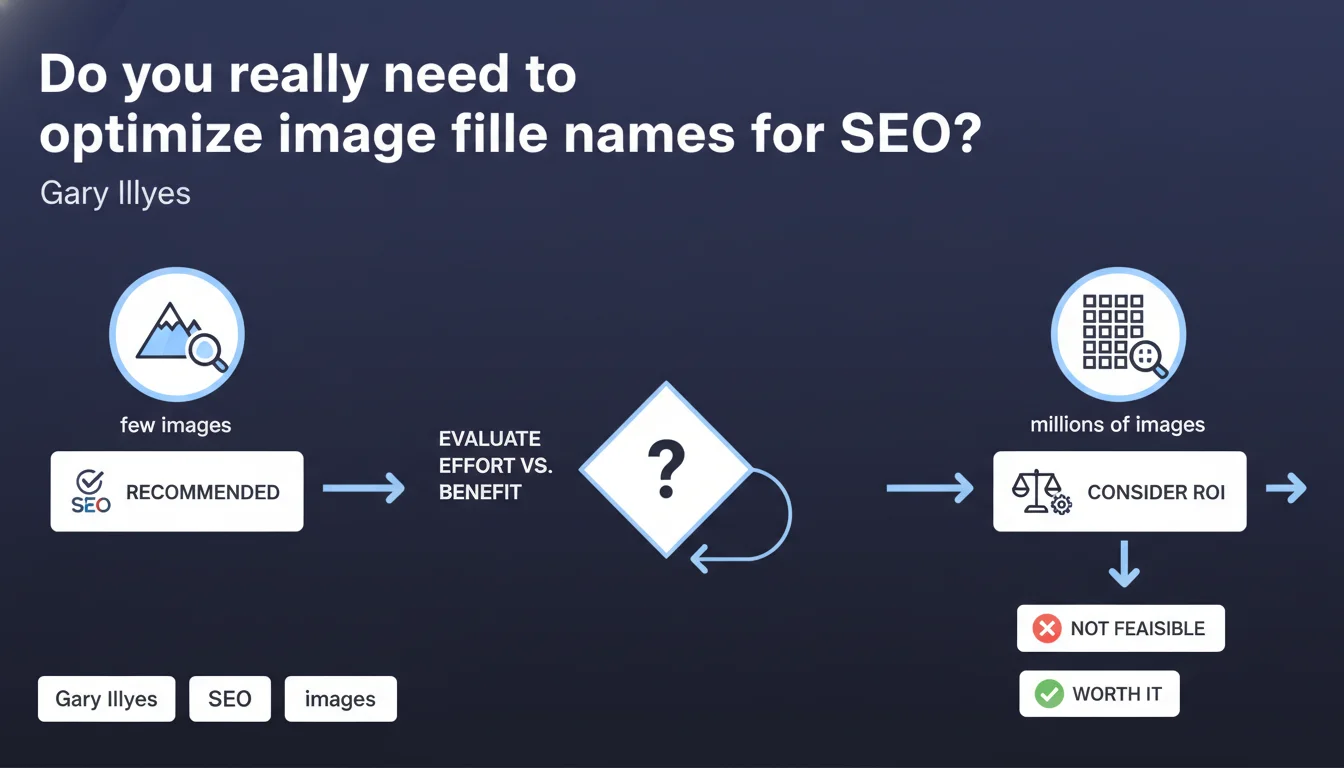
Gary Illyes confirms that descriptive file names for images do provide SEO benefits, but qualifies this impact as "limited." For catalogs containing millions of images, Google suggests evaluating whether the ROI justifies the effort of systematic renaming—which implies that other optimizations may take priority.
What you need to understand
What exactly does "limited benefit" mean?
When Google talks about limited benefit, it doesn't mean useless. It means that in the image ranking algorithm, the weight of the file name is low compared to other signals like the alt attribute, page context, or image quality itself.
For a few dozen or hundreds of strategic images—a flagship product page, a commercial landing page—the effort is clearly worthwhile. But for an e-commerce site ingesting 50,000 new photos per month, automating this renaming can represent a significant technical investment.
Why does Google emphasize the volume of images?
The question of volume is central. Manually renaming 200 images takes a few hours. Industrializing an automated renaming pipeline for millions of files is an engineering project involving URL management, 301 redirects, CDN cache purging, and risks of breaking existing links.
Google implicitly recognizes that on high-volume sites, the opportunity cost can exceed the SEO gain. In other words: your time and development resources might be better invested elsewhere—page speed, internal linking, content.
What are the other image optimization signals that matter more?
- Descriptive alt tag: signal #1 for Google Images, no ambiguity there
- Page context: text around the image, page title, semantic markup
- Format and performance: WebP, lazy-loading, Core Web Vitals impact overall ranking
- Dedicated image sitemap: facilitates discovery and indexing at scale
- Structured data: Product, ImageObject to enrich the Knowledge Graph
SEO Expert opinion
Is this recommendation consistent with what we observe in practice?
Yes, broadly speaking. Tests I've conducted on e-commerce sites show that massive image file renaming rarely produces a visible jump in Google Images traffic within 3 months following—unless the alt text is absent or terrible.
However, on high-stakes pages (bestselling product sheet, strategic category page), a descriptive file name contributes to overall semantic coherence. It's a weak but cumulative signal. And on niche queries where competition is low, this small 1% optimization can tip a result from page 2 to page 1.
What nuances should be added to this statement?
Google doesn't specify at what threshold the benefit becomes negligible. 10,000 images? 100,000? 1 million? No figures provided. [Verify] based on your own A/B tests or before/after audits.
Another point: Gary Illyes is talking about generic images, but what about visual-heavy sectors—fashion, home décor, real estate—where Google Images generates 30 to 50% of organic traffic? In these verticals, even marginal gains can translate to thousands of additional visits. The cost/benefit calculation changes dramatically.
In what cases does this rule not apply?
If your site relies heavily on Google Images as an acquisition channel, neglecting file names would be a strategic mistake. Pinterest, Shutterstock, stock photo sites—for them, every signal counts.
Similarly, if you have the capacity to automate renaming via a script that generates descriptive names from product metadata (brand-model-color.jpg), the ROI becomes positive again. It's not so much the volume that's problematic as the marginal cost of optimization.
Practical impact and recommendations
What should you do concretely with new images?
For all new visual content, adopt a descriptive naming convention from upload. No need to over-optimize—a readable name that describes the image is enough: "corner-sofa-blue-velvet.jpg" rather than "IMG_3847.jpg".
Automate the process on your CMS or DAM side: if your team uploads 500 images per week, a naming template based on product attributes (category, brand, type) eliminates manual labor.
What mistakes should you avoid at all costs?
- Don't launch a massive renaming without first auditing your existing Google Images traffic
- Avoid keyword stuffing in file names—"running-shoe-men-nike-cheap-sale.jpg" won't rank better than "nike-pegasus-40-men.jpg"
- Never rename an already-indexed image without a 301 redirect—or you'll lose its ranking history
- Don't neglect the alt attribute in favor of the file name: this is a classic prioritization error
How do you evaluate if the renaming effort is worth it on your site?
Start with an A/B test on a sample: take 100 strategic images, rename them properly with redirects, track Google Images traffic evolution over 2-3 months. If you observe measurable gains, scale up. If not, focus on alt text and context.
Prioritize images already generating impressions but few clicks in Google Search Console (Performance tab > Search). These are the ones where an optimized file name can make a marginal difference.
❓ Frequently Asked Questions
Un nom de fichier optimisé peut-il compenser l'absence d'attribut alt ?
Faut-il utiliser des tirets ou des underscores dans les noms de fichiers ?
Quelle longueur maximale pour un nom de fichier image ?
Dois-je renommer les images dans mon sitemap si je modifie les noms de fichiers ?
Le nom de fichier influence-t-il le ranking dans la recherche classique (hors Google Images) ?
🎥 From the same video 14
Other SEO insights extracted from this same Google Search Central video · published on 04/05/2023
🎥 Watch the full video on YouTube →
💬 Comments (0)
Be the first to comment.